
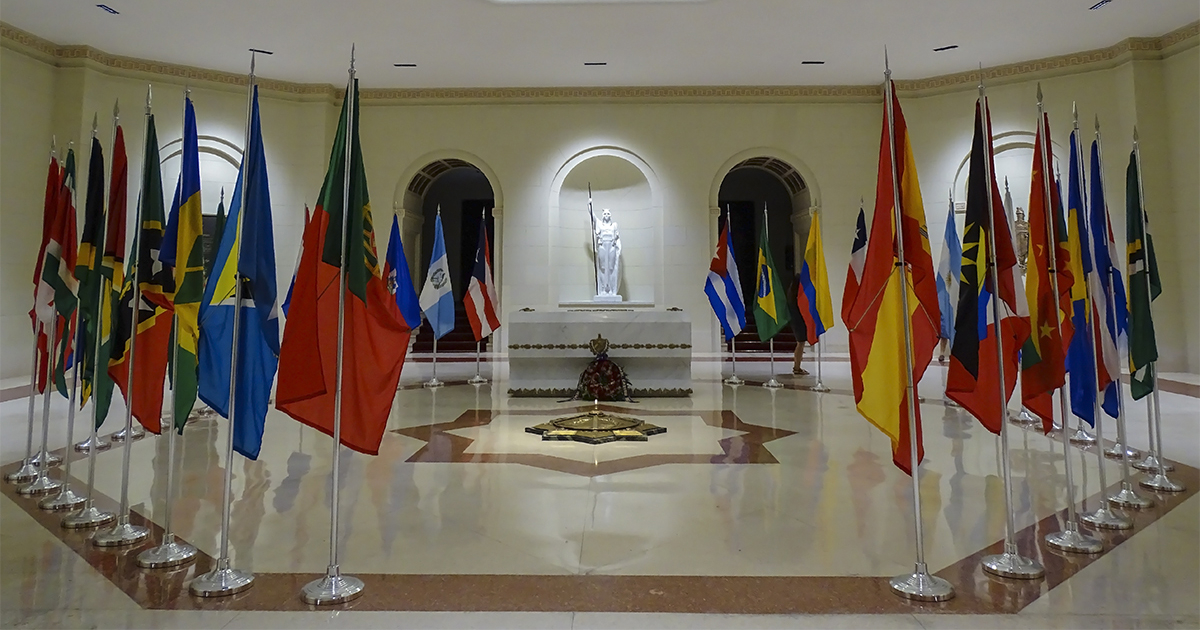
Recently They opened to the public the mysterious Tomb of the Unknown Mambi in the Capitol of Havana. The accompanying inscription reads:
“Here rests, symbolically, the moral, political and historical foundation of the nation: the mortal remains of an unknown Cuban soldier, to whose nameless efforts and sacrifices, the birth of Cuba as a Republic is owed.” Don't forget those words.
The matter deserves to bring up a very interesting conversation that I had with the grandson of Celia Sánchez's former secretary. The lady knew many things about the hidden world of the Cuban communist royalty, and she assured her grandson that this tomb was a bluff. She was by Celia's side until she died, and was forced to retreat when Celia went off the air. But he spoke openly with his grandson about this issue, which is of unusual relevance today.
The happy tomb, “inaugurated” by the sacrosanct Historian of Havana, Dr. Eusebio Leal Spengler, is now the most cared for and monitored space in the National Capitol, with the excuse that “it represents the foundation of the efforts to create a free and sovereign nation.” They open it from 8:00 a.m. until 12 noon, and from 1:00 to 4:30 p.m.
Behind the funeral hall, in another hidden room, there is a complex and sophisticated device of hidden cameras (photographic and video), which sweep minute by minute everything that happens there, whether there is an audience or not. It is also monitored on site 24 hours a day by zealous security guards distributed in three shifts.
The enclosure is a vault located beneath the Hall of Lost Steps. In front of a sophisticated votive lamp, there is the carried and brought Tomb of the Unknown Mambi, under a slab of Carrara marble, which coincides vertically with the center of the Capitol dome, the diamond and the eternal flame of bronze and marble that crowns the hall.
The cenotaph is surrounded by the flags of all the countries of Latin America (also that of Spain, counterproductive in the case of a mambí who is supposed to have fought against it) and is decorated with beautiful bronze sculptures, which reproduce the Coat of Arms of Cuba, the notes of the Bayamo Anthem, and the words of Carlos Manuel de Céspedes when he was named president in the Guáimaro Assembly.
It is, therefore, a summary of our history concentrated in a single monument, something unprecedented in the rest of the funerary sites in honor of any other Cuban martyr, Fidel included. As a culmination, a replica of the sculpture of The Republic, the work of the Italian sculptor Angelo Zanelli, also made of Carrara marble, completes the main niche of the room. The statuette reproduces the image of Pallas Athena that is found in the main room of the building.
The visitor, upon entering the pantheon, listens to the “Paraphrase on the Bayamés Anthem”, by the composer Hubert de Blanck, performed by the Camerata Romeu. Those who have visited say that the spectacle impresses with what is seen and heard. The Tomb of the Unknown Mambi is, in short, the most important place in the Capitol, and is supposedly dedicated to someone whose existence everything is unknown about.
Why this display of lavish worship for a person who is unknown, and who far surpasses, in luxury and magnificence, any other historical funerary monument on the Island?
Let's go back 55 years, to 1962. At that time Celia was at the height of Fidel's trust. It is more than proven - said and confirmed a thousand times by living and dead witnesses - that she and René Vallejo, in addition to their tasks in the PCC and in the nascent communist government of that time, were in charge of "the spiritual things" of the leader, who He simply “let himself be done.”
Celia's secretary told her grandson that Fidel had often said, since that time, that he wanted to be buried in the Capitol, because he was the foundation of the Republic, and its representation was in that place. Presumably, for that reason he never wanted that place, which he used to visit to give instructions on its decoration, to be used for anything, because it would be his grave. Since then it has remained closed to the public until today.
Let us remember that The Capitol began to be restored just after Castro became seriously ill. Currently, among the floral offerings that Cuba's mass organizations eventually dedicate to the “unknown mambí,” there is one every week in the name of Raúl Castro. Not even Martí has had the honor of receiving a weekly crown in Santa Ifigenia, let alone Fidel in his rock, which is only escorted for 12 hours a day. Rare for ashes worth millions on the spiritual market. If we think just a little, we will come to the conclusion that the Tomb of the unknown Mambi is the best, most elegant and conspicuous place in Cuba where a leader of Fidel's stature could be buried. There is no other that surpasses it in luxury and pageantry.
My informant's grandmother got tired of listening to Celia and René Vallejo talking about it in her presence. Vallejo was an expert spiritualist, and he was often seen accompanying Celia on trips to the interior of the Island, to look for sacrificial animals on farms whose farmers almost “produced” for her.
At the main entrance to the Palace of the Revolution, there is a large stone consecrated to Elegguá by Celia during the Missile Crisis, and in Fidel's first house in Laguito, there was a room intended only for those purposes. Let's tiptoe around other spiritual events, such as Fidel's trip to Guinea, or his suspicious red-and-black bead bracelets, which he wore at private events, and which many innocently associated with winks to the M-26-J.
The final project of the Tomb of the Unknown Mambí – undertaken by the Office of the Historian of the City of Havana, in charge of the complete restoration of the Capitol – reflects a solemnity typical of the sanctuary of a pharaoh, luxurious, indoors and guarded like a bank . The Cuban press itself refers to it with these words:
“The sensation that is perceived, even from the main entrance, located under the stairs of the monumental building, makes us swallow dry. The intervention respected the original elements of the premises, from the color of the walls, the decoration of the moldings, the granite floors, and the ornamental details,” says Granma.
I detest the conspiracy theories so typical of the Cuban people, who, by dint of being systematically deceived by their leaders, have made them almost a “modus vivendi”; We love to imagine what we have not been told. But you will agree with me that this one has a lot of potential to not be just an urban legend.
Did anyone really make sense that the leader par excellence of Cuba and the most important living communist revolutionary in the world, dwill rest at its end and forever, inside a horrible boulder, in a rural region far from Havana., outdoors and unsupervised? It was hard to believe then, and also now.
I remember, in this fateful hour, when the beast died and they set up the funeral circus, that I suspected that, inside that urn, there was at most a quarter of a pound of brown sugar.
I confirmed it when a friend sent me a very illustrative video of the day after the funeral ceremonies: Three funeral processions identical to the “official” one, were traveling calmly back to Havana along the Central Highway.
A lot of rubbish will come out under the rug when all this is over, but I fear that the bulk of the waste will be found in the Tomb of the Unknown Mambi, in the Capitol.
What do you think?
COMMENTFiled in:
opinion article: The statements and opinions expressed in this article are the exclusive responsibility of its author and do not necessarily represent the point of view of CiberCuba.