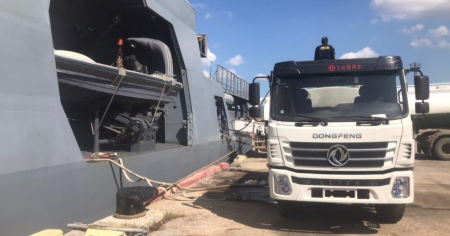
A donation from China consisting of 66 containers with over 1,580 tons of rice arrived this Tuesday at the port of Mariel, in the province of Artemisa.
The shipment was the first of a total of seven deliveries that will complete 20,000 tons of the important grain between the months of June and August.
Four of those shipments are expected to be received at the port of Mariel and the remaining three will arrive at the port of Santiago de Cuba.
Oscar Pérez-Oliva Fraga, the new Minister of Foreign Trade and Foreign Investment of Cuba (MINCEX), thanked the Government and the people of China for the "noble gesture" at a time when the island is experiencing "complex economic moments."
"We are confident that this donation will benefit a significant number of people in the western and eastern regions, thus helping to meet the food needs of our country," assured the head of MINCEX in the presence of the Chinese ambassador to Cuba, Ma Hui.
Pérez-Oliva recalled that this shipment is part of a comprehensive aid package from the Chinese government to Cuba, totaling 20,408 tons of rice, of which 408 have already been delivered through six charter flights in April.
He added that the comprehensive aid package from the Asian nation to Cuba also includes actions aimed at the energy and food sectors, among others, seeking to develop sustainable cooperation for the benefit of the Cuban people.
For his part, Ma Hui, the Chinese ambassador to Cuba, emphasized that the donation is a demonstration of the friendship and mutual assistance between China and Cuba.
"Food security and sovereignty are fundamental interests of all countries and a shared responsibility of the international community," the diplomat stated.
Ma reminded that, in addition to addressing the "urgent needs of sister Cuba," China also collaborates with the Cuban side to study and explore medium- and long-term solutions that ensure sustainable agricultural development on the island. "China is willing to share its experience and advanced technology with the world and with the Cuban side, strengthen technical and personnel exchanges in the agricultural field, help improve food production capacity, and defend food sovereignty and security," Ma specified.
The shortage of rice, a staple food on the tables of Cubans, has been one of the many struggles experienced by residents on the island in recent months.
Most of the rice consumed in Cuba is imported or comes from donations, as national production has collapsed in the last decade.
From there, the Cuban government repeatedly turns to two key Asian allies: China and Vietnam, in the search for the important cereal.
The relations between Cuba and China are a pillar of the survival of the Cuban regime.
This Wednesday, Cuba's Minister of Foreign Affairs, Bruno Rodríguez Parrilla, begins an official visit to the Asian giant.
According to the official MINREX website, during his stay and as part of the program of activities, Rodríguez will hold official talks with leaders and senior officials of that country.
Filed under: