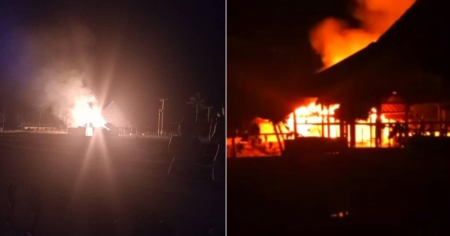
Cuba faces one of the worst forest fire crises of recent decades in 2025.
In just four and a half months, the province of Pinar del Río has recorded over 7,100 hectares of forests consumed by flames, a figure that surpasses the total affected areas between 2021 and 2024.
The data, reported by the official newspaper Granma, marks an alarming record, especially in a province with extensive experience in fire management.
In the last five years, the annual average was 1,512 hectares, which makes the scale of the damage accumulated so far in 2025 even more alarming.
One of the most devastating fires of the year recently occurred in the mountains of San Juan and Martínez, affecting over 2,500 hectares across three municipalities.
It was the third classified as "very large scale," alongside five others categorized as "large scale" (more than 50 hectares).
The authorities attribute this situation to a combination of natural and human factors.
According to Lieutenant Colonel Alexander Pereda, head of the Forest Guards, the intense drought—some areas have gone more than three months without rainfall—the accumulation of dry material, and strong winds have created highly flammable conditions.
However, it warns that 83% of incidents are caused by human actions: from illegal hunters and loggers to farmers conducting uncontrolled agricultural burns.
Beyond the damage to forests, wildfires severely impact ecosystems, biodiversity, and air quality.
Yoel Vázquez, a specialist from the Ministry of Science, Technology, and the Environment (CITMA), points out that the economic losses extend far beyond timber: they encompass pollutant emissions, loss of fauna and flora, and risks to human health.
A clear example is the fire in Arenales, in the municipality of Minas de Matahambre, which devastated 3,240 hectares and whose extinguishment required more than 500 people, heavy machinery, and a dozen helicopter flights. Damages are estimated to exceed one hundred million pesos.
Although the authorities have issued over 1,300 fines this year for environmental violations, the persistence of these incidents shows that the measures taken have not been sufficient.
Among the cited deficiencies is the failure to carry out preventive measures. The construction of firebreaks and controlled paths, essential for halting the spread of fire, was only executed at 69% of what was planned for 2025, and in 2024 it fell even further behind.
The combination of indiscipline, lack of resources, and climate change presents a significant challenge for Cuba.
The increasing number of wildfires not only threatens the country's forest heritage but also urgently calls for a comprehensive review of the strategies for prevention, control, and awareness regarding the sustainable use of natural resources.
Frequently Asked Questions about Wildfires in Cuba in 2025
What is the magnitude of forest fires in Cuba in 2025?
In 2025, wildfires in Cuba have reached an unprecedented scale, surpassing the total number of hectares affected in the last four years. In Pinar del Río alone, more than 7,100 hectares of forest have been consumed in just four and a half months, marking an alarming record for this region experienced in fire management.
What are the main causes of wildfires in Cuba?
The main causes of forest fires in Cuba are human, representing 83% of the cases. These include illegal hunters and loggers, as well as farmers who carry out uncontrolled agricultural burns. Human activity is the primary cause of fires in Cuba, although natural factors such as intense drought and strong winds also play a role.
What impact do wildfires have on the Cuban environment?
Wildfires have a devastating impact on the Cuban environment, affecting ecosystems, biodiversity, and air quality. The economic losses are not limited to timber; they also encompass pollutant emissions and the loss of wildlife and vegetation, along with risks to human health.
How are the Cuban authorities responding to the wildfires?
Cuban authorities have implemented measures such as the issuance of over 1,300 fines for environmental violations and the deployment of brigades to combat fires. However, the measures taken so far have not been sufficient, as the construction of access roads and firebreaks has only been completed to 69% of what was planned for 2025, reflecting a deficiency in preventive efforts.
Filed under: