The harsh reality of daily life in Cuba has once again been brought to light, this time through the lens of a foreign visitor.
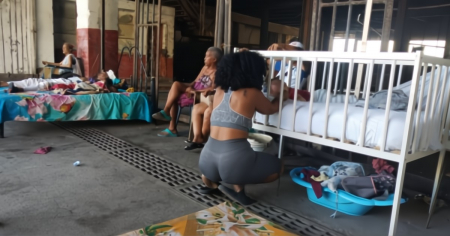
The American YouTuber Adventure Elliot went viral after posting a video documenting his visit to a dilapidated lot in Havana, where hundreds of people live in overcrowded and inhumane conditions.
"Five hundred people live here," the YouTuber comments, visibly shocked.
In the video, shared on TikTok, Elliot enters a communal home in the heart of the capital, accompanied by a resident who guides him to the room where he lives with his mother, his son, and a nephew.
The space is minimal: a single room that serves as both a living area and kitchen, a bathroom separated by a curtain, and beds on a wooden barbecue structure on the roof of the building. There is no running water: they must carry it from the floor below.
"All these rooms are small like this, but inside live 10 or 12 people. That's how we live," confirms her Cuban guide as he shows the tiny kitchen and the minuscule refrigerator.
Structural misery: the legacy of state abandonment
Elliot Adventure is not the first to denounce the precarious housing conditions in Cuba, but his images reignite the international debate on the housing crisis on the Island.
The building shown is riddled with dampness, cracks, and ceilings and floors ready to collapse without any maintenance from the State. "At any moment, this could come down," he states in a segment of the video.
The influencer highlights the government's lack of responsibility in ensuring a basic level of housing dignity.
These structures, some over a century old, are crumbling while the regime continues to blame the U.S. embargo for all its woes, without taking any responsibility for its share.
A total crisis: transportation, health, and food
In addition to the housing disaster, Elliot has documented other aspects of the humanitarian crisis the country is facing: the collapse of public transportation, the fuel shortage, the lack of food and medicine, and mass migration.
"Transportation is a problem. There is no gasoline. People wait for hours or walk kilometers to get around," he explained in another video published in April.
In a fragment of the recording, he is seen giving money to two elderly people, greeting them with respect. "There is a lot of hunger."
Regarding the healthcare system, one of the "jewels" that the dictatorship used as propaganda for decades, Elliot dismantled the official narrative: "There is no insulin, there is no ibuprofen. The pharmacies are empty."
And regarding agriculture, he pointed directly to the failed economic model: "Farmers have to sell everything to the State. They do not make any profit. Basically, they are slaves."
Until when will the silence last?
What these videos show is not new to Cubans, but the external perspective shines an uncomfortable spotlight on a truth that the government has been trying to conceal for years behind empty rhetoric and unfulfilled promises.
This is not about foreign propaganda or media manipulation; these are unfiltered images of a country that is crumbling while its leaders continue to blame others and prioritize repression over reforms.
Havana, like many other cities in the country, is falling apart, and not due to the embargo, but because of decades of neglect, centralism, corruption, and official indifference.
What is clear through the lens of a foreigner is that life in Cuba today is a constant struggle for survival, with no clear future and a present that hurts.
Meanwhile, the regime remains silent. A silence as profound as that which reigns in buildings on the brink of collapse.
Frequently asked questions about the housing and humanitarian crisis in Cuba
What is the current housing situation in Cuba?
The current housing situation in Cuba is critical. Many buildings are in a state of disrepair, with cracks, moisture, and roofs on the verge of collapse. This reflects state neglect and a lack of maintenance, resulting in a housing crisis where thousands of families live in inhumane conditions.
What other problems do Cubans face besides the housing crisis?
Cubans are facing multiple issues, including shortages of food and medicine, the collapse of public transportation, and a lack of fuel. Furthermore, the crisis is exacerbated by mass migration and the government's failure to provide effective solutions.
What is the impact of the U.S. embargo on the Cuban crisis?
Although the Cuban government blames the U.S. embargo for many of the country's problems, the reality is that the crisis in Cuba is also a result of decades of centralization, corruption, and official indifference. The embargo is a factor, but not the sole reason for the current situation.
How has tourism influenced the Cuban economy?
Tourism in Cuba has been promoted as a source of income, but a significant portion of the economic benefits is allocated to the government and does not translate into improvements for the population. Despite investments in the tourism sector, the population continues to face scarcity and poverty.
Filed under: