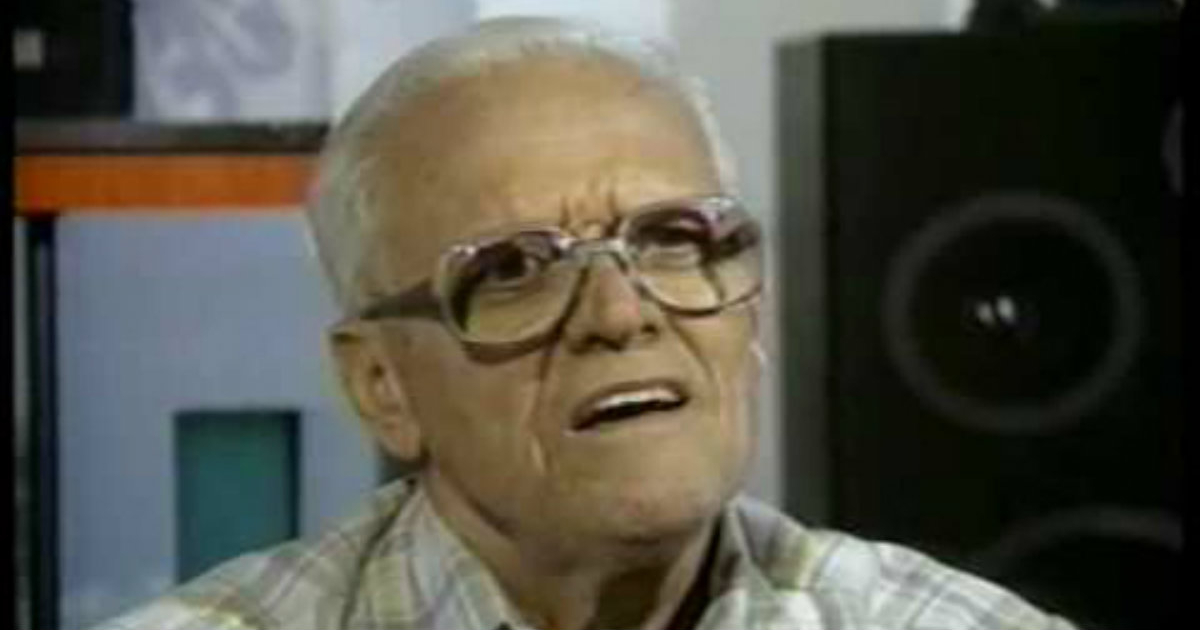
For the benefit of all Cubans, Tito Gómez had a long life and sang for more than fifty years; he maintained that unique voice, with a powerful and unmatched timbre, until nearly the end of his days, traversing the main genres of Cuban popular music.
We wanted to commemorate, in ten moments, the presence in our culture of one of the most spectacular singers in Cuban popular music, someone capable of singing well everything, or almost everything, which is not the same but doesn’t matter.
1. From a very young age, Tito dreamed of being an opera singer. It's no surprise that the Supreme Court of Art, the famous amateur contest, introduced him to the world of art in 1937, when he sang excerpts from María la O and Rosa la China by Ernesto Lecuona.
2. During the 1930s, Tito Gómez was seeking a stable orchestra to become a solo singer. In 1939, he worked with the orchestra at the Casino Deportivo and with the Sevilla Biltmore at the Hotel Nacional, with which he recorded songs like Timbero, la timba es mía and Blen, blen, blen, both composed by Chano Pozo. He performed in Peru, Puerto Rico, and Honduras as a singer promoting the Hotel Nacional.
In 1942, he began to work sporadically with the Riverside Orchestra, and seven years later, he decided to stay on as a permanent soloist with that group, which was directed by Enrique González Mantici and often performed at the Montmatre. He performed in New York in 1944 with the AfroCubans and with Panchito Riset.
4. In 1950, he had his first major success as a singer, alongside the Riverside orchestra, and it was, of course, Vereda tropical. From that point on, Tito continued a triumphant career in records, dance performances, cabarets, and on radio programs (CMQ and RHC Cadena Azul) and television.
5. The major hits followed: the bolero chá Amor, amor, amor (1952); the bolero mambo Alma de mujer (1955); the boleros Alma con alma (1955), Hasta mañana vida mía (1964), and Voy a ser feliz (1971). He covered several classics of traditional Cuban music like Y tú qué has hecho, by Eusebio Delfín, and Pensamiento, by Rafael Gómez.
6. For three or four decades, Tito Gómez had to sing, at all his performances, his unique version, infused with Cuban flair, to the rhythm of chachachá, of Vereda tropical, a famous Mexican bolero composed by Gonzalo Curiel. It is hard to find a Cuban who lived between the 50s and the 80s who did not revel in the five "vis" of the final refrain and in Tito Gómez's spectacular closing: Tropicaaaaaaaaaaal.
In an era of great bolero singers (the 1950s and 60s), such as Roberto Faz, Benny Moré, Orlando Contreras, Orlando Vallejo, Rolando Laserie, Domingo Lugo, Fernando Álvarez, and Lino Borges, Tito Gómez stood out for his lyrical voice and for giving the bolero a more vibrant and danceable flair, combined with son, rumba, guaracha, montuno, and cha-cha-chá. Additionally, Riverside had adopted a very modern jazz band format that closely resembled Benny Moré's Banda Gigante.
8. In 1975, after about thirty years of working with Riverside, Tito decided to part ways and start a new career, as he was still very popular, performing as a soloist with the Jorrín Orchestra, led by Enrique Jorrín, who is known as the creator of the chachachá, a rhythm that Tito Gómez mastered perfectly. In this new phase of his career, he established himself as one of the greatest improvisational singers of Cuban music.
He remained active, performing live on television and playing with his own bands or alongside other artists, as he maintained the same timbre, sonority, brilliance, and above all, his excellent pitch. He occasionally joined more modern creators like the group Algo nuevo, led by Juan Pablo Torres, and the American Ray Barreto, until the 1990s when he stepped away from music due to his advanced age and the vulgarity and low quality that dominated the dance-pop music of that time.
10. In 2007, EGREM released an album featuring 16 of Tito Gómez's greatest hits within the series Las voces del siglo. The album began, of course, with the words: “I'm going down the tropical path…”
Related videos:
Filed under: