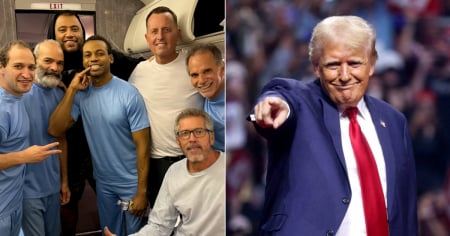
Despite the release of six Americans held in Venezuela, the United States government reiterated that it will not change its stance regarding the regime of Nicolás Maduro and that it will not recognize his mandate as legitimate after the 2024 elections, which have been labeled as fraudulent by Washington and several allied countries.
The special envoy of the Department of State for Latin America, Mauricio Claver-Carone, made it clear that the meeting between Richard Grenell, special envoy for Donald Trump, and the Chavista leader did not constitute a negotiation, but rather a meeting to convey specific demands from the U.S. administration.
Among these requests are the deportation of Venezuelan criminals in the U.S., such as the detained members of the violent gang Tren de Aragua, and the immediate release of all American citizens detained in Venezuela, the agency EFE reported.
"It's not a negotiation."
In statements to the press, Claver-Carone emphasized that "Venezuelan criminals from gangs like Tren de Aragua and others must be deported, and Venezuela has to accept them; it is their responsibility." He also stressed that the Maduro regime must move forward with the release of unjustly imprisoned Americans.
"If these requests are not met, there will be consequences," warned the official, reminding that Trump has been categorical in his stance of maximum pressure against chavismo.
Likewise, he dismissed any possibility of negotiating over Venezuelan oil, assuring that the U.S. does not need this resource and that its energy policy is based on self-sufficiency.
Meeting and Reactions
The meeting between Grenell and Maduro took place at the Miraflores Palace, where the Chavistas insisted on the need to "turn around" bilateral relations.
Nonetheless, the White House was quick to reject any interpretation suggesting recognition of the Venezuelan leader. Karoline Leavitt, press secretary for the Trump administration, reaffirmed that the U.S. position remains one of not recognizing Maduro's reelection and maintaining economic sanctions.
Meanwhile, Washington's allies in the region, such as Costa Rica, Panama, Guatemala, El Salvador, and the Dominican Republic, continue to support the U.S. stance in rejecting the Venezuelan electoral fraud.
The international community and Venezuelans in exile are closely monitoring the next steps of the Trump administration in its strategy towards Venezuela, which remains steadfast in its goal of pressuring the Chavista regime, despite gestures and statements that have caused concern among opponents and civil society, such as the cancellation of the extension of Temporary Protected Status (TPS) for Venezuelan immigrants.
The new measure—which grants an additional 18 months (until October 2026) of protection against deportation, along with work permits—could represent a harsh blow for over 600,000 Venezuelans already in the United States, who may face the risk of being returned to their home country in the coming months.
Filed under: