The Cuban boy Damir Ortiz Ramírez, diagnosed with neurofibromatosis type 1, a plexiform neurofibroma in his right eye, in addition to acute leukemia, has obtained a humanitarian visa to receive treatment for his illness at a hospital in the United States.
According to confirmed in a Facebook broadcast by activist Idelisa Diasniurka Salcedo Verdecia, the U.S. Embassy in Cuba informed the mother of the child, Eliannis Ramírez, that the parole had been approved.
"They said that for Damir, the embassy will be open", celebrated the opposition member, who has been working to obtain a travel permit to save the child's life.
The diplomatic mission conveyed the good news to Eliannis Ramírez, specifying that this Saturday he was to go to the embassy.
Even though the embassy is closed on weekends, they will make an exception for Damir's mother due to the seriousness and urgency of the situation.
"Now that we're just a step away, we need to fill out the forms they requested, which are quite small; they said no payment needs to be taken to the embassy," Salcedo said, excitedly.
However, the child, who must be transferred immediately to the United States, needs an air ambulance, a service that costs around 38 thousand dollars, as noted by the activist.
Despite organizing a fundraising campaign through the platform GoFundMe to support the child's mother, that money cannot be used until the child arrives in the U.S. and proof of their location is provided. Therefore, he urged Cubans to help with any monetary contribution.
"When they have the visa stamped in their passport, we will all need to come together to pay for that air ambulance and save the child because he needs it. With just a few people giving a dollar, we will reach that goal, even if it's just one dollar. Because the fundraising is still on hold since the policy does not allow us to use that money because the child is not here," Salcedo stated.
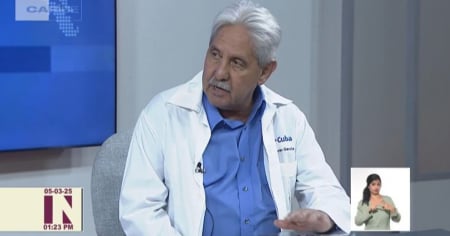
On his part, Dr. Miguel Ángel Ruano Sánchez, president of the Free Cuban Medical Guild, emphasized the need to unite in order to get Damir out of the Cuban hospital where he is currently being treated: "There, they are not doing what should be done; they are doing what they believe they should do, while we are fighting for them to do what is right."
"One must wrest it from the hands of the dictatorship, from those doctors with whom we have had to struggle so much to do the right thing, and yet they have not done so. So, please, we only ask you, we plead with you, that from this moment you set up the accounts and share them," he said.
Last week, the doctor explained that the medical treatments that were not provided to Damir have contributed to the worsening of his condition.
He also added that the young child never underwent a tumor study on his right eye through a biopsy that would allow for a definitive conclusion that it was indeed a plexiform neurofibroma.
In recent months, Damir's health situation worsened with a diagnosis of acute leukemia, further complicating his already fragile condition.
A hospital in Miami, Florida, agreed to treat Dami, and a GoFundMe campaign was launched to raise $40,000 to cover medical and travel expenses.
The family had already requested a humanitarian visa for the child, but the embassy had denied it due to the lack of documentation issued by the Ministry of Public Health of Cuba (MINSAP).
Eliannis Ramírez and Cuban activists continued to appeal to the international community and U.S. authorities for Damir to receive the urgent medical attention he needs.
Frequently asked questions about the case of the Cuban boy Damir Ortiz
What is the current health situation of Damir Ortiz?
Damir Ortiz, a 10-year-old Cuban boy, suffers from type 1 neurofibromatosis and a potential leukemia. His condition is critical, with paralysis in his legs, partial blindness, and tumors in the spinal cord. He is currently hospitalized in intensive care at the Juan Manuel Márquez Pediatric Hospital in Havana, Cuba.
Why was a humanitarian visa necessary for Damir?
The humanitarian visa for Damir Ortiz was necessary to facilitate his transfer to the United States and receive specialized medical treatment that is not available in Cuba. A hospital in Miami agreed to treat him, but the visa process encountered obstacles due to the lack of certain required documents.
What obstacles did Damir's family face in obtaining the humanitarian visa?
The family of Damir faced problems mainly because the Ministry of Public Health of Cuba refused to issue the necessary documentation for the visa, claiming that the country had the resources needed to treat the minor. Without this documentation, the United States Embassy initially denied the visa.
What actions were taken to support Damir's case?
To support Damir, fundraising campaigns were organized on GoFundMe and peaceful demonstrations were held outside the U.S. Embassy in Havana. Activists and the international community have also urged a swift solution that would allow the child to receive the necessary treatment.
Filed under: