
Related videos:
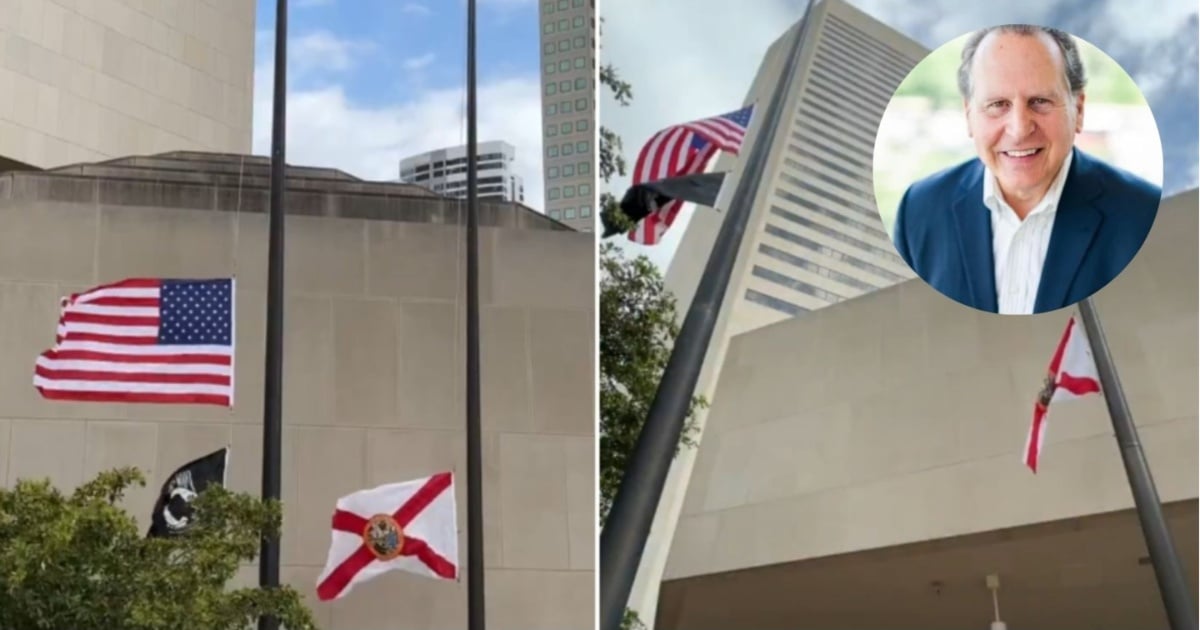
The flags are flying at half-mast in Florida this Friday in honor of the former Cuban-American congressman Lincoln Díaz-Balart, who passed away on March 3 at the age of 70.
An official notice issued by Governor Ron DeSantis this Thursday indicated that, in honor of Díaz-Balart's memory, the flags of the United States and the State of Florida would fly at half-staff from sunrise to sunset on this Friday, March 7, 2025.
In the State Capitol in Tallahassee, Florida, and in all the local and state buildings, facilities, and grounds throughout Miami-Dade County, a tribute will be held in this manner for the former congressman.
Lincoln Díaz-Balart was a leader in the Cuban-American community and a staunch opponent of communism and the Castro regime. During his time in public service, he demonstrated unwavering support for democracy both in the United States and abroad," the statement from DeSantis highlighted.
The also congressman Mario Díaz-Balart, brother of the deceased politician, announced that the Cuban-American community of South Florida will bid him farewell on Saturday, March 8, with a mass at Corpus Christi Catholic Church, located at 3220 NW 7th Ave, Miami, at 11:00 a.m.
Born on August 13, 1954, in Havana, Lincoln Rafael Díaz-Balart y Caballero dedicated himself to public service and the promotion of democracy in his homeland.
He was the son of the Cuban politician Rafael Díaz-Balart and Hilda Caballero Brunet, and the nephew of Mirta Díaz-Balart, Fidel Castro's first wife. Therefore, her son, Fidel Castro Díaz-Balart, was his cousin.
Lincoln emigrated as a child to the United States, after the Cuban revolution of 1959. He studied at the American School in Madrid, the New College of Florida, and obtained his law degree from Case Western Reserve University. Before embarking on his political career, he practiced law in Miami, providing legal assistance to low-income individuals.
Although he was initially a member of the Democratic Party, in 1985 he changed his affiliation to the Republican Party.
He was elected as a member of the Florida House of Representatives in 1986 and later to the Florida Senate in 1989.
During his time in the legislative body, Díaz-Balart stood out for his advocacy for immigrants' rights and his strong opposition to the Cuban regime. He was one of the sponsors of the National Security Act and the DREAM Act, aiming to facilitate access to higher education for immigrant students
He also actively participated in the La Rosa Blanca Institute, an organization dedicated to promoting the democratization of Cuba and honoring the memory of the martyrs who fought against Fidel Castro's regime. This institute was founded in January 1959 by his father, Rafael Díaz-Balart, in New York, and was the first anti-Castro organization in exile.
Frequently asked questions about the tribute to Lincoln Díaz-Balart
Why are the flags at half-mast in Florida?
Flags are flying at half-staff in Florida in honor of former Cuban-American Congressman Lincoln Díaz-Balart, who passed away on March 3, 2025, at the age of 70. Governor Ron DeSantis ordered this tribute in recognition of his legacy and political contributions.
Who was Lincoln Díaz-Balart and what was his legacy?
Lincoln Díaz-Balart was a Cuban-American former congressman known for his advocacy of immigrant rights and his opposition to the Cuban regime. Born in Havana, he dedicated his life to public service in the United States, holding positions in the Florida House of Representatives and the Florida Senate before being elected to the United States House of Representatives. His legacy includes the promotion of democracy in Cuba and the defense of human rights.
How did Lincoln Díaz-Balart influence policy towards Cuba?
Lincoln Díaz-Balart was a key figure in promoting pressure policies against the Cuban regime. He participated in the creation of laws such as the Cuban Democracy Act, which reinforced the embargo, and was an active advocate for Cuban dissidents and exiles. His work always aimed to promote freedom and human rights for the Cuban people.
What is the Instituto La Rosa Blanca and what role did Lincoln Díaz-Balart play in it?
The La Rosa Blanca Institute is an organization dedicated to promoting the democratization of Cuba and honoring the memory of the martyrs who fought against the regime of Fidel Castro. Founded in 1959 by Rafael Díaz-Balart, father of Lincoln, this institute was the first anti-Castro organization in exile. Lincoln Díaz-Balart actively participated in its activities, continuing his father's legacy.
What impact did Lincoln Díaz-Balart's political career have on the Cuban-American community?
Lincoln Díaz-Balart had a significant impact on the Cuban-American community by advocating for their rights and promoting policies that benefited immigrants in the United States. He was an influential leader who championed the freedom of Cuba and supported exiles, leaving a lasting legacy in politics and the fight for human rights.
Filed under: