Pope Francis was discharged this Sunday from the Gemelli University Hospital in Rome, where he had been hospitalized for 38 days due to severe bilateral pneumonia, a complication that put his life at risk and kept him away from the Vatican since February 14.
At 88 years old, Jorge Mario Bergoglio has overcome one of the most delicate medical episodes of his papacy, as confirmed by sources from the Holy See and the doctors at the medical center.
Before returning to his residence in the Vatican, the Pontiff appeared at one of the hospital balconies at 12:01 noon, from where he greeted and blessed the nearly two thousand faithful gathered in the central square of the Roman hospital.
Despite his noticeable weakness and breathing difficulties, Francisco did not want to deprive the believers of his closeness.
"Thank you all. I greet this lady with the yellow flowers,” he said affectionately upon noticing a bouquet of roses held by one of the parishioners in the crowd.
During the two minutes he spent on the balcony, the Pope displayed a mixture of serenity and resignation, with kind gestures and a shy smile, although his face revealed physical weariness.
True to his style, he even raised his thumb as a sign of optimism before giving his blessing.
A measured return under strict medical supervision
After bidding farewell to the faithful, the Pontiff got into a white Fiat 500, accompanied by his security team.
However, before heading to the Casa Santa Marta, he decided to make a stop at the Basilica of Santa Maria Maggiore, a place with which he has a special connection.
There, as is customary before and after each international trip or during significant moments of his papacy, he prayed before the image of the Virgin.
In statements given by Sergio Alfieri, the surgeon in charge of the medical team that treated the Pope at Gemelli, it was reported that the Pontiff will need to remain in recovery for at least two months.
"You should avoid large gatherings and ceremonies that involve considerable physical exertion," explained Alfieri.
Specialists recommend prioritizing rest and respiratory physiotherapy, which had already begun during the last days of hospitalization.
Limitations in the papal agenda
Although his recovery has been positive, it is unlikely that the Pope will be able to preside over the extensive liturgies of Holy Week.
However, the Vatican does not rule out the possibility that he may appear on the central balcony of St. Peter's Basilica on Easter Sunday to deliver the ' Urbi et Orbi’ blessing, which grants a plenary indulgence to Catholics around the world.
During his hospitalization, the Pope's health experienced significant ups and downs.
The diagnosis of severe bilateral pneumonia led to acute respiratory failure, which necessitated the administration of high-flow oxygen and the implementation of unassisted mechanical ventilation.
According to the medical report, "his life has been in danger on two occasions" due to the severity of the infectious condition and the advanced age of the Pope.
In the past week, however, her recovery made significant progress, which led to the decision to discharge her from the hospital.
The doctors emphasized that "the latest progress is at home" and that the hospital environment could pose a risk of new infections for someone with his clinical profile.
A weakened figure, but with the same determination
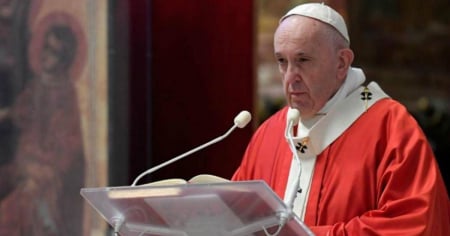
In the first image released by the Vatican after almost a month of hospitalization, the Pope was seen a few days ago dressed to celebrate Mass, sitting in a wheelchair in the chapel of his room.
Since then, his mood has been positive and, despite the obvious signs of physical wear - he appears thinner and has a muted voice - his spirit remains alert and strong, as emphasized by the Vatican.
This Sunday's Angelus was broadcast virtually by the Holy See, as Francis still lacks the physical capacity to deliver it in public.
In his message, he again referred to the situation in the Middle East, lamenting the resumption of bombings in Gaza and the seriousness of the humanitarian crisis.
"I ask that the weapons be silenced immediately and that there is the courage to resume dialogue so that all hostages are released and a definitive ceasefire is reached," declared the Pope.
This episode has marked a turning point in the papacy of Francis, which now exceeds twelve years.
Now he/she will have to adjust to new physical limitations that will likely affect his/her usual schedule and pace. Although the doctors are optimistic about his/her recovery, rest time is essential.
Frequently Asked Questions About Pope Francis' Health After His Hospitalization
What was the reason for Pope Francis's hospitalization?
Pope Francis was hospitalized due to severe bilateral pneumonia. This condition, which complicated his health, required a prolonged stay at the Gemelli University Hospital in Rome. Bilateral pneumonia is an infection that affects both lungs, which can be particularly dangerous at his age of 88 years, especially considering he is missing part of a lung since his youth.
How has Pope Francis's health evolved since his hospitalization?
After 38 days of hospitalization, the health of Pope Francis has shown favorable development, allowing for his medical discharge. However, he will need to continue convalescing for at least two months, avoiding significant physical exertion and prioritizing rest and respiratory physiotherapy. Although his recovery has been positive, his age and the initial clinical condition make rigorous medical follow-up essential.
What restrictions does Pope Francis have on his schedule after being discharged from the hospital?
Pope Francis will need to avoid large gatherings and ceremonies that require significant physical exertion, according to his doctors' recommendations. Although it is unlikely that he will be able to preside over the extensive liturgies of Holy Week, the Vatican does not rule out his presence on the central balcony of St. Peter's Basilica to give the ‘Urbi et Orbi’ blessing on Easter Sunday.
What has been Pope Francis's state of mind during his recovery?
Despite the medical challenges, Pope Francis has maintained a positive outlook. He has shown signs of serenity and optimism, even during his public appearances, such as when he greeted the faithful from the hospital balcony. Furthermore, he has continued to engage in some work and spiritual activities, which reflects his commitment and determination.
Filed under: