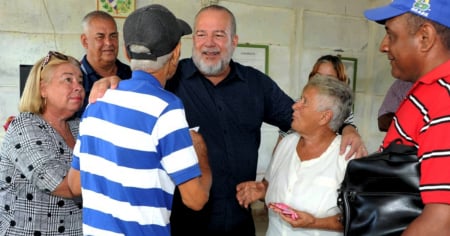
The celebration of the II International Transport and Logistics Fair in Havana was presented by the Cuban Prime Minister, Manuel Marrero Cruz, as a sign that the Cuban regime endures in power despite decades of widespread mismanagement, particularly in the sector.
“Demonstrate that we are alive,” said Marrero Cruz to the National Television News (NTV), reaffirming the alleged will of the government of Miguel Díaz-Canel to reverse the structural deterioration of the transportation sector, one of the hardest hit by the economic crisis affecting the island due to its poor management.
During his speech at the event's inauguration, Marrero defended the usefulness of these fairs in response to criticisms on social media, which label these gatherings as propaganda gestures without tangible results.
“On the contrary… This proves that we are alive, this demonstrates that we are not only betting on sustainability, on overcoming this situation, but also on our development,” affirmed the head of government.
In his speech, Marrero cited as examples the electric tricycle projects and ambulances signed in previous fairs, which are now operational in several provinces. “Where there were times when it was difficult to reach the hospital, today, with an affordable price, these means of transport are continuing to expand,” he said.
Regarding the ambulances, he emphasized that this is an agreement with the company Mercedes Benz, which ensures technical assistance and sustainability. “They are currently providing service to hospitals with great efficiency alongside drivers from the ambulance system,” stated Marrero, again praising the opaque agreement signed at the beginning of the year between MINSAP, MITRANS, and the mixed company MCV Comercial S.A.
Recent reports from state media indicate that public transportation in Cuba meets only 18% of the national demand, while over 80% of the vehicle fleet is in critical or non-operational condition.
In cities like Havana, where blackouts and fuel shortages further complicate mobility, thousands of citizens rely on alternative solutions such as bike taxis, private trucks, and, more recently, electric tricycles.
A structural crisis with roots in state management
Despite the official enthusiasm surrounding these events, the reality of transportation in Cuba remains dire and is a direct result of decades of misguided policies, chronic disinvestment, and ineffective centralization.
The collapse of the public transportation system is not a recent phenomenon, nor is it solely a consequence of the current economic context; rather, it is the culmination of a gradual deterioration process that accelerated in the 1990s and has only deepened since then.
Before 1959, Cuba had one of the most efficient and advanced transportation systems in Latin America. The country boasted a functional railway network, tram lines in cities like Havana and Santiago, and a notable fleet of buses and taxis that ensured urban and rural mobility.
However, following the arrival of the "revolutionary" government, the state-driven model applied to all strategic sectors, including transportation, marked the beginning of a decline that has ultimately turned mobility in Cuba into a daily odyssey for millions of citizens.
The lack of sustained investments, the deterioration of the vehicle fleet, the inability to produce spare parts, as well as the gradual elimination of rail transport and efficient urban services, have left the population with few viable options.
State policy has favored specific projects for decades without continuity or maintenance, many of which were inspired by temporary agreements with political allies—first the USSR, then Venezuela and China—that failed to establish sustainable infrastructure.
Today, the few state buses that operate are barely doing so; trains are hardly running, and passenger maritime transport is virtually non-existent.
Meanwhile, the private sector is trying to fill the gaps with converted trucks, aging almendrones, and improvised alternative transportation, often lacking clear regulations or minimum guarantees for users or drivers.
The fuel shortage, which the regime itself acknowledges as one of the main current problems, has further intensified the crisis. In recent months, provinces such as Villa Clara, Santiago, and Camagüey have had to suspend entire bus routes, prioritizing the scarce resources available for sectors deemed essential by the government.
Marrero Cruz's optimistic speech at the fair clashes with this daily reality: overcrowded bus stops, waiting times exceeding two hours, collapsed school transportation, and emergency ambulance services with limited coverage.
Citizens, however, do not have access to updated public statistics that would clearly measure the impact of the crisis, a common pattern in the management of a government that has been in power for 66 years and that avoids acknowledging its direct responsibility in the collapse of the sector.
Beyond fairs and announcements, concrete results remain scarce. Meanwhile, Cubans continue to wait for decent, functional, and accessible transportation as an essential part of their rights and basic needs.
The assertion of "that we are alive" put forward by Marrero Cruz raises a concerning question about to what extent the Cuban regime will pursue its strategy of remaining in power, despite evidence showing detrimental effects on the quality of life for its citizens.
Filed under: