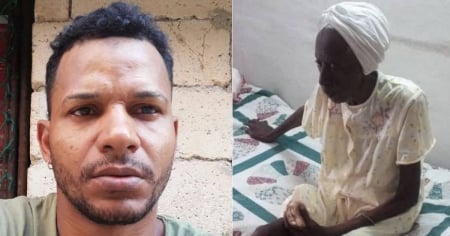
The Cuban dissident rapper Maykel Castillo Pérez, known as Maykel Osorbo, sent a strong message from the 5 y Medio prison in Pinar del Río to the military who prevented him from attending his grandmother's funeral, Hilda Rojas Mora, who recently passed away in Havana.
Through an audio shared on social media, Osorbo addressed the unit chief and the officers who came to inform him of the denial. In his remarks, he harshly criticized the "hypocritical" attitude of the military, accusing them of lacking sensitivity and coherence, and of acting under systematic repression. He stated, "Don’t pretend to feel pain; you don’t feel anything," and demanded, "You are not good people or anything; that doesn’t exist. Don't be hypocritical with me."
The coauthor of the song "Patria y Vida" questioned the official justification based on institutional regulations, stating, "What regulation? You violate all the regulations. You have violated every one from the beginning to the end with me."
He also unabashedly reaffirmed himself as a counter-revolutionary. “Am I a counter-revolutionary? Yes. I am not offended by you calling me a counter-revolutionary. It doesn’t bother me that you say what I am; what I am not is what you are,” he declared, making his moral distancing from those who repress him clear.
Osorbo criticized the authorities for thinking he could have believed there was even a slight chance he would be allowed to attend the funeral. “When have you ever taken someone here anywhere? Me? You’re going to take me, partner? If moving me requires moving half the country,” he said, in a defiant and resigned tone.
Despite the pain, Osorbo stated that his bond with his grandmother goes beyond a physical farewell. “It doesn’t matter. My grandmother knows that I love her, you know? It doesn't matter, my son,” he expressed, reaffirming that repression has not managed to break his affection or his dignity.
A previous denial filled with pain
The denial of permission for Osorbo to attend the funeral was announced on April 1 and generated a wave of outrage on social media. His grandmother, who raised him since he was ten years old, passed away of natural causes at the age of 85. The family had requested that he be allowed to say goodbye under supervision, as is dictated by procedures in other circumstances, but their request was ignored by the Cuban authorities.
The musician and activist Yotuel Romero then condemned the incident, comparing it to the treatment received by the iconic Celia Cruz, who was also prevented from returning to Cuba to say goodbye to her loved ones. "This is not politics, it is humanity," Yotuel stated, announcing that they would take the case to international organizations.
A symbol of political repression
Maykel Osorbo was sentenced to nine years in prison for his activism and for openly confronting the Cuban regime. His imprisonment has been deemed unjust by various human rights organizations, which recognize him as a prisoner of conscience. His case has become a symbol of the personal and familial cost associated with dissenting in Cuba.
With this message from prison, the artist raises his voice once more, not only to denounce a specific event but to reaffirm his dignity in the face of a system that, in his words, "violates from beginning to end."
Frequently Asked Questions about Maykel Osorbo and His Situation in Cuba
Why couldn't Maykel Osorbo attend his grandmother's funeral?
Maykel Osorbo was unable to attend his grandmother's funeral because the Cuban authorities denied him permission to leave prison, despite his family's pleas and the special bond he shared with her. This denial has been perceived as another demonstration of the political repression that Osorbo faces due to his activism against the Cuban regime.
What message did Maykel Osorbo send from prison after the death of his grandmother?
From prison, Maykel Osorbo sent a message criticizing the attitude of the military who denied him the chance to attend his grandmother's funeral. Osorbo described the military's attitude as "hypocritical" and reaffirmed his stance as a counter-revolutionary, making it clear that his moral distance from the Cuban regime is significant and expressing that his bond with his grandmother transcends the physical farewell.
Why is Maykel Osorbo considered a prisoner of conscience?
Maykel Osorbo is regarded as a prisoner of conscience because his imprisonment is a result of his political activism and opposition to the Cuban regime. Various human rights organizations, such as Amnesty International, have denounced his situation as an example of political repression in Cuba and have called for his immediate release.
How has the international community reacted to the case of Maykel Osorbo?
The international community has expressed concern for the situation of Maykel Osorbo. Various human rights organizations and activists have condemned his imprisonment and called for his release, describing him as a symbol of political repression in Cuba. Additionally, reports have been filed with international bodies to advocate for his case.
Filed under: