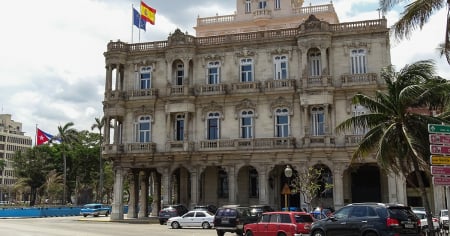
Cuban applicants for Spanish citizenship are reporting from Havana about prolonged delays, lack of institutional responses, and a black market for credentials valued at hundreds of euros.
A few months before the expiration of the Law of Democratic Memory (LMD), many Cubans have reported irregularities and delays in the procedures of the Consulate General of Spain regarding the naturalization processes on social media.
The main criticism is directed at the lack of response in the delivery of credentials necessary to schedule appointments and continue their nationality application processes.
According to reports gathered by elTOQUE, over 800 individuals currently lack access to usernames and passwords needed to log into the Bookitit system, which is essential for scheduling the in-person submission of their files.
The affected individuals claim to have adhered to the Consulate's procedure, which includes emailing the required documentation in PDF format, but they have not received confirmation or any response, despite waiting more than a year in many cases.
Concern about the expiration of the deadline
The Democratic Memory Law, also known as the "Grandchildren's Law", expires on October 22, 2025. An instruction published in the Official State Bulletin (BOE) in November 2024 allows for the possibility of submitting documentation in person even after that date, as long as the online application was submitted within the deadline.
The current problem lies in the fact that numerous descendants do not even have the basic credentials to take that first step. A list of more than 550 affected individuals was reportedly submitted on March 18 at the General Affairs window of the Consulate, demanding an immediate solution.
New electronic tool still without full access
On March 25, the diplomatic office announced on its social media that "the new electronic Civil Registry model at the Consulate General of Spain in Havana is now operational. From now on, civil registry certificates can be obtained electronically."
The measure had been announced since 2024 by the Directorate General of Legal Security and Public Faith, to manage applications for nationality by choice.
The tool is available at some consulates such as the one in Miami and allows the applicant to obtain a legal receipt after uploading the initial documentation. However, in the case of the Consulate in Havana, the tool has not yet been widely implemented for LMD applicants.
The lack of access to this new system and the limited official communication from the Consulate have created a state of uncertainty and helplessness among the descendants of Spaniards on the island.
Black market and counterfeit documents
Alongside administrative delays, illegal practices associated with the process have proliferated. Instances of selling access credentials for the Bookitit system on the black market have been detected, with sums ranging from 600 to 800 euros, as well as the forgery of ecclesiastical documents required for the accreditation of Spanish ancestry.
The Diocesan Historical Archive of Ourense, in Galicia, warned about the existence of a black market for counterfeit documents originating from Cuba, with prices reaching up to 3,000 euros.
This situation not only undermines the legality of the process but also highlights the desperation of many Cubans to find a legal migration alternative.
Record figures and hopes for continuity
Cuba is among the countries with the highest volume of requests under the LMD. As of 2023, more than 226,000 petitions have been recorded. These figures far exceed those achieved under the previous Historical Memory Law, which accumulated 192,064 files at the Consulate of Havana over three years.
Those who manage to obtain a valid appointment before the deadline will be able to complete their process even beyond 2025, possibly until 2028, thanks to the new digital system. However, the lack of access to credentials could leave hundreds of applicants sidelined.
In response to the lack of transparency and institutional accountability, applicants have begun to organize themselves to bring attention to the issue, through social media groups and collective letters addressed to the Consulate and Spanish authorities.
Cuban descendants of Spaniards are demanding immediate measures that guarantee their right to nationality and put an end to the uncertainty that threatens to marginalize those who have faithfully followed the required steps.
Frequently asked questions about issues at the Spanish Consulate in Havana and the Grandchildren's Law
Why are there so many delays at the Spanish Consulate in Havana?
Delays at the Spanish Consulate in Havana are due to the high demand for nationality applications under the Law of Democratic Memory, along with issues in accessing the necessary credentials to schedule appointments. Additionally, the consular infrastructure has been affected by events such as energy crises and hurricanes, further complicating the process.
What is the black market for credentials and how does it affect the nationality process?
The black market for credentials involves the illegal sale of access to the Bookitit system, which is necessary for scheduling appointments at the Consulate. These credentials are sold for amounts ranging from 600 to 800 euros, impacting the nationality process by creating economic and legal barriers for legitimate applicants. Additionally, counterfeit documents needed for the accreditation of Spanish ancestry have been detected.
What measures has the Spanish Consulate in Havana taken to improve procedures?
The Spanish Consulate in Havana has implemented a new electronic Civil Registry system, which allows for digital certificate retrieval to streamline procedures. It has also increased the number of people who can submit their files weekly by 37.33%, although it still faces significant challenges in meeting the demand.
Can the nationality process be extended beyond the deadline set by the Law of Grandchildren?
Those who manage to secure an appointment before the deadline of the Democratic Memory Law can complete their process beyond 2025, possibly until 2028, thanks to the new digital system. However, this is not an extension of the deadline, but rather a guarantee of continuity for those who have already begun the procedure.
Filed under: