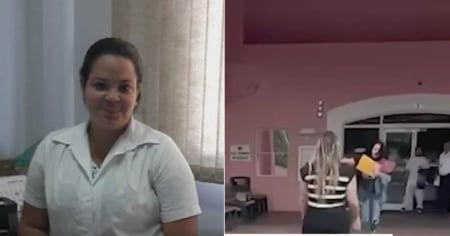
"I almost had a heart attack," confessed a young Cuban in a video posted on his TikTok account @andro_el_talento_oficial, after receiving his work permit in the United States. "God's timing is perfect. I applied a month ago for my work permit... and within 15 days, I received the work permit and the receipt."
The young man, a beneficiary of the I-220A immigration status, excitedly shared that, after weeks of uncertainty, he had received both the extension and the approved document. "Here it is, I'm not lying," he said while showing the envelope. "Can you imagine if the I-220A got the residency? The world is going to find out," he exclaimed.
The video has generated dozens of reactions from other Cuban migrants. “I applied two months ago and nothing,” wrote one user. Another commented: “I applied five months ago, and after 15 days I received the letter for the 540-day extension, but still nothing about the card.” A third user noted: “I’ve been waiting for four months and nothing, I just received the extension letter, but I’m still waiting.”
There were also those who shared positive experiences. "It was the same for me, it arrived in 15 days," wrote one person. "I obtained my work permit through residency, not through asylum like the other, and it came in a month," stated another. "I was granted it for five years," added another user. The phrase "I thought it was the residency" was repeated in several comments, reflecting the collective anxiety with each official notification.
The creator of the video responded to many comments, advising to apply six months in advance to avoid setbacks and reminding that in their case, the permit was processed under category C9. “That's right, it will arrive at any moment. Blessings,” they wrote in response to several inquiries.
His story is part of a series of recent cases that provide hope to Cuban migrants amidst an uncertain legal landscape. At the beginning of April, a young Cuban woman in Miami received her residency after four years of waiting under status I-220A. Days earlier, a mother shared the moment when her young son, who benefited from humanitarian parole, received his residency in the United States.
A young woman in Las Vegas also made headlines after winning her asylum case and sharing her excitement on social media. In March, the Cuban Laura de la Caridad González was released from the ICE detention center in Florida following the intervention of Congresswoman María Elvira Salazar, who requested that Cubans with I-220A and no criminal record not be detained.
Shortly before, the Cuban Dariel López Ramos defended the migrant community in a viral video, showcasing the auto detailing business he built in less than three years in the United States.
These testimonies contrast with the growing uncertainty caused by recent decisions made by the United States government. According to Cuban lawyer Willy Allen, the Department of Homeland Security has suspended the permanent residency application processes for refugees and asylum seekers. “At this moment, the residency for which they applied is already undergoing a suspension process,” the lawyer stated in remarks to America Tevé.
He also warned that the revocation of humanitarian parole and the halt to family reunification directly affect thousands of Cuban migrants, including those who had already been approved to adjust their immigration status. Allen noted that many individuals with Form I-220A still do not have a cut-off date and, therefore, would not be directly impacted. However, he cautioned that the delays in work permits and the recent arrests of migrants during routine appointments with ICE could be part of an intimidating strategy. "I believe they were detained to send a message ... the government wants to promote the idea that migrants should self-deport," he stated.
In this scenario, the testimony of the young Cuban who received his permit has created a domino effect of hope. "Thank you for encouraging those of us who are still waiting," wrote one user. As immigration policies become stricter and legal processes grow more complex, hundreds of Cubans insist on the same idea: to resist, to stay informed, and to continue fighting.
Frequently Asked Questions about the I-220A Immigration Status for Cubans in the United States
What is the I-220A status and how does it affect Cubans in the U.S.?
The I-220A is a document that grants parole to migrants, allowing them to remain in the U.S. while their immigration status is determined. For many Cubans, this represents a legal limbo, as they have no access to permanent residency nor the possibility of returning to their home country without risks.
How can Cubans with I-220A obtain permanent residency in the U.S.?
Cubans with I-220A can apply for permanent residency through the Cuban Adjustment Act, although the process can be lengthy and complicated. It is crucial to prepare adequately and meet all legal requirements, as well as to seek legal advice to increase the chances of success in their cases.
What are the most common challenges for Cubans with I-220A in the United States?
Cubans with I-220A face legal uncertainty and a lack of access to permanent residency, which can create a constant fear of deportation. Moreover, they must adapt to the economic and cultural differences of a developed country, which can be a long and complicated process.
What impact do U.S. immigration policies have on Cubans with I-220A?
U.S. immigration policies can significantly influence the future of Cubans with I-220A. Recent government decisions have suspended permanent residency processes for refugees and asylum seekers, which directly impacts these migrants. The political situation and upcoming presidential elections could either tighten or loosen these policies, increasing or decreasing the uncertainty about their future in the country.
Filed under: