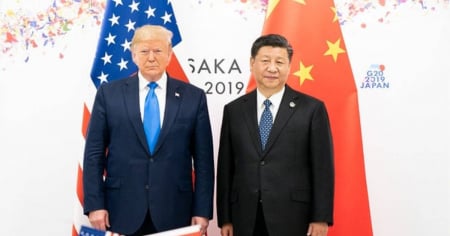
The Chinese government responded firmly to the new tariff escalation announced by the President of the United States, Donald Trump, escalating the trade conflict between the two largest economies in the world.
According to a report by CNN en Español, "the United States' threat to raise tariffs on China is one mistake after another," the Chinese Ministry of Commerce stated in an official announcement. "China will never accept it. If the United States insists on following its own path, China will fight until the end."
The statement comes just hours after Trump announced a new tariff of 34% on all imported Chinese products, which would raise the total levies to over 54%. Beijing reacted swiftly, imposing equivalent tariffs of 34% on American products, in addition to enforcing controls on strategic exports and sanctions against U.S. companies.
According to an article from the People's Daily, the organ of the Chinese Communist Party, the country's official position is clear: "the more pressure we receive, the stronger we become." The text emphasizes that China will turn this crisis into an opportunity, highlighting its ability to withstand and adapt to external tensions.
During the weekend, senior Chinese officials held meetings with representatives from American companies such as Tesla and GE HealthCare, assuring that the country remains a "safe and promising" destination for foreign investments.
Some analysts believe that Beijing is trying to project an image of strength, positioning itself as a defender of a new global trade order against the protectionism driven by Washington. However, the combative rhetoric of Chinese leader Xi Jinping also risks entangling both powers in a dangerous spiral of escalation with no diplomatic exit.
Bilateral trade between both nations reached half a trillion dollars last year. However, the new tariffs come at a delicate time for China, which continues to face the effects of a prolonged real estate crisis, local government debt, and an uneven recovery after the pandemic.
As Trump cancels meetings with Chinese envoys and threatens to impose additional tariffs of 50%, the international community watches with concern the escalating tension. Governments in Asia and Europe have already been affected by similar measures, in what many view as a protectionist shift from Washington that could redefine the rules of global trade.
Unstoppable escalation: China responds more firmly to Trump's threats
Tensions between Washington and Beijing continued to escalate on Monday, after President Donald Trump warned that he would impose additional tariffs of 50% on Chinese products if Beijing did not retract its retaliatory measures, which include tariffs of 34% on U.S. exports.
In a new statement, cited by BBC Mundo, China's Ministry of Commerce accused the Trump administration of "extortion" and warned that if this line persists, they will respond with "strong countermeasures." Beijing labeled Washington's stance as "unilateral and intimidating" and asserted that it will "fight until the end."
The state agency Xinhua also reacted strongly, deeming the U.S. logic as "completely absurd." "That is not diplomacy. It is clumsy extortion disguised as politics," stated an editorial published on Tuesday.
Even the Chinese Ministry of Foreign Affairs shared an old speech by Ronald Reagan to criticize Trump’s trade policies. In the video, Reagan warned that tariffs provoke retaliation and harm the American economy. According to Chinese sources, those words take on “new meaning in 2025.”
Meanwhile, the Chinese government has mobilized its state-owned enterprises to stabilize financial markets, and the sector regulator announced measures to encourage stock market investments by insurance funds. Asian stock markets reacted positively this Tuesday, recovering some of the losses incurred following announcements from Washington.
Experts cited by the BBC estimate that China will not back down. Although the new tariffs could seriously affect its export sector, Beijing is not willing to "appear weak," especially given an internal context marked by a slowing economy, high youth unemployment, and pressures on domestic consumption.
“The Communist Party has the courage and confidence to deal with the impact… it is fully capable of facing these challenges,” assured the People's Daily in an editorial addressed to the public.
Trump confirmed on his Truth Social network that he is not considering halting the measures, and that there are many countries interested in negotiating bilateral trade agreements with the United States. However, the key question remains: who will give in first in this unprecedented trade war?
From smartphones and computers to screws, batteries, or heaters, hundreds of products are at stake. And although both nations could withstand for months, the economic interdependence and lack of immediate alternatives pose enormous challenges for both sides of the conflict.
The President of the United States, Donald Trump, detailed last Wednesday from the Rose Garden of the White House what he has defined as a tariff war declaration by his country against the world, a measure he had been preparing for weeks.
“Today we have good news to share,” declared the leader before announcing a 25% tariff on all cars manufactured abroad, a measure that will take effect starting at midnight, reported El País.
Trump also announced that his administration will impose a blanket tariff of 10% on all imports from any country, although he clarified that it will be higher for those countries that he believes take the most advantage of the United States.
In that group, he included the European Union, which will be subject to a 20% tax, emphasized El País.
Trump delivered a strong message to Americans this Monday, urging them not to be "weak" or "stupid", but to be "strong, brave, and patient" in the face of the economic reforms he has implemented since taking office.
Minutes before the New York stock market opened with a new and expected decline, Trump defended his global trade war.
“The United States has the opportunity to do something that should have been done DECADES AGO! Don't be weak! Don't be stupid! Don't be a PANICAN (a new party based on weak and stupid people!)” he wrote on X.
“Be strong, brave, and patient, and GREATNESS will be the result!” he added.
On his part, the administrator of the Government Efficiency Department of the White House during Donald Trump's second presidency, Elon Musk, has expressed his disagreement with the recent tariff policies of the current administration.
During a video conference intervention at the Italian League party congress in Florence, Musk advocated for the creation of a free trade zone between the United States and Europe, featuring "zero tariffs" and increased labor mobility between the two continents.
Frequently asked questions about the trade war between the United States and China
What is the main cause of the current trade war between the United States and China?
The main cause of the current trade war is the imposition of tariffs by the United States on Chinese products and China's reciprocal response with its own tariffs. Donald Trump has justified these measures as a way to protect the American industry and reduce the trade deficit. However, China believes that these actions violate international trade norms.
What measures has China taken in response to the tariffs from the United States?
China has responded by imposing a 34% tariff on American products and has implemented export controls and sanctions on U.S. companies. Additionally, it has placed certain American companies on its "unreliable entities list." These actions are part of a strategy to demonstrate strength and adaptability in the face of external pressures.
How do tariffs impact the economy of the United States?
Tariffs could lead to slower economic growth and an increase in inflation in the United States. According to the Federal Reserve, the impact of tariff rates could be more long-lasting than anticipated, affecting both consumers and businesses, who might face higher costs on imported goods.
Which products will be most affected by the tariffs between the United States and China?
Electronic products, clothing, furniture, and food are the most affected by the new tariffs. These items, which rely heavily on production and assembly in China, will see a significant increase in their consumer prices in the United States, particularly impacting families with middle and low incomes.
What are the possible consequences of this trade war on a global scale?
Trade tensions could lead to a global recession, as tariffs increase product costs and reduce international trade. Additionally, the protectionist measures from the United States could isolate the country from its trade allies and destabilize global trade, negatively impacting global economic growth.
Filed under: