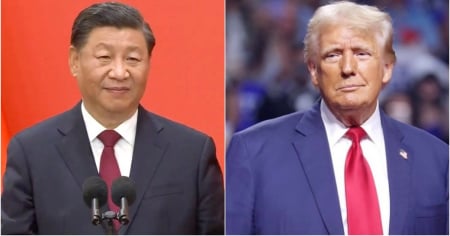
Trade relations between China and the United States are entering a new phase of tension and confusion.
While U.S. President Donald Trump claims that both powers are engaged in active negotiations to reduce the high tariffs that have been imposed on each other, Beijing categorically denies that there are ongoing talks.
This clash of versions has not only sparked political reactions but has also shaken financial markets, which perceive contradictory signals amidst a possible trade de-escalation.
Trump's statements: "Everything is active."
On Tuesday, Donald Trump stated to the press that discussions were underway with China and that the tariffs imposed on exports from the Asian country would be “substantially” reduced from the current 145%.
"Everything is active," he noted in response to questions about whether there was dialogue with Beijing.
This Thursday, he insisted that members of his government had a meeting in the morning with Chinese representatives, although he refused to identify them.
"It doesn't matter who they are. We may reveal it later, but they had meetings this morning," he said in response to reporters.
These statements came after his administration suggested a possible reduction of tariffs from 145% to a range between 50% and 65%, as anticipated by The Wall Street Journal.
The Chinese response
However, Beijing has denied the statements made by the American leader.
This Thursday, the spokesperson for the Ministry of Commerce, He Yadong, denied that there are currently any negotiations taking place.
“China has taken note of some information that has recently appeared in foreign media. [...] I would like to emphasize that there are currently no trade negotiations between China and the United States. Any claim about progress in trade talks between China and the United States is purely speculative and lacks factual basis,” he stated, in comments reported by the international press.
Additionally, he figuratively criticized U.S. statements by asserting that "any type of consultations and negotiations must be conducted based on mutual respect and in a fair manner," and that any claim about progress "is as absurd as trying to catch the wind."
Guo Jiakun, spokesperson for the Ministry of Foreign Affairs, went further by labeling Trump's statements about "daily" contacts between the two governments as "false information."
“As far as I know, China and the United States have not held consultations or negotiations regarding the issue of tariffs, let alone reached an agreement”, he stated, according to remarks reported by the Global Times.
"If the United States truly seeks to resolve issues through dialogue and negotiation, it should abandon its maximum pressure approach, cease threats and coercion, and engage in dialogue with China based on equality, mutual respect, and reciprocity," Guo stated.
The background of the tariff dispute
The trade war between the two powers intensified in recent months with Washington imposing unilateral tariffs of 145% on Chinese products.
In response, Beijing imposed a 125% tariff on US imports, and also implemented non-tariff measures, such as restricting the export of rare earths and blocking purchases from Boeing.
In addition, China filed several complaints with the World Trade Organization.
The Chinese Ministry of Commerce reiterated that the root of the problem lies in the measures imposed by the U.S.
“Unilateral measures to increase tariffs were initiated by the United States. If the United States truly wants to resolve the problem, it should heed the rational voices of the international community and all parties within its own country, completely cancel all unilateral tariff measures against China, and find ways to resolve differences through equitable dialogue,” said the spokesperson for the Chinese Ministry of Commerce, as reported by AP.
Market Implications: Cautious Upsurge
Despite the exchange of accusations, financial markets reacted with optimism to the signs—however weak they may have been—of a potential easing of tensions.
The S&P 500 rose by 2% on Thursday, reaching its highest level since April 3, while European indices such as the Euro Stoxx 600 and the German DAX headed towards a second consecutive week of gains.
In Asia, the Japanese Nikkei rose by more than 2%, while the South Korean Kospi increased by over 1%. The Hang Seng index in Hong Kong climbed by 1.5%, recovering some of its recent losses.
This recovery was also fueled by statements from the People's Bank of China, which reaffirmed its loose monetary policy as support for growth amid trade tensions.
A dispute without a clear horizon
The apparent attempt by Donald Trump to project optimism contrasts sharply with Beijing's firm denial, which not only dismisses any progress but also ridicules it as illusory.
The trade war, rather than calming down, seems to remain a landscape filled with uncertainty, both diplomatically and economically.
As the two largest economies in the world continue their standoff, international observers and markets are confronted with an ambiguous narrative that swings between confrontation and a desire for reconciliation.
Filed under: