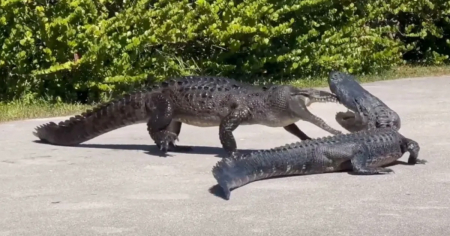
A new study from the University of Florida revealed that almost all alligator attacks in the state are caused by human behavior.
The research, published in April, concludes that 96% of the recorded attacks since 1948 occurred in contexts where individuals engaged in risky behaviors, such as swimming or wading in areas known to be inhabited by these reptiles, reported ClickOrlando.
Although alligator attacks in Florida are not common, with nearly 500 reports since 1948 and about 30 fatalities, the research provides a clear overview of the factors that trigger them.
The main finding is that alligators do not seek to attack, but they react defensively or predatorily when people enter their natural territory.
"Bites can be prevented if people are more aware of their surroundings and avoid risky behaviors," said Professor Frank Mazzotti, one of the study's authors, as quoted by ClickOrlando.
Among those behaviors are walking pets near water, swimming in unauthorized areas, or moving abruptly in bodies of water where alligators inhabit.
On the contrary, simply being near the water, for instance, walking along the shore, posed a much lower risk, according to researchers.
The study becomes even more relevant considering that the mating season for alligators in Florida extends until June, which increases their activity and the likelihood of encounters with humans.
In addition to the investigation, a list was released detailing all the fatal alligator attacks in the state, which shows that most of the victims were swimming or very close to the water at the time of the attack.
The University of Florida also shared several key recommendations to reduce the risk of alligator attacks: do not feed these wild animals, which is not only dangerous but also illegal; always respect the signage that marks swimming areas; swim only during the day, when alligators are less active; and keep children and pets under strict supervision when near the water.
These recommendations are even more relevant following a recent attack in Florida, where a 61-year-old woman died after being attacked by an alligator while canoeing with her husband on Lake Kissimmee, south of Orlando.
According to a report by CBS News, the incident occurred when the boat passed over a large alligator, causing it to thrash and tip the canoe. Both fell into the water, and the victim ended up on top of the animal, which fatally bit her.
Her husband tried to rescue her, but he was unable to prevent the attack, and the woman was found dead minutes later by the authorities.
Recently, the Government of Florida opened registrations for its annual alligator hunting program, a regulated activity since 1988 that combines recreation, population control, and ethical controversy.
This program takes place in swampy areas and freshwater bodies in the state, allowing participants to hunt up to two specimens between August 15 and December 31.
Applications can be submitted until June 2, the Florida Fish and Wildlife Conservation Commission (FWC) announced, as reported by EFE in an article published this Monday.
This year also sees the return of the format known as Alligator Super Hunt, which allows for multiple applications to increase the chances of selection.
A total of 7,356 standard permits and 100 additional ones for this special category will be granted, and it was also reported that the permit fees are $272 for residents and $1,022 for non-residents.
Frequently Asked Questions about Alligator Attacks and Their Behavior in Florida
What is the most common cause of alligator attacks in Florida?
The most common cause of alligator attacks in Florida is human behavior, according to a study from the University of Florida. Ninety-six percent of attacks since 1948 occurred in contexts where people engaged in risky behaviors, such as swimming in areas known for the presence of alligators.
What measures can be taken to prevent alligator attacks in Florida?
To avoid attacks from alligators, people should be more aware of their surroundings and avoid risky behaviors. This includes not swimming in unauthorized areas, not walking pets near the water, and keeping children and pets under strict supervision. Additionally, one should respect signage and not feed alligators.
How does the alligator mating season affect their behavior?
During the mating season, which lasts until June, alligators increase their activity and may have more encounters with humans. This is because they are seeking mates and are more territorial, which can raise the risk of attacks if people do not take the necessary precautions.
What recommendations does the Florida Fish and Wildlife Conservation Commission offer to avoid dangerous encounters with alligators?
The FWC recommends maintaining a safe distance from alligators, not feeding them, and avoiding swimming outside of designated areas. Additionally, it is important to monitor pets and keep them away from the water. If a dangerous alligator is spotted, the FWC emergency line should be called.
Filed under: