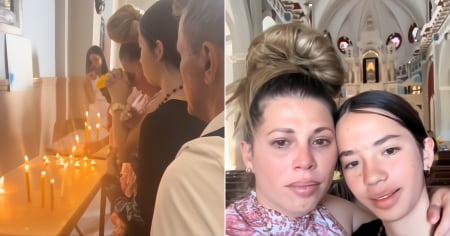
A Cuban woman has shared on social media a story that seems straight out of a movie: she was deported from the United States and, almost simultaneously, was granted permanent residency. "I was deported and rewarded all at the same time," she said, surprised, in a video posted on TikTok.
The user, identified on social media as @amy_te_lo_cuenta, recounted that her ordeal began in 2019 when she crossed the border with an I-220A, a document that allows one to stay in the country but does not guarantee a stable immigration status. “You know, the piece of paper that says ‘stay but don’t get your hopes up’,” she explained with an ironic tone.
After a year and three months in U.S. territory, he managed to start the process to obtain permanent residency. Seven months later, he received the first notice regarding his case — which he referred to as "the first torch" — and while waiting for a response, he was given the date for his hearing before an immigration judge.
She hoped that, as in previous occasions, her hearing would be postponed since she had already begun the residency process and had even submitted her fingerprints. But this time, there was no room for negotiations: the judge issued a deportation order. “I screamed, I cried, I pleaded, but in the end, it was inevitable,” she recalled, visibly distressed.
The young woman was given a 30-day deadline to leave the United States. In the midst of desperation, her legal team requested an extension while they awaited a response regarding her residency. Then, the unexpected happened: she received approval for her green card.
"I can't explain how I was feeling at that moment; the whole life I had built over the last four years was coming crashing down," he said. Later, he discovered that it was all a mistake: "I had never had a deportation order."
As a reflection, the Cuban left a message to her followers: “Moral: never take anything for granted, as the final word always belongs to the one above.”
The case has generated multiple reactions on social media, with comments of surprise and solidarity regarding a migration process that many Cubans are intimately familiar with due to its complexity and lack of guarantees.
Frequently Asked Questions about Immigration Processes for Cubans in the United States
What is the I-220A document and how does it affect Cuban migrants in the U.S.?
The I-220A document is a type of probation granted to some Cuban migrants that allows them to remain in the United States while their immigration cases are being resolved. This status does not guarantee permanent residency or stable work rights, and many migrants remain in legal limbo for years until they receive a final decision.
How can a Cuban migrant face a deportation order in the U.S.?
To face a deportation order, Cuban migrants can seek the support of specialized immigration lawyers who can present strong arguments to immigration authorities. It is crucial to have a competent legal team to negotiate with the judicial system and explore options such as asylum applications or permanent residency that may halt the deportation process.
Is it possible to obtain permanent residency in the U.S. after being under I-220A status?
Yes, although it is not guaranteed, some Cuban migrants under the I-220A status have managed to obtain permanent residency after lengthy legal processes. The acquisition of residency depends on several factors, such as meeting legal requirements, proper case preparation, and the ability to demonstrate conditions of risk or persecution in their country of origin.
What options do Cubans with I-220A status have to work in the U.S.?
Cuban nationals with I-220A status can apply for work permits while awaiting a resolution to their immigration case. These permits are not automatic and must be requested through specific procedures, with the assistance of legal counsel, to increase the chances of approval.
Filed under: