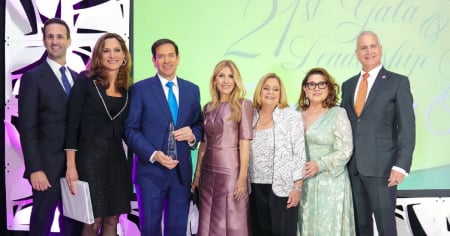
The Adam Smith Center for Economic Freedom at Florida International University (FIU) held a posthumous tribute to the former Cuban-American congressman Lincoln Díaz-Balart.
The recognition was awarded last Friday during the Annual Champions of Freedom Dinner, reported Martí Noticias.
The organization recognized the tireless work in defense of democracy in Latin America by the Cuban-American, who passed away last March, the information notes.
"An extraordinary leader whose lifelong commitment to freedom and democracy remains inspirational. We are honored to share this moment with the Díaz-Balart family," reads a post on X from the Adam Smith Center.
The Republican congressman from Florida, Mario Díaz-Balart, brother of Lincoln, was one of the speakers of the evening. In his speech, he recalled the immense legacy of Lincoln.
Others who received this prestigious recognition this year include the President of Costa Rica, Rodrigo Chaves; Fred Voccola, co-founder of Kaseya; Luis Amodio, CEO of OHLA; Marián de la Fuente, journalist and media executive; and Nadia Ferreira, model, philanthropist, and entrepreneur.
The Champion of Freedom awards distinguished individuals for their defense of economic and individual liberty.
Associated with FIU, the Adam Smith Center for Economic Freedom is composed of an independent and nonpartisan group of experts dedicated to informing, innovating, influencing, and inspiring on topics such as economic freedom.
Trajectory of Lincoln Díaz-Balart
Born on August 13, 1954, in Havana, Lincoln Rafael Díaz-Balart y Caballero dedicated his life to public service and the promotion of democracy in his homeland
He was the son of the Cuban politician Rafael Díaz-Balart and Hilda Caballero Brunet, and the nephew of Mirta Díaz-Balart, who was Fidel Castro's first wife. Therefore, her son, Fidel Castro Díaz-Balart, was his cousin.
Lincoln emigrated to the United States as a child, following the Cuban Revolution of 1959. He studied at the American School in Madrid and the New College of Florida, and earned his law degree from Case Western Reserve University. Before starting his political career, he practiced law in Miami, providing legal assistance to low-income individuals
Initially a member of the Democratic Party, in 1985 he switched his affiliation to the Republican Party.
He was elected as a member of the Florida House of Representatives in 1986 and later to the Florida Senate in 1989. In 1992, he was elected to the United States House of Representatives for Florida's 21st congressional district, a position he held until 2011, when he retired from Congress. His younger brother, Mario Díaz-Balart, succeeded him.
During his time in the legislative body, Díaz-Balart stood out for his defense of immigrant rights and his strong opposition to the Cuban regime. He was one of the sponsors of the National Security Act and the DREAM Act, aiming to facilitate access to higher education for immigrant students
“Defender of the oppressed and silenced, author of the democratic requirement for the lifting of U.S. sanctions against the Cuban dictatorship, and author of the Nicaraguan Adjustment and Central American Relief Act (NACARA). Lincoln's legacy of achievements will endure for generations and continues...,” Mario Díaz-Balart recalled in his message.
In addition to his legislative work, Lincoln Díaz-Balart actively participated in the La Rosa Blanca Institute, an organization dedicated to promoting the democratization of Cuba and honoring the memory of the martyrs who fought against Fidel Castro's regime. This institute was founded in January 1959 by his father, Rafael Díaz-Balart, in New York, making it the first anti-Castro organization in exile.
Frequently Asked Questions about the Legacy of Lincoln Díaz-Balart and His Impact on the Defense of Freedom
Who was Lincoln Díaz-Balart and what was his legacy in American politics?
Lincoln Díaz-Balart was a prominent Cuban-American former congressman known for his tireless advocacy for democracy and immigrant rights. His political legacy includes the promotion of laws such as the DREAM Act and the Nicaraguan Adjustment and Central American Relief Act (NACARA), as well as his steadfast opposition to the Cuban regime. Díaz-Balart dedicated 24 years to public service, including 18 years in the United States House of Representatives.
What recognition did Lincoln Díaz-Balart receive after his passing?
Lincoln Díaz-Balart was posthumously honored by the Adam Smith Center for Economic Freedom at Florida International University (FIU). He was recognized for his tireless work in defending democracy in Latin America during the Annual Champions of Freedom Dinner. In addition, the city of Hialeah designated a street in his honor, highlighting his influence in the Cuban-American community.
What role did Lincoln Díaz-Balart play in the Cuban exile community?
Lincoln Díaz-Balart was a key figure in the Cuban exile community, known for his unwavering support for the democratization of Cuba and his opposition to the Castro regime. He was actively involved in the La Rosa Blanca Institute, an organization dedicated to honoring the memory of the martyrs of the struggle against Fidel Castro, founded by his father, Rafael Díaz-Balart.
How has the memory of Lincoln Díaz-Balart been honored in Florida?
The memory of Lincoln Díaz-Balart has been honored in various ways in Florida. Flags were flown at half-staff throughout the state following his passing as a tribute to his legacy. Additionally, masses were held in his honor in Miami, and his name was given to a street in Hialeah, highlighting his impact on the local community and his fight for freedom in Cuba.
Filed under: