
Related videos:
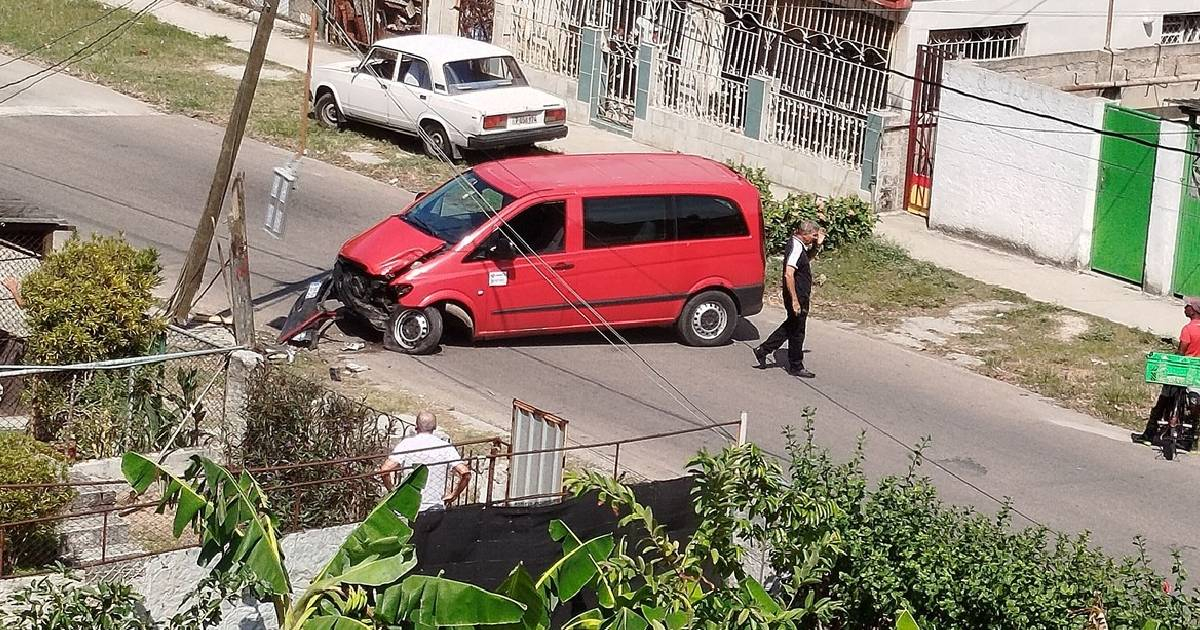
A driver is believed to have lost control of his vehicle after falling asleep, crashing into an electric pole in the Havana neighborhood of La Timba, in the Plaza de la Revolución municipality, according to citizen reports shared on social media.
The information was published by the user William Prado in the group Facebook "ACCIDENTS BUS & TRUCKS for more experience and fewer victims!", where he noted that the accident occurred on 39th Street, between 2nd and 4th, without providing details about the driver's health status or whether there were any injuries.
“Apparently the man fell asleep; this just happened now…” Prado wrote, offering no further information about the incident.
Until now, there has been no official confirmation regarding the exact causes of the accident or potential damage to the electrical infrastructure or injuries to third parties.
The incident adds to a series of accidents recently reported in the capital, many of which are linked to driver fatigue, mechanical failures, or poor road conditions.
The number of fatalities from accidents in Cuba rises in the first quarter of 2025
Traffic accidents in Cuba decreased during the first quarter of 2025, but the number of fatalities increased compared to the same period in 2024, according to data published by the Minister of Transport, Eduardo Rodríguez Dávila.
The information was shared on their official Facebook account along with an infographic that, according to the headline, allows for a more detailed analysis of the behavior of traffic accidents in the country.
Between January and March, there were 1,738 accidents recorded, 144 fewer than in the same quarter of the previous year. There was also a decrease in injuries: 1,514 people were injured, 87 fewer than in 2024. However, fatalities rose from 146 to 173, an increase of 27 deaths.
Rodríguez acknowledged that this increase in deaths "was more pronounced in the month of March."
In addition to the national balance, the report shows significant territorial variations. The highest increase in accidents occurred in the provinces of Villa Clara, Cienfuegos, Granma, Sancti Spíritus, and Las Tunas. There was also an increase in incidents in Ciego de Ávila and Camagüey.
Regarding deaths, the provinces with an increase in fatalities were Havana, Ciego de Ávila, Camagüey, Villa Clara, Cienfuegos, Granma, and Santiago de Cuba. The first three reported the highest numbers.
Likewise, the number of injured increased, particularly in Cienfuegos, Sancti Spíritus, Ciego de Ávila, Camagüey, and Las Tunas, as well as in Holguín and Santiago de Cuba.
The Minister of Transport emphasized that this information is useful for refining preventive measures and argued that "everything we do in that effort is insufficient, as a family is never the same after losing one of its members to an accident that could have been avoided."
Despite the implementation of control measures, road accidents remain a critical issue in Cuba. The government continues to blame human factors while avoiding addressing structural causes such as the deterioration of roads, the lack of proper signage, and the crisis in public transportation, which forces many to resort to risky modes of transport.
In January, the government pointed to drivers as the main culprits of traffic accidents, when assessing the causes of road incidents throughout 2024.
Failing to pay adequate attention to vehicle control was the main cause of traffic accidents last year, followed by disrespecting right of way and speeding, according to a report from the Specialized Traffic Organ of the National Revolutionary Police (PNR). In its report on road accidents during 2023, the Cuban government attributed 91% of the incidents to human factors.
The consumption of alcoholic beverages or the violation of traffic laws also appear as common causes of traffic accidents. Additionally, there is a need to reinforce both the mandatory breaks for professional drivers and the structural maintenance of bridges and traffic signage at high-risk points.
These factors are compounded by the widespread deterioration of old cars still on the road in Cuba, along with the poor condition of the roads, a combination that proves fatal and contributes to the increasingly deadly accidents reported in the country.
The Cuban government has acknowledged that 75% of the country's roads and thoroughfares are in a condition ranging from fair to poor. This situation presents a significant challenge for the communist regime, as it directly impacts the quality of life of citizens and the provision of essential services.
The main focus of deterioration is on roads of municipal and specific interest, with particular attention to mountain roads and difficult-to-access paths, such as those in the Turquino Plan.
These sections require mechanized actions for their repair, but the government lacks the necessary equipment and funding.
In July 2023, the Minister of Transport himself warned about economic and financial factors that directly impact road repair and maintenance activities. He also pointed out deficiencies in the management and administration of the boards, as well as the diversion of funds allocated for road infrastructure to other areas.
Frequently Asked Questions about Traffic Accidents in Cuba
What are the main causes of traffic accidents in Cuba?
The main causes of traffic accidents in Cuba are a lack of attention while controlling the vehicle, disrespect for right of way, and speeding. Additionally, driving under the influence of alcohol, poor technical condition of vehicles, and the deterioration of roads are mentioned as factors contributing to the high accident rate in the country.
How has road accident rates changed in the first quarter of 2025 in Cuba?
During the first quarter of 2025, traffic accidents in Cuba decreased, but the number of fatalities increased. A total of 1,738 accidents were reported, which is 144 fewer than in the same quarter of the previous year, but deaths rose to 173, 27 more than in the same period of 2024.
What measures are being taken to reduce the number of traffic accidents in Cuba?
The Cuban government is implementing control and prevention measures, such as reinforcing mandatory breaks for professional drivers and improving road signage in high-risk areas. However, criticism arises regarding the inadequate addressing of structural causes, such as the poor condition of the roads and the public transportation crisis.
What role does the state of the roads play in accidents in Cuba?
The condition of the roads in Cuba is a critical factor contributing to the high accident rate. It is estimated that 75% of the roads are in fair to poor condition, which directly impacts road safety and increases the risk of accidents.
What actions is the Cuban government taking to improve road infrastructure?
The Cuban government has implemented a work system to address the repair and maintenance of roads, including collaboration with universities and research centers. However, it faces significant limitations due to a lack of funding and equipment to carry out the necessary repairs.
Filed under: