
Related videos:
At least 17 of the 18 injured in the derailment of Extra Train #16, which was covering the Holguín–Havana route, were discharged from the hospital this Wednesday after receiving treatment at the Manuel Ascunce Domenech University Hospital in the city of Camagüey.
Only one patient remains hospitalized due to a fracture in the kneecap, although she will be transferred soon by private transport, as per her family's decision, reported the official portal Cubadebate.
The accident occurred on Tuesday night, around 9:45 p.m., at kilometer 522.6 of the Central Line, near the commercial area known as El Cárnico.
According to official sources and Transportation Minister Eduardo Rodríguez Dávila, the incident did not result in any fatalities or serious injuries.
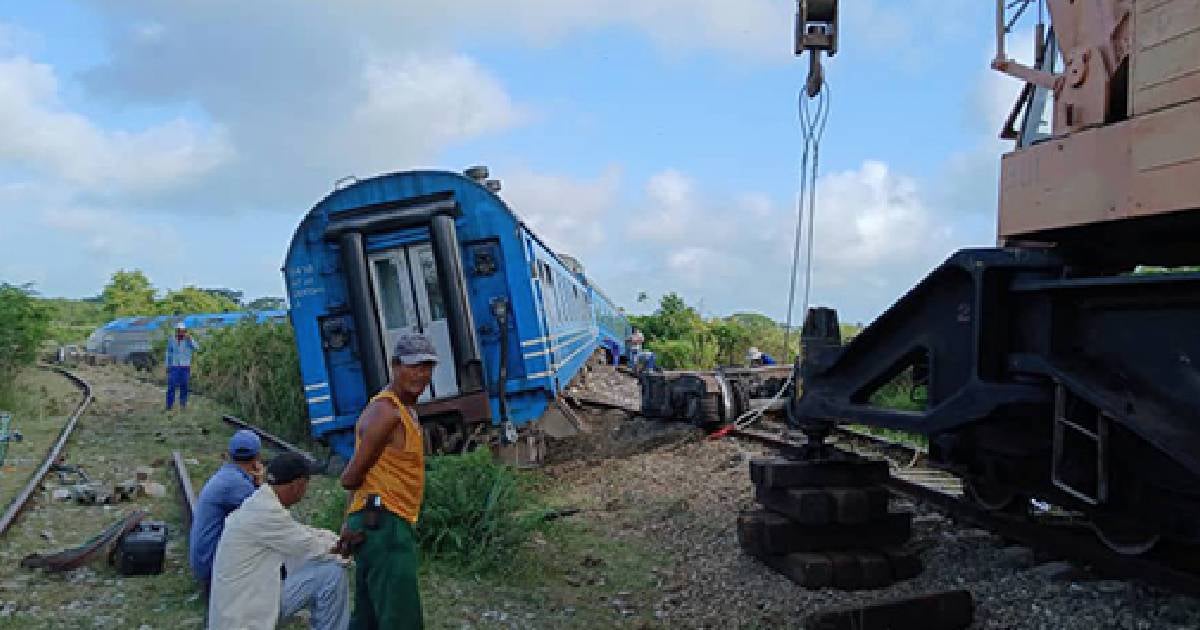
The train, consisting of 12 cars, sustained damage to the generator van and two passenger coaches, while the remaining nine carriages were transported intact to the Camagüey station. The locomotive was not affected.
After the accident, the passengers in the undamaged carriages were evacuated by relief train to the station in Camagüey, the information details.
Another 250 travelers were relocated to buses to continue their journey to Havana, while three injured individuals chose to return to Holguín by personal decision, in taxis arranged by Agencia Taxis Cuba.
In addition, travelers who were at the remaining nine stations along the route were also transported by land, as part of an operation organized by the Ministry of Transport.
The accident resulted in the destruction of three sections of railway (each containing 23 sleepers) and the breakage of four rails, two on the Central Line and two on the Cárnico branch. Recovery work began at 5:00 a.m. this Wednesday following the police investigation, with the participation of five track brigades and specialized teams.
Two sections of new sleepers have been installed, and work continues on the removal of the derailed cars using a special crane, with the aim of clearing the way before the arrival of the Habana–Guantánamo train, which was temporarily stopped in Santa Clara and resumed its route at 10:00 a.m. towards Majagua, Ciego de Ávila.
Minister Rodríguez Dávila stated that the authorities in the province of Camagüey took "commendable" action in response to the incident.
It also confirmed the activation of a centralized command center to coordinate passenger assistance, transportation logistics, and repair efforts.
An investigative commission is already working to clarify the technical causes of the derailment, in collaboration with the Revolutionary National Police and other agencies of the Ministry of the Interior, the Cuban regime reported.
Frequently Asked Questions about the train accident in Camagüey and the situation of railway transport in Cuba
How many people were injured in the train accident in Camagüey?
The train accident in Camagüey resulted in 18 injuries, of which 17 have already been discharged from the hospital. Only one patient remains hospitalized due to a fracture in the patella.
What damage did the train suffer during the derailment?
The derailment of Extra Train #16 affected the generator car and two passenger cars, while the nine remaining carriages were transported intact to the station in Camagüey. The locomotive was not damaged.
What are the causes of the train accident in Camagüey?
Until now, the exact causes of the accident have not been clarified. An investigative commission is working in collaboration with the National Revolutionary Police and other agencies to determine the technical causes of the derailment.
How was the transfer of passengers managed after the accident?
After the accident, the passengers were evacuated by rescue train and bus. Passengers from the undamaged cars were taken by rescue train to the Camagüey station, while another 250 travelers continued their journey to Havana by bus.
What problems does the Cuban railway system face?
The Cuban railway system faces issues of deteriorating infrastructure and technical limitations, which compromise the safety of long-distance public transportation. These problems are evident in frequent accidents and the need for constant repairs.
Filed under: