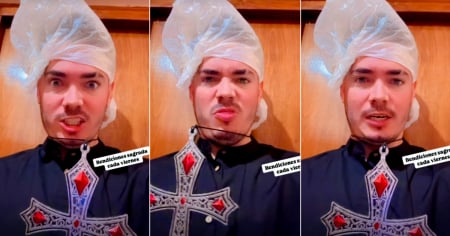
Sandro Castro, grandson of the Cuban dictator Fidel Castro, has once again become the focus of public outrage following the release of a video on Instagram in which he recommended “nine beers daily” as a formula for “maintaining good health”.
Although it may seem like a distasteful joke or an absurd performance on the surface, the content of the video generated a wave of outrage among Cubans. And rightly so.
In a country where the minimum wage is 2,100 Cuban pesos and the majority of the population subsists on barely enough, the suggestion to spend 178 dollars a month on beer (equivalent to over 65,000 CUP) is an obscene insult.
A provocation that reflects impunity
For thousands of Cubans, the grandson of the commander has become a sort of court jester, someone who acts with complete impunity, shielded by his surname. But his humor does not elicit laughter; instead, it generates anger, frustration, and, above all, a sense of institutionalized mockery.
This is how more than 1,600 comments expressed themselves on the Facebook page of CiberCuba, where citizens of all ages have reacted with indignation.
From phrases like “How long will this clown last!” to accusations of “emotional blackmail of the people,” along with claims that “if he were an ordinary young man, he would already be in prison,” the response of rejection was massive and forceful.
The Cynical Face of Inequality
While Cubans face blackouts, long lines to acquire basic goods, inflation, and a freefall in their purchasing power, Sandro flaunts his own privilege in celebration.
It's not just that he drinks beer. It's that he promotes it as a "healthy" way of life, with a nod to the state-owned company Cervecería Bucanero S.A., without clarifying whether it is advertising content.
This attitude, detached from any sense of responsibility, reveals a brutal disconnection from the national reality. The vast majority of citizens, especially those who do not receive remittances, can hardly afford a daily breakfast, according to recent data from the Cuban Observatory of Human Rights.
Reactions: Between mockery and rage
A portion of the audience wonders whether Sandro "el Sangrón" acts out of sheer provocation, or if his videos are actually a covert sabotage against the system that upholds him.
Others interpret him as a "black sheep" within the Castro clan, a character who "discredits his family" and "ridicules the system." However, as many users have pointed out, this alternative reading does not remove his responsibility nor does it mitigate the lack of respect with which he behaves.
"It’s untouchable," "he mocks the people," "neither the police nor ETECSA mess with him," are phrases commonly found among the over a thousand comments generated by the video.
Several recalled that young people who have protested or written critical songs against state-owned companies have been arrested, while Sandro enjoys unlimited megabytes, abundance, and cameras.
A symptom or a symbol?
Beyond the character, the case of Sandro Castro is revealing. It illustrates how a hereditary elite lives with its back turned to the suffering of the people, while openly and repeatedly displaying its disdain.
His figure has become a symbol of impunity and cynicism, of a Cuba where the rules only apply to those below. “Bread and circuses,” commented one user. But in Cuba, there is no longer bread, and the circus, embodied by Sandro, does not entertain but rather hurts.
Facing an increasingly tense scenario, with an engaged youth, prolonged blackouts, and structural hunger, the provocations of this "revolutionary influencer" could end up being more than just mockery: a spark.
And as someone wisely wrote on Facebook: “Nothing is more certain than that one day follows another.” Time — and the people — will set things right.
Filed under: