
Related videos:
The golden age of Cuban fencing featured outstanding figures who reached Olympic and world podiums; one of those legends is the elegant and skilled foil fencer Rolando Tucker, who today has the opportunity to exchange "thrusts" with CiberCuba.
What is the extraordinary Cuban fencer Rolando Tucker doing now?
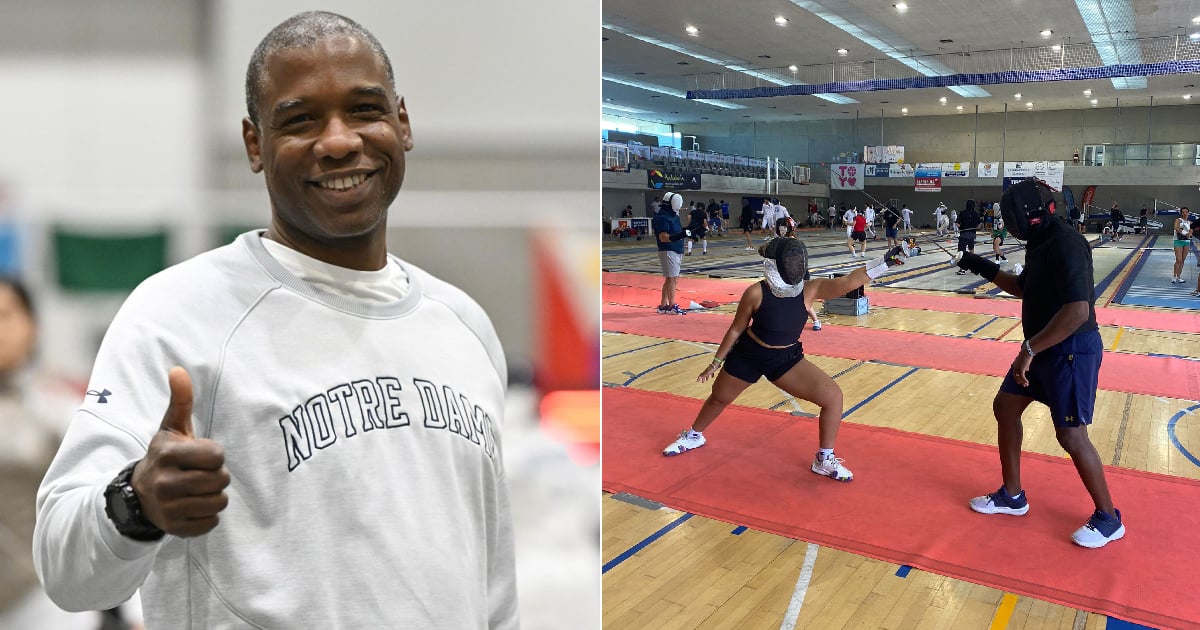
Thank you for the "extraordinary" comment. It's truly an honor coming from a superstar of sports journalism. I am currently at Notre Dame University in the United States, where I work as a foil coach.
Very happy with my job and the human quality of my colleagues. It is unbeatable, and the work environment is great as well. This is reflected in the team's results: we have won four out of the last five NCAA National University Championships.
Working with this wonderful cast, I have had the pleasure and fortune to train, three years ago, the most talented student I have ever had, Nick Itkin, who is currently ranked third in the world.
I also have the opportunity to continue the work we have been doing with my daughter Ariadna, who is performing very well in the senior World Cups. She is 20 years old and studies Psychology at the same university where I work. I have another daughter, Frida, who is 17 and is about to enter her final year of high school.
Returning to my work, it takes place in a highly professional environment, and the four coaches in the program are very dedicated to the athletes' performance.
This program itself has an entire team of dedicated professionals (gunsmith, physiotherapists, physical trainers, psychologists, etc.). I’m not boasting when I say that mentioning them all would create a long list. This is just referring to the foil fencers. If we consider the other weapons, there are also many champions.
Fencing in the United States has surged dramatically. Not only do they make their presence felt at the continental level, but also on the global stage. Examples are multiplying.
Tucker, I know that you don't just train them. In addition to that, what role do you play?
In addition to training them, I love giving talks that inspire young people to dare to dream. My way of teaching fencing is truly a means to provide athletes with a course in personal development, where they learn skills for success in life applied to fencing.
Currently, we are training several outstanding fencers, such as Liam Bas and Victoria Pevzner, junior world team champions in 2025, and Chase Emmer, holder of the individual National University Tournament title and medalist in a World Cup two years ago.
In addition, to Josefina Conway, national monarch of Division 1, and Ariadna Tucker, top 8 in the 2024 Junior World Championship.
How do you get to the United States?
I arrived with my family in 2014, but first, let me give you a quick overview, okay?
In 2001, I left Cuba and went to live with my wife in Valencia, Spain. There, I started working at the Mediterranean Fencing Club of Valencia.
Since fencing is a minority sport, I took on several side jobs to earn a sufficient income. Thus, I worked for a while from five to seven in the morning delivering newspapers; then, from 9 a.m. to 3 p.m. as an insurance agent for MAPFRE, and from 5 to 9 p.m. in the fencing room.
It was a lifestyle that was really hard to maintain. I didn't rest and I would even fall asleep at traffic lights. That's when I decided to quit delivering newspapers and focus on the insurance agency and fencing.
I share this little story with you because I know there are many people right now struggling with life, and I want to encourage them to understand that it is just a phase that will also pass. If they continue to fight with dignity and perseverance, one day their opportunity will come as well.
As the fencing industry was not improving financially and the insurance situation was getting worse, after working in it for 10 years, I began to explore other options.
I always believed that when the box is empty, it's foolish to keep looking for what you can't find in the same box. As Pablito Milanés said: “Clinging to things that are stuck is to be a little absent from life.” So I stepped out of the box… hahaha!
I looked into what the best options would be for me and, among other things, I started to inquire about fencing in the U.S. A friend sent my resume to a club, and within a week they contacted me to attend a training camp.
From the training camp arose the opportunity to stay and work with them, and that's how in 2014 I came to the United States to work at the Fencing Sports Academy.
Is the family... all with you?
Yes. My wife comments that in Valencian it is said: “On va la corda va el pual”, which in Spanish means “where the rope goes, the bucket of water goes.” In other words, we all jump into the well together. If there was water, we learned to swim, and if not, well, we crashed together… Hahaha…
At first, the idea was for me to come and try it out for a year to see how it went; they would come later. But, without a doubt, I much preferred the idea of all of us leaving together.
You left the Cuba team very young. How many years were you part of the national team, and why did you leave after the World Cup in Cape Town in 1997 if you were still in your prime?
I was on the national team for 10 years. From 1990 to 2000. I got injured in the 95 World Cup. There's a video on my YouTube channel where you can see me limping during the final, and I even fall down because it was extremely difficult for me to stay on my feet.
Apparently, I felt fine after the surgery, but it was just an illusion. The pain continued to bother me a lot and only grew worse.
Additionally, by adopting unusual positions to avoid pain, I injured my right knee and had to undergo surgery as well. Continuing in the same manner, I began to feel discomfort throughout my hip (nowadays, I can't sit for long hours without experiencing pain or my leg going numb).
Training was a struggle, and that began to demotivate me. The natural consequence was that the results were no longer the same, and I stopped being the number 1 in the world.
After being number 1 for three years, I knew I had only one path ahead of me. It was clear that fencing and I had already given each other the best we could offer: I gave my youth and my physical capabilities; it gave me many joys, recognition, and something equally important, a means of living for myself, my parents, and my brother.
But, once again, Pablito's words were completely relevant. Fencing had already come to a halt for me because I would never perform at such a high level again; it was breaking my body, and moreover, I was already married and living separately from my wife due to rules (imposed by the system I lived in) that defy common sense and all logic of human development.
Let's forget the sad moments and remember the joyful ones, which were numerous in your career. Tell me an anecdote from that Cerro Pelado experience you had, and if you can, compare it to the current moment, which is really quite different from the past.
From my time at Cerro Pelado, I remember the Olympic cafeteria… hahaha. In Cuba back then, it was a delight to eat there every day. I remember the endless football matches we played after training with all my teammates and others. I recall the rivalry and the camaraderie at the same time.
I will tell you that I had two companions who set an example of the cleansing of men's souls: Raúl Perojo and Eddy Patterson. Coincidentally, the two of them were eliminating each other to determine the fourth man who would join the team on one of the tours.
I am convinced that they were aware of how important it was for their lives (not just because of the medals; it’s important to remember that being part of a team and traveling was often a matter of having better or worse food for you and your whole family).
They fought with all their might, but at the same time, they helped each other, supporting one another; if one needed a wire or a foil on the piste, the other was the first to dash out to get it.
That was incredible. They admired me because I was number 1, but from that moment on, I admired them much more, because I believe that the most important thing is to be good human beings, and everything else will eventually come.
This anecdote is just one more example of the kind of people that made up that team and why, although we were very good individually, we achieved more success as a group.
Is that why they reached the very top level as a team in the world?
The level achieved, I always say, was the result of a long process of evolution and development of Cuban sports, and fencing in particular. I believe that no one triumphs alone, and although I certainly contributed my talent and immense effort, there were also all the conditions present for this to flourish and bear fruit.
For example, I believe that without my partner Elvis Gregory, I would not have come this far, because through his actions he taught me that we could also beat the Europeans and that the sky was the limit.
It's not that he told me; it's just that he's like that, and I saw it, observed it, reflected on it, interpreted it, and agreed with him. I decided that I wouldn't let them win anymore. But I believe that by becoming number 1 before him, I also motivated him to realize he still had much more to offer.
So I like to think that I returned the favor by inspiring him. In this way, he also became number 1 in the world. I believe that combination of boundless ambition, talent, camaraderie, and the excellent work of our coaches was what propelled us to the very top of the global elite.
Satisfied with what has been achieved?
Certainly, I am proud of what I have achieved. It's much more than I ever dreamed. I was a child who dreamed of building a robot. I would read books on recreational physics and I enjoyed scientific magazines.
Elvis always laughs at me because he remembers that one day he came to my house on December 31st, when everyone in Cuba is celebrating and it's also my birthday, and he found me, in dim light, playing chess with my mother. Hahaha..
You can see that I was not much of an athlete, and I still am not. I enjoy watching soccer, volleyball, athletics..., but without being a follower or fanatic. While everyone discusses soccer or wants to watch the final of the baseball league, I am actually more interested in learning to listen better to others and watching videos of Jorge Bucay (Argentinian psychologist) and Mario Alonso Puig, speaker and neurosurgeon; even any discussion among my friends who teach Physics and Mathematics at the University of Notre Dame.
I often joke that I am not an athlete; I am a fencer. I am drawn to fencing because of its intellectual component and the relationship between moment, time, distance, and angles, which, for me, is also the best way to understand the world around us.
I explain this so you understand why being a champion was not on my mind. I admired Efigenio Favier, a fencer, because he was ranked number 30 in the world, and Tulio Díaz because he was a world runner-up, do you understand?
That was stratospheric for me. And look: I spent three years being number 1 and I was world champion. We could have won more things, that's true, but my father always said, "Be happy with what you have and fight for what you're missing."
Since I cannot fight for more results, I remain happy with what I have. Life is surprising and wonderful. That’s why part of my current professional activity is speaking to others to inspire them.
Just as there was a need for "a load to kill rogues," today there is a need for an army of "dream restorers." I consider myself one, and I am currently working to form a squad. Giving talks at clubs, federations, fencing halls, etc. is one of the things that brings me the greatest joy.
I am developing a project called Fencing Pro Tech to fulfill my dream of bringing new technologies to fencing. It consists of online classes that allow me to bring knowledge and practice of fencing to locations where they may not have access to high-level coaches or, in some cases, even a fencing salle.
Moreover, besides the medals they placed around my neck, fencing has given me many greater things. The medals have an aspect of ego which is fine, I’m not saying it’s not, but it's not everything.
More than that, he gave me a brother: Elvis Gregory Gil! He took me to Spain to meet a woman, Mari Carmen, who isn't perfect, but she is ideal for me, and on top of that, I’m lucky that she agreed to marry me.
Fencing taught me that human growth is nearly infinite and that people deserve to dream… to dream even when you don't achieve those dreams! And that the best part of winning a medal is learning the way to guide others to achieve it.
You've turned out to be a philosopher, Rolando… What was your happiest moment?
Well, regarding the World Championships, I would say the happiest moment was winning the first team gold medal in Budapest '91. It was unexpected; it felt amazing. Sharing the joy with my teammates and the entire delegation. Seeing the happiness of so many other countries that celebrated with us as if the medal was theirs.
In '94, when I won individual gold. I was really so focused on distance-time-moment, actions-opponents, etc., that I barely realized the achievement I was accomplishing.
That state of flow never came back to me so perfectly, despite my efforts to find it. That day felt effortless. The '95 World Cup, in the final, I was in so much pain that I could hardly see my teammates taking their shots; I just kept thinking, "Come on, you can do it, you only have 15 touches left." Then, "you only have 10 touches left..."; then, "you only have five..."
When I finished that last fight, it felt like a weight had been lifted off my shoulders. And thank God we won in the end!!
Speaking of rivals. From a distance, which one was the most challenging?
The toughest rival I ever faced was my brother Elvis. It seemed like he always knew what I was going to do. But for me, without a doubt, the best fencer I have ever seen is the Ukrainian Serguei Gouloubitsky, who competed at the time for the now-defunct USSR. I took great pleasure in watching those two greats compete.
There were many other very good shooters; it would be quite lengthy to name them all. However, left-handers always gave me a lot of trouble. In fact, in the World Championship where I won individually in '94, I only lost one match, and it was against a shooter who wasn't among the best... but he was left-handed. I think in the poule he only defeated me, and I only lost to him. Hahaha… Funny, right?
Current situation in Cuba, what do you think about the number of athletes who leave the ship, not the Homeland?
The current situation of sports in Cuba is pitiful, at least for me. It pains me, it hurts to see how the results have dropped so much. But the overall situation in the country is also concerning.
I was there recently and saw my elementary school faded, with worn-out uniforms, with eyes lacking in spirit, with colors corroded by time, neglect, and what’s worse, self-pity.
If the fencing halls are no longer what they used to be, the results won't be either. It's logical. I'm not interested in assigning blame or politics. I prefer to focus on solutions rather than the problem, who is at fault, or where it originated.
Athletes are leaving because they are people too. Professionals, coaches, remain human beings, uninterested in the lengthy exit process that may or may not pertain to their situation. They are not interested because their vital time is short and running out. They need to resolve their situation now, in order to continue improving. It is a human, logical, and normal matter.
In addition to your role as a coach, I know that you are involved in another project.
That's right. I am trying to support the Pena de la Esgrima en Cuba and the idea of its president Jesús Ortiz, a valuable former sabre fencer, to unite Cuban fencers both abroad and within the country. I think that is a wonderful initiative. In fact, I am a member of the group.
Ortiz is a professor of professors and was for many years the head of the fencing department at "Fajardo" and a medalist in World Cups as an athlete.
In addition to what I already mentioned about my project Fencing Pro Tech, which would be the realization of a dream.
Three world gold medals, an Olympic bronze that could have been better in Atlanta (in teams), a life on a constant rise, a top-level coach, father, son, husband... Rolando Tucker is a powerhouse of intelligence and tenacity.
Filed under: