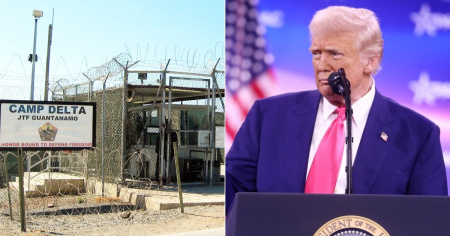
The Guantanamo naval base continues to be used by the Donald Trump administration as a detention center for migrants, now with a significant expansion of the profile of those detained.
According to internal documents from the U.S. government obtained by CBS News, immigrants from countries as diverse as China, Jamaica, Liberia, and the United Kingdom were recently transferred to Guantánamo, expanding the group beyond the Latin Americans who had been detained previously.
Currently, there are 54 migrants held in the enclave: 41 in the high-security prison Camp VI and 13 in the Migrant Operations Center.
Federal officials told CBS News that the majority of those transferred are classified as "high risk," a category that includes serious criminal records or alleged gang affiliations.
However, the same research revealed that there are also "low-risk" detainees, without a criminal record, regardless of their immigration status.
Guantánamo has become a key component in the deportation strategy of the current U.S. government, which has faced criticism for using controversial facilities as a means of deterring migration.
The facility, historically associated with indefinite detentions for terrorism and allegations of torture, now houses migrants from at least four continents.
It is unclear why the government decided to send individuals from regions such as Asia, Africa, and Europe to Guantánamo, although it is suspected that the saturation of the immigration detention system within U.S. territory is behind this measure, emphasized the cited source.
In May, an official memo revealed by the press showed that the criteria for selecting who would be sent to Guantánamo did not necessarily include a criminal record, despite President Trump publicly stating that only "the worst" would be transferred.
The policy has faced strong criticism from civil rights organizations that question the legality of holding detainees outside of U.S. territory without guaranteed access to legal protection, especially in a facility like Guantánamo, which has been the subject of allegations of abuse for two decades.
The use of the base adds to other recent decisions made by the government: in March, more than 200 Venezuelans accused of gang-related activities were transferred to El Salvador and incarcerated in the high-security prison CECOT.
Additionally, Trump inaugurated a new immigration detention center in the Everglades, Florida, nicknamed the "Swamp Alcatraz," on Tuesday.
The Department of Defense informed Congress that by April of this year, 21 million dollars had been spent on flights to Guantanamo, with a cost exceeding 26,000 dollars per flight hour.
For months, the administration of Donald Trump has been redesigning its immigration policy with increasingly restrictive and controversial measures. In early 2025, the possibility of housing immigrants in tents was ruled out, deemed an unsustainable solution in light of the detention system's collapse.
Instead, the strategy shifted towards the repurposing of high-profile facilities. In March, the last immigrants from Guantánamo were temporarily withdrawn, but this measure was merely a pause within a broader plan for operational reorganization.
By April, the shift was evident. The administration admitted to having spent over 40 million dollars on operations to imprison and transfer migrants, prioritizing military facilities and extraterritorial centers.
In June, intentions became even clearer. Trump proposed to even send European citizens to Guantánamo, broadening the profile of detainees beyond those from Latin America and the Caribbean.
That same month, the United States Supreme Court endorsed the use of the naval base as an immigration detention center, allowing Trump to resume and escalate a policy that now includes individuals from four continents and has reignited old legal controversies surrounding civil rights and extraterritorial detentions.
Frequently Asked Questions about the Use of Guantanamo Bay for the Detention of Immigrants
Why is the Trump administration using Guantanamo Bay to detain immigrants?
The Trump administration is using Guantanamo Bay to alleviate congestion in detention centers in the U.S. Additionally, it aims to deter irregular migration by employing a location historically associated with the detention of terrorists. The base has been chosen for its capacity to house a large number of detainees and for the logistical challenges it poses for escape or unauthorized access.
What kind of immigrants are being sent to Guantánamo?
According to government documents, immigrants classified as "high risk" are sent, as well as those with no serious criminal records. Most of these immigrants are deemed high risk due to alleged gang affiliations or criminal backgrounds, although individuals with low risk have also been relocated solely based on their immigration status.
What are the criticisms of the immigrant detention policy in Guantánamo?
The criticisms focus on the legality and the conditions of detention in Guantanamo, as immigrants are kept outside of U.S. territory without guaranteed access to legal protection. Human rights organizations have denounced the lack of transparency and inhumane treatment, as well as questioned the use of a place associated with torture and indefinite detentions.
How much does it cost to maintain immigrants at Guantánamo Base?
The cost of keeping immigrants in Guantánamo is extremely high, reaching up to $26,000 per flight hour for transfers and estimates of up to $100,000 daily per detainee. These figures have been criticized as a waste of resources, especially given the isolation and logistical complications of the base.
Filed under: