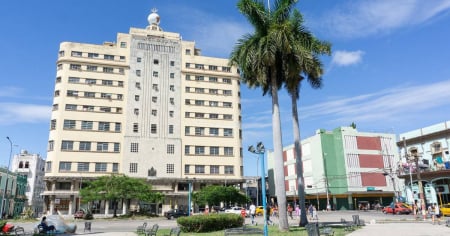
With one hand on their hearts and the other on history, a group of Cuban Freemasons gathered in front of the San Diego Lodge to reaffirm institutional sovereignty and denounce the silence of the Ministry of Justice in the face of a crisis that shakes the foundations of one of the oldest fraternal organizations in the country.
"The building is not us," said one of the brothers firmly, in statements collected by Cubanet, while urging his companions to enter the headquarters and they sang the national anthem.
This action is preceded by the events of May 25, when hundreds of Freemasons from across the country gathered in Havana to demand an extraordinary session of the High Masonic Chamber.
With a valid quorum of 117 representatives and 121 members of the Grand Lodge, they succeeded in ousting Mayker Filema Duarte, who had arbitrarily suspended the internal elections scheduled for March, in an attempt, according to the complainants, to remain in office indefinitely.
The vote was clear: Filema had to go, and in her place, Deputy Grand Master Juan Alberto Kessell Linares was appointed through regulatory means.
However, the government's response was not one of support for internal legality, but rather of reprisal and delegitimization. The Ministry of Justice, instead of mediating impartially, backed the expelled Filema and later, in an even more drastic action, imposed Lázaro Cuesta Valdés as Commander of the Supreme Council, replacing José Ramón Viñas, a critical figure of the regime.
This decision was accompanied by a direct threat: if the Masons did not accept the new leader appointed by the Government, their bank accounts would be frozen and they would lose their legal status as an association.
“We tried through all legal means, even unconventional ones, to assert our will... but the Ministry of Justice preferred to endorse the disrespect”, one of the brothers reported in statements to Cubanet.
Despite the legitimacy of the act, Filema and her officials ordered the closure of all the Lodge's venues, which forced the Freemasons to hold their sessions in the street, in front of the statue of Carlos Manuel de Céspedes, under heavy police surveillance.
Since then, the members of the order have attempted to re-enter the Masonic lodges, without success. During a demonstration in June, several brothers were detained and warned by the authorities, including Kessell Linares himself.
"Today we are going to make an entrance and we will see what happens," said one of the spokespeople, as those present sang the national anthem in a civic reaffirmation event.
The Directorate of Associations of MINJUS, led by Miriam García, has faced significant criticism for initially supporting Filema, despite the legal evidence presented by the masons. Recently, Deputy Minister Lilia María Hernández welcomed a delegation from the order, proposing a new Masonic session under the leadership of the already dismissed leader.
The response was clear: absolute rejection of any state imposition.
“The Grand Lodge of Cuba is sovereign and is governed by its Constitution,” asserted Kessell Linares. “If the government wants to dominate us, we will not allow it.”
Cuban Freemasonry, hit in 2024 by a corruption scandal involving its former Grand Master Mario Urquía Carreño, is currently experiencing its second major crisis. But this time, the response has been different: unity, mobilization, and defense of its founding principles.
“We are the rightful guardians of this institution. Above all, we are committed to our oaths”, declared another brother. And although they have not yet regained their temples, they have made it clear that Freemasonry lives on in those who practice it with dignity, not in the walls that attempt to block its way.
Frequently Asked Questions about the Crisis of the Grand Lodge of Cuba
Why are Cuban Freemasons seeking to recover their Grand Lodge?
Cuban Freemasons seek to reclaim their Grand Lodge due to the unjust dismissal of their legitimate leader and state interference in their internal affairs. The crisis began when Mayker Filema Duarte attempted to illegitimately extend his term as Grand Master, leading to his dismissal by the Masonic High Chamber. However, the Ministry of Justice supported Filema, creating tension and conflict between the Masonic community and the Cuban government.
What role has the Ministry of Justice played in the Masonic crisis in Cuba?
The Ministry of Justice has played a controversial role by supporting the dismissed Mayker Filema Duarte, instead of respecting the internal decision of the Freemasons. The Directorate of Associations of MINJUS, headed by Miriam García, has been criticized for backing Filema and not mediating impartially. This intervention has been seen as a violation of the autonomy of the Grand Lodge of Cuba.
How has the Masonic community reacted to the imposition of a new leader by the government?
The Masonic community has firmly rejected the imposition of a new leader by the Cuban government. The Masons have upheld their stance in defense of the sovereignty and autonomy of the Grand Lodge, expressing their disagreement with any external intervention that violates their foundational principles. The mobilizations and demonstrations are a clear reflection of their determination to regain legitimate control of their institution.
What consequences does the Grand Lodge of Cuba face if it does not accept the leader imposed by the government?
If the Grand Lodge of Cuba does not accept the leader imposed by the government, it could face the freezing of its bank accounts and the loss of its legal status as an association. This threat adds to the reprisals already suffered, such as the closure of Masonic venues and police surveillance during their meetings, which has intensified the conflict between the Masonic community and the State.
Filed under: