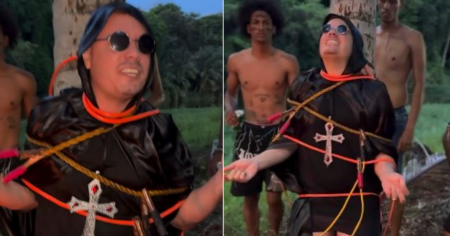
The eccentricities of Sandro Castro, the grandson of Cuban dictator Fidel Castro, have transcended the island's borders and gained international attention amid the severe crisis facing the Caribbean nation.
Media outlets such as the German Deutsche Welle in Spanish and El País from Spain have focused their attention on the 33-year-old young man, who has become one of the most visible symbols of the decadence of Castroism, by openly displaying a life of luxury amidst the worst economic and social crisis the island has faced in decades.
"Sandro is famous for showcasing a life of privilege on social media, while Cuba endures its worst crisis in decades," noted journalist Amir Valle.
It is also questioned "why the defenders of the revolution do not make the revolution condemn Sandro Castro, who is betraying the memory of his grandfather," he asserts.
For many observers, their presence on Instagram, where they have amassed over 115,000 followers, not only unsettles the public but also reveals the deep inequalities imposed by the power elite in Cuba.
The journalist Carla Colomé, in El País, describes him as a figure who breaks the revolutionary myth from within. According to the historian Sergio López Rivero, Sandro “represents the synthesis of the failure of the socialist project: he is the ailing caricature of the Revolution, a product of its most protected elite.”
What most worries the regime's spokespersons is not just Sandro's lifestyle, but his influence and reach on social media.
Although he defines himself as an "entrepreneur" and a "young revolutionary," his statements and posts have come close to veiled criticism of the system, such as when he asked Donald Trump for more opportunities for immigrants or when he made ironic remarks about internet prices and the lack of chicken.
Sandro has provoked mixed reactions: some see him as a privileged buffoon, while others view him as the most sincere representation of the exhaustion of the official narrative.
He is the son of Alexis Castro Soto del Valle—one of Fidel's sons with Dalia Soto del Valle—and Rebeca Arteaga; his childhood was spent in the vicinity of Punto Cero, the Castro family's complex in Havana.
According to testimonies from people close to the family, such as Idalmis Menéndez, ex-partner of Álex Castro, the young man grew up surrounded by luxuries, oblivious to the hardships faced by millions of Cubans.
Frequently Asked Questions about Sandro Castro and Inequality in Cuba
Who is Sandro Castro and why is he controversial in Cuba?
Sandro Castro is the grandson of the late Cuban dictator Fidel Castro and has sparked controversy by showcasing a life of luxury on social media, contrasting with the severe economic crisis faced by Cuba. His posts on Instagram, which include plane rides and extravagant displays of goods like Cristal beer, have been seen as a symbol of the inequality and privileges of the Cuban ruling elite.
How has the Cuban people reacted to Sandro Castro's actions?
Sandro Castro's actions have provoked outrage and rejection among Cubans, who see him as a symbol of the elite's disconnection from the people's reality. His posts are interpreted as provocations and mockery of the daily struggles faced by Cuban citizens, thus generating a strong social polarization around his figure.
What impact do Sandro Castro's social media posts have?
Sandro Castro's posts on social media have gained international attention, highlighting the inequality and failure of the Cuban socialist project. His behavior is not only controversial due to his ostentation, but it has also included veiled criticisms of the system, leading to a mix of fascination and rejection both within and outside of Cuba.
What does Sandro Castro symbolize in the context of the Cuban regime?
Sandro Castro is seen by many as a representation of the failure of the Cuban socialist regime. His figure highlights the contradiction between the official discourse of equality and the reality of privileges enjoyed by the elite. For some, he is a caricature of the Revolution, while for others, he is a reflection of the regime's disconnection from the Cuban people.
Filed under: