
Related videos:
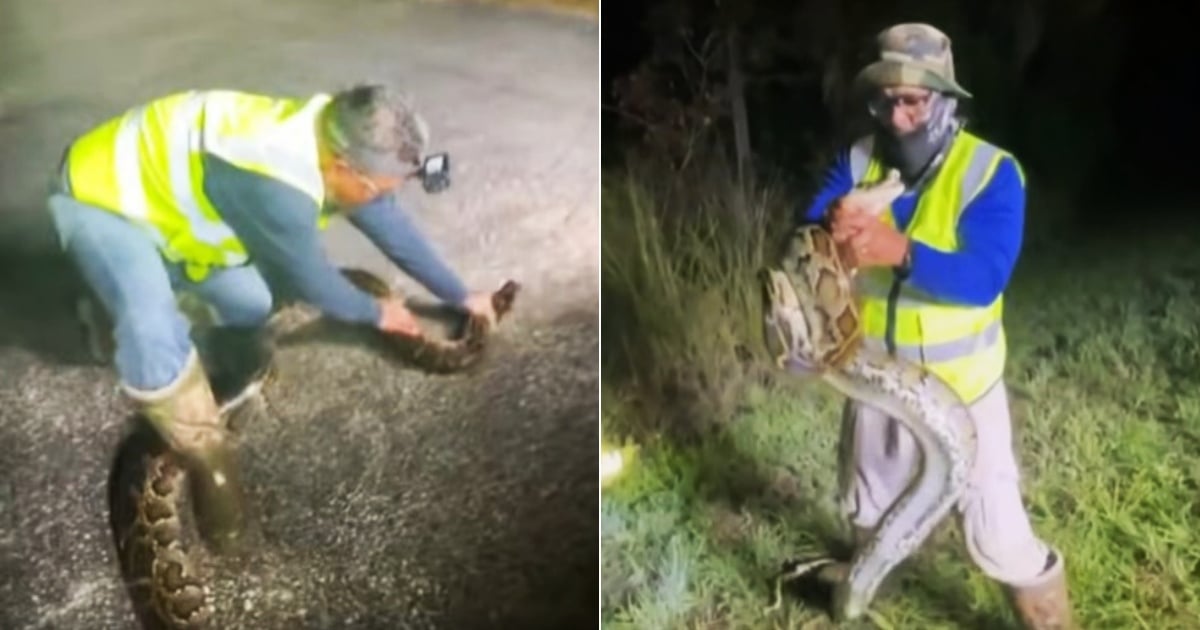
A couple has turned python hunting into a risky but lucrative activity. Bayo Hernández and his wife actively participate in the removal of this invasive species that threatens the delicate ecological balance of the Everglades.
Both venture into the depth of the wetland at night, when the pythons are more active, to catch them by hand.
The work is not easy, as they face reptiles that can exceed five meters in length and, although they are not venomous, they can exert deadly pressure with their bodies on their prey.
“There are no natural predators for these snakes here. If we don't stop them, they will continue to reproduce uncontrollably,” Bayo explained in recent statements to the Univision network, which accompanied him on one of his adventure days as a python hunter.
Bayo and his wife participate in a state competition that rewards those who capture the largest number of specimens of this invasive species.
The grand prize reaches $10,000, which serves as an extra motivation for those, like Bayo and his partner, who dedicate themselves to this dangerous work in defense of the ecosystem.
Burmese pythons, native to Southeast Asia, arrived in Florida as exotic pets.
Many were released by their owners or escaped during hurricanes like Andrew in 1992. Nowadays, they reproduce unchecked and have caused a drastic decline in the population of native mammals, such as raccoons, opossums, and rabbits.
The Florida Fish and Wildlife Conservation Commission (FWC) promotes the Python Challenge each year, an event aimed at engaging the community in the eradication of this environmental threat.
Certified hunters, like Bayo and his wife, are key players in this collective effort that combines ecological awareness with the potential for an attractive financial reward.
On July 11th, the Florida Python Challenge 2025 officially began.
The event, which ran until this Sunday, offered a prize pool of $25,000 and aimed to encourage, once again, the eradication of this invasive species that threatens the native wildlife of South Florida.
In addition to $10,000 to the participant who captures the most pythons, the competition also awards $1,000 to the person who catches the longest snake.
All participants receive an official t-shirt, and many take part both for the prize and the goal of contributing to environmental conservation.
Since the year 2000, the authorities have removed approximately 23,500 specimens in the state, according to the Florida Fish and Wildlife Conservation Commission.
Most of these snakes are concentrated in Everglades National Park, located in Miami-Dade County, but their expansion now reaches from the south of Lake Okeechobee to Key Largo, and from the western part of Broward County to Collier County.
There have also been reports of sightings in Naples and areas near Lake Okeechobee.
In July 2023, a 22-year-old captured a 19-foot-long, 125-pound female python in the Big Cypress National Preserve, the largest ever recorded in the state.
Strict rules to protect native species
The competition is governed by a set of rules designed to prevent harm to the ecosystem:
- The use of firearms is prohibited, as well as the use of dogs or other animals to assist in hunting.
Participants will also be disqualified if they kill native snakes or destroy eggs of indigenous species.
Only professional hunters are allowed to transport live pythons. Novices are required to humanely euthanize them at the same location of capture.
The correct identification of species is crucial, as some Burmese pythons can be mistaken for protected native snakes.
Beyond the competition, the organizers emphasize the educational value of the event, as it allows participants and the audience to learn about the importance of preserving ecological balance
A threat to one of the richest ecosystems on the planet
The Everglades cover nearly four million acres and are home to more than 360 species of birds, 300 species of fish, 50 species of reptiles, and 40 species of mammals, among many other forms of life.
Among its most emblematic species are the manatee, the Florida panther, the American crocodile, the Cape Sable seaside sparrow, and the Key Largo mouse.
Burmese pythons, by feeding on native animals and occupying their ecological niche, have contributed to the local decline of several species.
FWC studies have detected severe impacts on native mammals and warn that these snakes also prey on threatened or endangered species.
Frequently Asked Questions about Python Hunting in the Florida Everglades
Why is python hunting important in the Everglades?
The hunting of pythons is crucial for protecting the Everglades ecosystem, as these invasive snakes have caused a significant decline in native wildlife. Burmese pythons feed on local mammals, birds, and reptiles, including threatened species, and they have no natural predators in the region, allowing for unchecked reproduction.
What is the Florida Python Challenge?
The Florida Python Challenge is an annual event designed to reduce the population of Burmese pythons in the Everglades. It offers prizes to those who capture the most snakes and the longest one, encouraging public participation in the fight against this invasive species. Additionally, it aims to educate about the importance of maintaining the ecological balance of the region.
What are the rewards for hunting pythons in Florida?
The Florida Python Challenge offers a prize of $10,000 to the participant who captures the most pythons and $1,000 to the one who catches the longest snake. These incentives aim to encourage more people to join the environmental conservation effort.
What rules must participants of the Python Challenge follow?
Participants in the Python Challenge must adhere to strict rules to protect the ecosystem: the use of firearms and animals for hunting is prohibited, and only professional hunters may transport live pythons. Additionally, they must avoid harming native species or destroying the eggs of indigenous species.
How did the Burmese pythons end up in the Everglades?
Burmese pythons arrived in the Everglades mainly through intentional releases or accidental escapes of exotic pets. These reptiles, native to Southeast Asia, found a favorable environment for uncontrolled reproduction due to the absence of natural predators in the region.
Filed under: