
Related videos:
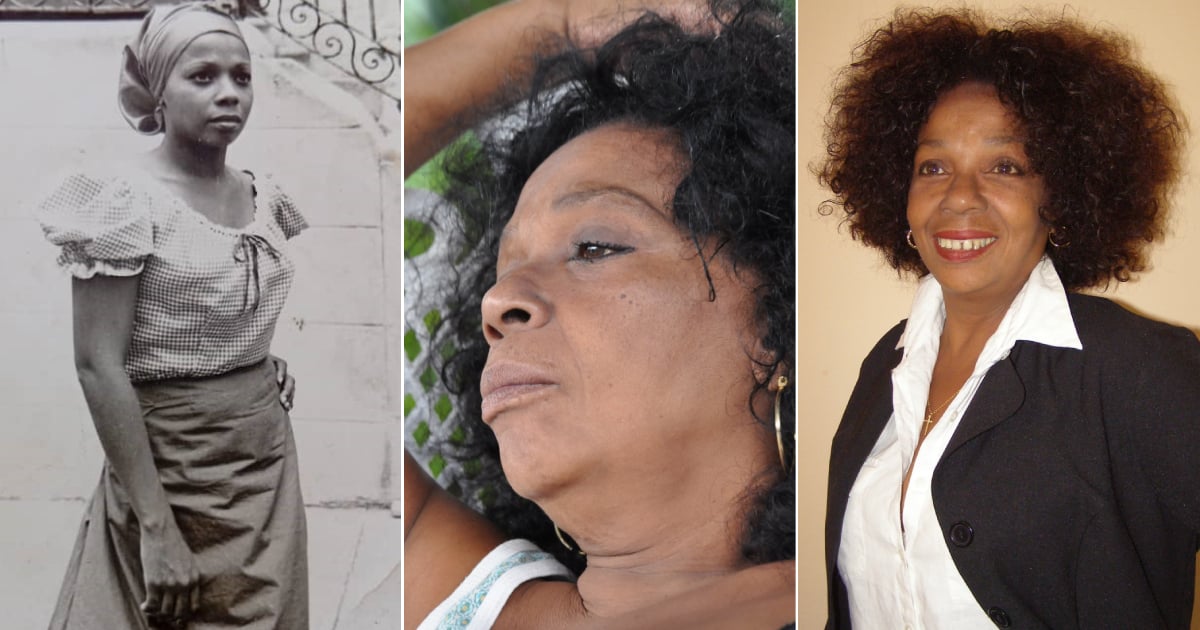
In a long list of top actresses who have made their mark on diverse stages such as theater, film, radio, and television, one of those legends is our guest today. It is a privilege for CiberCuba to speak with the distinguished Natasha Díaz.
The profession of acting requires immense dedication. When did you decide to become one?
Acting has become, over the years, my life; so much so that when I spend time without working, I feel it. I believe that all actors have that instinct to observe and listen, because every person who walks by can be a character that offers the possibility of different inflections or traits.
What I loved was singing, but when I discovered acting, I told myself, “stick to your trade”—acting is my passion... and I love it so much! I study the psychology of each character deeply, and when it comes time to perform, you realize that person is already in your skin, and you don't just represent “a”... you actually become “in”. I do a lot of research; I don’t settle for what’s written in the script, and I keep creating. I believe that talent exists, but it needs to be nurtured!
What can you tell me about Natasha, Natividad Anisia Díaz Chirino?
I got married at 19, in 1968. Back then, it was a good age to get married; my oldest daughter was born a year later. My great-aunt and my grandmother took care of the baby while I started at the acting school of the ICRT. It was a time of exodus for actors, which is why that school was created.
I was introduced thanks to Antonia Valdés, a wonderful artist and friend of my paternal grandmother. I was in a theater group directed by the actors Alden Knight and Eric Romay. When I presented myself at school, the great Roberto Garriga told me, "You are ready to star," based on the results I achieved in the entrance exams.
That's when the divorce happened, as my partner didn't like the work I did at the theater at night in the now-defunct Tespis hall. Life went on: I was struggling with a young child and trying to improve my situation, as my home was a tiny room in San Lázaro between Gervasio and Escobar. I swapped places several times until I finally got this one, where I currently live, in Vedado... It may sound easy, but I went through a lot!
Later, I remarried in 1980, and in 1983 I had my youngest daughter while continuing to work and study. I grew more and created many educational spaces with young characters, but in the latest television production of Cecilia Valdés, I played the role of María de Regla's daughter, who was taken to breastfeed Cecilia, and it was a character that had seven lines. The director was Raúl Pérez Sánchez.
When he was going to make The Girl with the Golden Arrow, he argued with me because they were suggesting another actress, but he wanted me (at that time I was at Radio Progreso doing lead roles).
I was having a little beer at the restaurant Moscú (also long gone) when Jorge Villazón, an unforgettable human being and actor, said to me: “Hey, hurry up, they're looking for you,” and from that moment I didn't stop because then came El viejo espigón and other projects, as I did everything.
My first television role was that of a prostitute in A Streetcar Named Desire, a play directed by Roberto Garriga, who, despite his reputation for having a bad temper, cared for me deeply. I went through a lot of hardship, but I didn't feel it at the time because I was fighting for what I wanted.
No one gave me anything, and that’s why I have a supreme dignity, because everything I have achieved has come from my hard work, God's help, and my efforts, without wishing to be ungrateful, for example, towards Raúl Pérez Sánchez.
I have my family: my two daughters, who are now grown women; three grandchildren, one born in Spain who is 24 years old, another who is 10, and the little one who is three, as well as my sons-in-law who love me very much. My family life compensates for the struggles of my work.
Working with emotions makes you very sensitive. In this regard, has your life been easy or difficult?
I have an extreme sensitivity; so much so that I hurt myself. I feel pain for what happens to someone I don't even know, and this helps me when I work. That's why I don't overlook any character; I delve deeply into each role.
We were talking about a small role in a recent episode of Tras la Huella, and I really like it because each chapter features a very different character, and I study them as if they were the main role, adding that sensitivity you ask about.
Has being Black influenced you not to take on a specific lead role that you would have liked?
Well, "supposedly" in 1959 racism in Cuba ended… but racists remained, and many of them! They are like a plague. They are aesthetic standards. The world moves forward, there's already the internet, but racism is still there, especially among those who claim to be "revolutionaries"!
These are things I observe and keep to myself. When the script says: "We need a black person," then they call me. Look, the only one who changed a character was Raúl Pérez Sánchez, and it was in El viejo espigón.
The role of Asenneh Rodríguez was Verónica Lynn, and he gave Asenneh that role, while I received the character of this one. The great Verónica took on another role within the novel. That's why I keep mentioning it. So, if the script doesn't specify that a Black character is needed, you won't be called.
I’ve done quite a bit, but that’s a pain I have… no resentment, no hate! Now that I’m 75, I say: “Well, let’s see if they call me to at least take on a small role, because if they didn’t call me before, now that I’m old and I’ve become grandma number 1, grandma number 2, they’ll call me even less, because racism is something that will never end.”
Only intelligent people overlook that. What they do is harm the programming of television because the product offered to the public is supposed to improve over time; however, it is diminishing. I suffer with every soap opera when there is a character who seems utterly out of place; I watch Cuban television because I am here and I am interested in what happens in my country; I am interested in television because, furthermore, it is my job.
So we agree that there is racism?
A while ago, they called me for the third time to play Camila. They called me for that theater to play the santiaguera or the jabá, and then to play the grandmother, and I told them NO! Because Camila... !!! Camila is me!!!
Let's see...! It didn't hurt me either, but I would have liked it. And as I told you, Julita, racism doesn't go away. I don't talk about it because I'm transparent, but if you ask me, I'll answer you: Yes, there is racism!
The Cuban audience considers you (myself included) a great talent on stage, in television, and in film... Why don’t we see Natasha Díaz as much as we would like?
I have done film and theater. It was a blessing that Héctor Quintero called me to perform in Sábado corto: it was an explosion of emotions because I remember that theater packed and everyone applauding every day. Then I was directed by Nelson Dorr, another wonderful experience. After that, television came along. So many moments, so many anecdotes!
But right now we don't see you as we would like to…
Oh, Julita! I turned down two novels because the producers pay very little, as they have no money, and they pick you up at 5 a.m. to record from Monday to Saturday; not to mention studying the script... Well, you know how it is. In any case! Let's see if they call me again because I've already said no twice, and it seems you're expected to say yes.
But I would like to thank Magda González, who called me for the second season of the hit series Calendario; everyone was very kind. Then, in the third season, they increased my salary, and I really felt great in that group.
Which of the means gave you the most satisfaction?
All the media has given me satisfaction. In cinema, for example, since I made Polvo rojo to Las noches de Constantinopla, which has never been shown again in Cuba. I was fortunate, privileged to work with Don Paco Rabal, and I also did very well in Plaff… hahaha. With the shortage of eggs (we have that now too hahaha!!!), seeing how the eggs broke hahaha…; in addition to working with my friend Daisy Granados… It was wonderful!
With so much love, I cherish in my heart The Young Woman with the Golden Arrow, a remarkable decade filled with fond memories: those Papaloteros… How satisfying it is that the 20-year-old young men greet me warmly! I wonder, “How do they know me when I haven’t worked in a long time?” Ah, they remember me, “Mercedes,” Pedrito’s mom, one of the papaloteros, what do you think?
As for which medium gave me the greatest satisfaction, well, all of them! Radio allowed me the pleasure of working with Caridad Martínez, who recently passed away. In the novel segment, I voiced young boys; it was a humble family, and I played the role of “Mangaso,” who was up to 16 years old. I asked her, “Cary, who are you going to choose to play the adult version of the character?” and she replied, “You.”
It is a pleasure for me to bring entertainment to people's homes.
If you had to take a snapshot of your career, what and who would have to be included? Good moments, difficult moments in your life...?
One of my virtues is gratitude. I thank Raúl Pérez Sánchez, Caridad Martínez… and every director who has counted on me, just as I regret that others have not done so.
I am very grateful for the National TV Award I received in 2023.
Right now, with everything that's happening in my homeland, I'm immersed in a little second-hand clothing business... a garage sale! I'm fabulous, and I feel like I'm in a moment to give it my all like a champion!!!
On the other hand, many friends who always called me "Negra" have passed away, and I loved that my friends referred to me that way. Well, more men than women. Of course, because of "the drinks," which I haven't had for many years now. You know I'm an alcoholic. I stopped drinking in 2003 until 2016, when I had a relapse.
That's part of the situation; the doctors warned me and told me that I'd never be able to be a social drinker. But after some years, you start to believe you can handle it. Indeed, I was in Spain with my daughter and said, “Give me a small beer with alcohol,” and I felt great. Ah! But when I got back to Cuba, I thought I could have some rum, and then I had a fall that left me with a gash on my forehead. I almost killed myself, and that was the last time!
I panicked and never again. Then I said, “When I turn 80, I’m going to have a cider,” but I’ve already decided against it, no way! What if the same thing happens and I die on my 80th birthday? No, absolutely not! I’ll stick with my non-alcoholic “San Miguel” and enjoy myself. I don’t miss it; I don’t need to drink. And on November 27th, I told my daughter: “I’m not smoking another cigarette since they’re too expensive,” and I’ve quit smoking as well.
What is the leading actress Natasha Díaz up to nowadays, and what would you like to be doing at this stage of your life? Do you consider being older to be a disadvantage?
I love acting, whether it's serious or comedic. I always put a bit of myself into it to make people shift in their seats, and I continue because I find so much joy in making others happy, truly so much…
I'm not suffering from not working in acting because selling clothes is also an art, hahaha..
I have spent time in Spain, but I absolutely adore Cuba. I have residency in Spain, but I can't live there, and even though I've been treated wonderfully, I feel good there, but... I am from here! I miss Cuba, the people who say wonderful things to me on the streets. In Cuba, I have always felt free, because I do what I want and say what I want.
As I get older, I cherish acting more, and I reiterate, I don't suffer because I'm not being called. Besides my garage sale, I beautify my home; I love to paint. Above all, I enjoy my grandchildren... Ah! But you know what? I believe there's still something I need to do, that character in my life, because acting is so vast in what can be achieved. One must study a lot... It's sublime!
As for the current situation we are experiencing, I am very sorry and I believe it is a problem for Cubans to solve. Look, for example, I - and perhaps it's wrong to say this - help many people. I am happy to do it and many times I tell myself, “Oh my God, if only I earned good money, how I would help people, both those I know and those I don’t.”
And in fact, I do it because when I hear that X needs a medicine and I have it, I call her and give it to her. Look, I don’t know how we’re going to get out of this, but we have to move forward, and I’m not speaking for myself but for those who are really suffering, including the children.
The love for my daughters and my grandchildren is unparalleled because it is enormous, and I have no words to express it. Often, I think of those mothers who have their children far away or in sad circumstances… How they must be suffering! Having a child in adverse situations is very hard.
It is a joy and an honor, and I thank God every day for allowing me to have my daughters and for their well-being. I know I am old, but I feel very good; I have always been strong and healthy.
And if they don't create opportunities for adult women... they're the ones missing out! Look how interesting life can be for anyone my age. In Brazilian novels, the beautiful grandmothers, well-dressed, eager to live, facing situations just like everyone else.
It's not the role of the grandmother with the little grandchild, and the grandmother is at the end... No, no, no...! They write good roles for elderly people, we're still alive, damn it!
I appreciate your admiration, your respect for actors and actresses, your respect for your profession, because you have dedicated yourself to being a good journalist, one of the brilliant ones, you are one of the tough ones, truly tough. We must take our hats off to you, but... for being a good person!
It is the first interview in my life where I allow myself to accept a compliment, and I wholeheartedly reciprocate every word written about this amazing artist known as Natasha Díaz, "the one with the spikes on her cap."
Filed under: