
Related videos:
Cuban television wanted to present its audience with a heroic postcard on the eve of the 99th anniversary of the dictator Fidel Castro. To achieve this, it interviewed the sculptor of the monolith that supposedly houses the ashes of “the mummy”, who, with an emotional voice, declared that “I see the commander every day.”
The script from the official media envisioned a moment of patriotic mysticism in front of the 24-ton rock. However, on Facebook, users of CiberCuba wrote their own version of the story… and it was not exactly a revolutionary tribute, but rather an outpouring of curses against the creator of a totalitarian communist regime that has led the entire island to material and spiritual ruin.
“In the blackouts, the hunger, the misery, and the horror it has left us”, one of the first comments was expressed, as if completing the sculptor's phrase. There was no reverent silence, but rather a festival of responses that turned the “eternal rock” into a mirror of daily ruin.
For some, the connection is direct and unembellished: “Of course he sees it, in the hunger, the misery, and the pain he has left us”. Others allowed a touch of dark humor: “The blackouts have him feeling unwell” or “Me too, if there are blackouts”, making it clear that darkness in Cuba is the most common form of “contact” with the leader.
Hunger, of course, took a prominent place on this altar of sufferings. "If you see him, tell him the people are dying of hunger", wrote one, while another summarized: "We all see it reflected in misery and hunger". The "Fidel's cure," in the end, can be summed up in two words: deprivation and scarcity.
Some comments expanded the picture: “In every centimeter of Cuba… in every hungry child, in the filthy hospitals… and if I keep telling you, I'll cry”. And there were also more explicit instructions for the sculptor, who has now become a messenger of discontent: “Leave him a message, tell him we are fed up with his M… Come on, you who see him often”.
There were even those who did not miss the opportunity to name names and assign blame, reminding about Castro Ruz's mother: "When you see him, tell him he's an SOB and that he led to the total destruction of such a prosperous country."
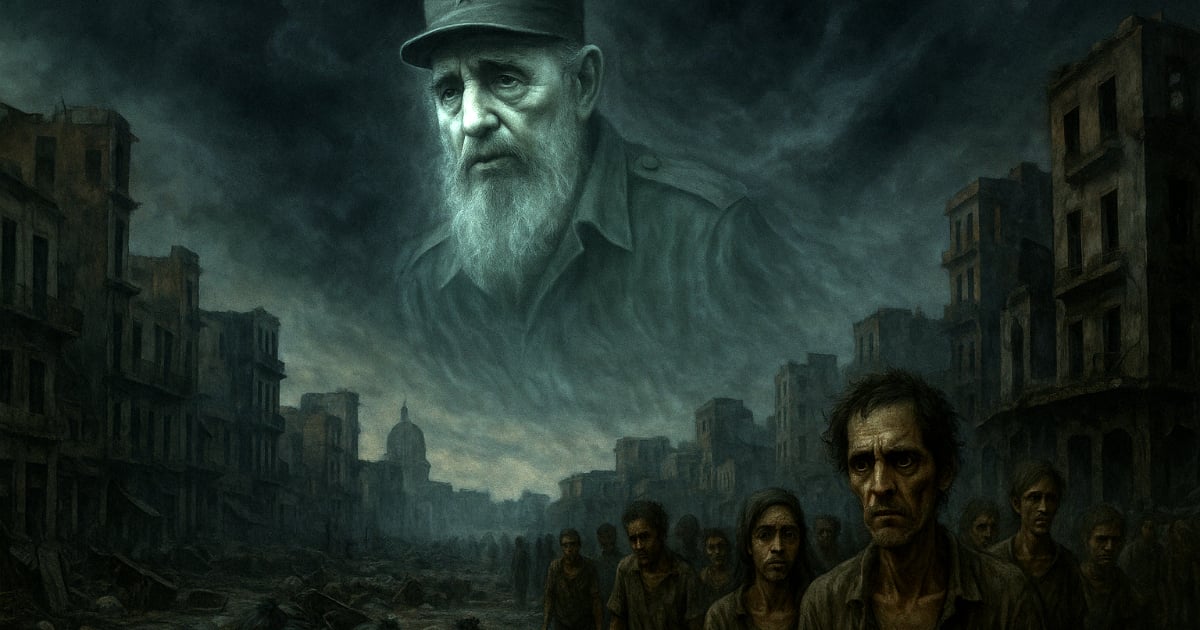
In just a few hours, over 2,300 comments buried under tons of irony the mystique that the official press sought to project. For the people, Fidel is not in the green marble or in the granite extracted from the Sierra Maestra. He is in the empty stomach, in the turned-off fan, in the pharmacy without medicine, in the street full of trash.
The regime is struggling to embed the idea of an “eternal” monument into the collective imagination. For Cubans, it is a “ashtray,” a “cambolo,” a “chunk of rock,” a “mound,” or a “coprolite.” And tomorrow, a significant majority wants to see it sink into Bartlett’s Pit.
On social media, it has already become a meme. There, the "appearances" of the commander don't require a uniform or a speech: just a blackout, an old man rummaging through trash "disguised as a beggar," a long line waiting for hours, a mother crying for her political prisoner son, or an empty plate to feel his "presence."
As one of the most striking comments summarized: "The people also see it in hunger, the garbage dumps, the blackouts, and all the human misery that beast left behind." And for that, there is no need to pilgrimage to Santa Ifigenia; it is enough to open the door of the house... or the refrigerator.
Filed under: