
Related videos:
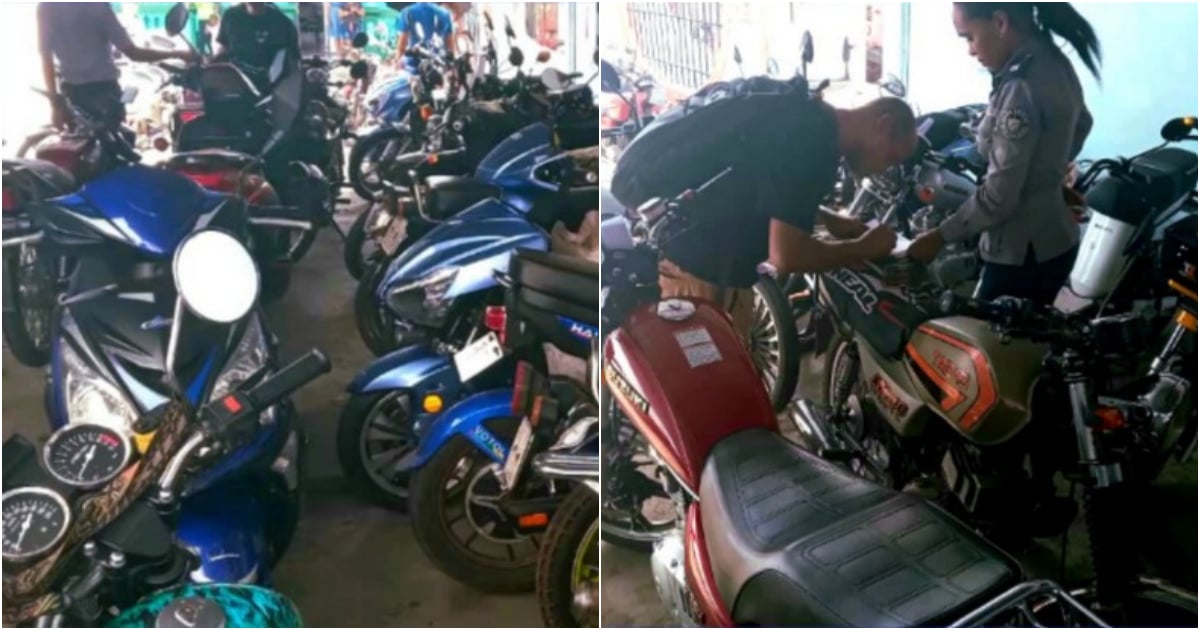
At least twenty motorcycles and scooters were seized in the Guantanamo municipality of Baracoa during an operation by the Ministry of the Interior (Minint) targeting unlicensed drivers, while some are facing criminal charges and others fines and warnings.
According to the information published on the official profile of Facebook "Guantánamo and its truth," the vehicles remain impounded at the Municipal Transport Directorate, where their owners will have to pay 1,000 pesos for each day of detention in order to recover them.
According to the source, one of the owners specified that two drivers were charged "with the offense of disobedience," due to being repeat offenders for not carrying their driver's license, while the others received fines and warnings.
The operation generated critical reactions on social media, where several users questioned the lack of preventive measures and the overtly repressive nature of the sanctions.
"If it were easier to get licenses in Baracoa, there wouldn't be so many people driving without documents," commented Carlos Ramírez.
Rafael García Benítez stated, "It is really necessary for them to obtain a license, but first a preventive effort should have been made. It’s a shame that everything is repressive."
Others pointed out inconsistencies in the requirements for electric bicycle riders and compared the strictness of the Cuban authorities with more flexible practices in other countries.
"Here where I am in hostile and cruel capitalism, if the vehicle has all the paperwork in order, it's a fine for the driver and that’s it," wrote Luis Miguel Rodríguez.
There were also voices expressing distrust regarding the fate of the money raised from the sanctions. “Money that will end up in someone’s pockets,” commented the user Tikito Tikito Cintra, reflecting the discontent caused by high costs and the lack of transparency in operations of this kind.
When assessing the causes of traffic incidents in the country during 2024, the Cuban government pointed to drivers as the primary responsible parties for traffic accidents on the island.
Furthermore, the number of accidents involving cycles and pedicabs has increased, along with the fatalities and injuries resulting from these incidents.
According to a report from the Specialized Traffic Body of the General Directorate of the Revolutionary National Police (PNR) released in January, motorcycles and mopeds were involved in 3% more incidents compared to 2023 and “in relation to the total number of accidents.”
Colonel Raúl Cano López, deputy chief of the specialized organ in criminal investigation and common offenses of Minint, deemed “the traffic indiscipline concerning along with the increase of electric motorcycles and mopeds in vehicle circulation, a condition that heightens the danger.”
He admitted that “a significant number of electric motorcycle riders can be identified without the appropriate driver's license, including those under the age of 16” and warned that “alterations are being made to the electrical systems to achieve higher speeds,” in addition to the use of unapproved helmets.
Many Cubans are frequently fined for riding electric scooters, also known as motorinas, without carrying a license.
In June 2020, nearly three months after the first cases of coronavirus were detected on the island, Cuban urban music singer Jorge Junior was detained in a part of Havana for riding one of those vehicles without the necessary documentation.
In the context of the covid-19 pandemic, in May 2021, electric motorcycle drivers in Cuba requested the Government to allow them to drive without a license.
However, in November 2022, the Provincial Transport Directorate in Sancti Spíritus announced the mandatory driving license for all types of motorbikes, a measure aimed at ensuring road safety and protecting the lives of drivers and pedestrians.
This regulation, which is already in effect and supported by Law 109 (Traffic and Road Safety Code), aims for the reorganization of electric cycle driving, a mode of transport that is increasingly involved in traffic accidents in the province, as noted in a article from the official newspaper Escambray.
In January, the Minister of Transport Eduardo Rodríguez Dávila reminded that it is prohibited to legalize motorcycles assembled with parts purchased from small and medium-sized enterprises.
In a post on his Facebook wall to address questions about motorcycle sales, the leader explained that if someone buys the parts of a motorcycle from a mipyme, builds the frame, and assembles a motorcycle, they will not be able to legalize it afterwards.
Frequently Asked Questions about the Operation in Baracoa against Unlicensed Drivers
How many motorcycles were seized in the operation in Baracoa?
During the operation in Baracoa, at least twenty motorcycles and mopeds were seized because their drivers did not have the required license.
What are the penalties for unlicensed drivers in Baracoa?
Drivers without a license face fines, warnings, and in some cases, criminal charges for disobedience if they are repeat offenders. Additionally, they must pay 1,000 pesos for each day their vehicles are impounded.
What criticisms have emerged on social media regarding the operation in Baracoa?
The operation has generated criticism on social media for its repressive nature and the lack of preventive measures. Users have questioned the difficulty of obtaining licenses and have compared the situation to more flexible practices in other countries.
Why does the Cuban government consider a license for electric motorcycles necessary?
The Cuban government believes that a driver's license is necessary to ensure road safety and to reduce the involvement of electric motorcycles in traffic accidents, which have increased in recent years.
Filed under: