Insecurity once again comes to light in Santiago de Cuba.
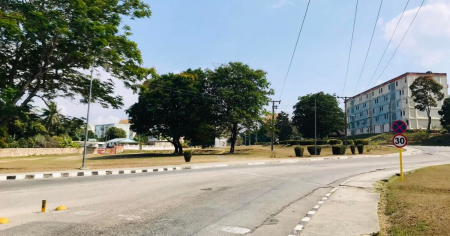
On Wednesday, residents of the Escario neighborhood, near the buildings known as 18 Plantas on Garzón Avenue, captured a phone snatcher in broad daylight, in yet another episode of community justice in response to the authorities' ineffectiveness.
The individual was identified as Alexander, a resident near the Conrado Benítez Oncology Hospital. His criminal record is well known among the people of Santiago.
"Some time ago, he was caught on Calle 4 after another outburst, and the next day he was back on the street," recalled independent journalist Yosmany Mayeta Labrada on Facebook, who reported that many neighbors suspect the individual acts with the complicity of the Police, which releases him time and again despite his repeated offenses.
Justice in the hands of the people
Videos shared on social media show a crowd surrounding the man, tying his hands behind his back and confronting him. "The phone, the phone!" a young man insists, while a woman shouts at him, "Get out of here!"
Among those present were men, young people, and even the elderly, reflecting the indignation of a community weary of living under the threat of increasingly daring criminals.
The comments from internet users left no doubt about their distrust of institutions.
"In two days they'll release him back onto the streets," wrote a user.
Another person pointed out: "That’s where the people have to hit him hard, because then they fine him and release him since those elements don’t speak poorly of the government."
A resident of Santiago added, "The police are sitting in their units slacking off while the criminals are taking advantage of the hardworking people."
Background of violence and impunity
Alexander's case is not isolated. In recent weeks, similar incidents have multiplied in Santiago de Cuba, where residents have had to take matters into their own hands due to the lack of police presence.
In the Santa Bárbara neighborhood, a thief armed with knives was subdued and tied to a post by residents after attempting to rob a house.
In another incident, a young man caught in a theft on Garzón Avenue was held by the shouting crowd until the arrival of the police.
In all cases, the common denominator is the same: the police arrive late, intervene only after the community has done the work, and those arrested are usually released shortly thereafter, reinforcing the perception of impunity.
A city under tension
The growing insecurity in Santiago de Cuba reflects the deterioration of public safety amid the economic crisis. For many residents, the streets have become a hostile environment where daylight robberies are becoming increasingly common.
Faced with police inaction, people choose to defend themselves collectively, even if that means resorting to violent methods or risking legal penalties.
Meanwhile, the population remains trapped between the fear of criminals and the lack of protection from a government that boasts of "defending the people," yet fails to guarantee the most basic right: the safety to walk the streets.
Frequently Asked Questions about Insecurity and Community Justice in Santiago de Cuba
Why are the citizens of Santiago de Cuba taking justice into their own hands?
The growing insecurity and the perception of inefficiency among the authorities have led citizens to take justice into their own hands. The lack of timely response from the Police and the quick release of captured criminals create distrust in the institutions. Residents are acting collectively to defend and protect themselves out of fear of becoming victims of crime.
What recent incidents reflect insecurity in Santiago de Cuba?
In Santiago de Cuba, multiple incidents of theft and snatching have been reported, where citizens have had to intervene directly. Recent examples include the capture of thieves by neighbors in areas such as the Escario neighborhood and Garzón Avenue. In some cases, the suspects have been tied up and beaten before the arrival of the police, reflecting the community's desperation and frustration.
How has the population responded to the lack of security in Santiago de Cuba?
The population has responded with actions of community justice, intervening in the detention of criminals when they have been caught in the act. The community has chosen self-defense methods, such as tying up suspects and waiting for the police to arrive. This phenomenon reflects a lack of trust in the authorities' ability to ensure public safety.
What do residents think about the actions of the police in Santiago de Cuba?
Residents express deep distrust towards the effectiveness of the Police in Santiago de Cuba. There are accusations that the Police do not act promptly and that criminals are quickly released after being apprehended. This perception of impunity has led the community to take matters into their own hands to protect themselves from crime.
Filed under: