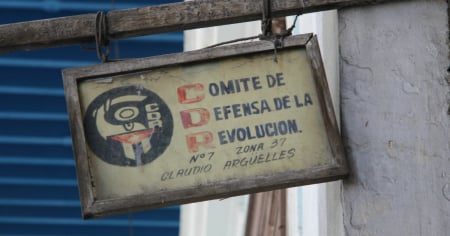
The former Cuban spy Gerardo Hernández Nordelo, national coordinator of the Committees for the Defense of the Revolution (CDR), shared a video on Facebook showing him at a CDR party in Ciego de Ávila, while Cuba is going through a crisis marked by power outages, food shortages, and growing social discontent.
The images show a casino wheel surrounded by people, in what appears to be an organized activity in anticipation of the 65th anniversary of the CDR, which will be celebrated on September 28th.
In an ironic tone, Hernández looks at the camera and states, "This is with artificial intelligence, there are no CDRs in Cuba. Haters, don't suffer, don't suffer."
The message, directed at those who question the relevance of the organization founded by Fidel Castro in 1960, has generated outrage on social media, where many users interpret it as a mockery of the difficult reality faced by most Cubans.
CDR between discredit and social control
The CDR were created as "the eyes and ears of the Revolution" and for decades operated as neighborhood surveillance apparatuses, promoting denunciation and political control in communities. However, today the organization is facing evident deterioration, seen in many places where the traditional "CDR watch shifts" are no longer held, and contributions are not collected, with its membership reduced to an aging and unmotivated base.
Aware of the discredit, the authorities are trying to reactivate the structure. At the beginning of September, Hernández launched a program of activities to "revitalize" the CDR, convinced that "we have to show Cubans that the CDR are useful, that we are in the neighborhood."
The plan includes the campaign "100 tasks for the centenary of Fidel Castro," as part of the official strategy to keep the figure of the deceased dictator alive.
From dance to neighborhood watch
The celebration illustrated by Gerardo contrasts with the other side of the CDR: its role as a tool of control in a context of growing social tension. In mid-September, at an event in Pinar del Río, the authorities called to transform each vigilance post into a “battalion of defense and combativeness” to confront the protests resulting from the energy crisis.
The official statement insists that "no one who considers themselves revolutionary can live in a neighborhood where the CDR does not function," but the reality in the neighborhoods presents a different picture, with power outages lasting more than 24 hours leading to cries of "Freedom," demonstrations with detainees and summary trials, and reports of extreme living conditions that are echoed throughout the country.
“Bread and circuses” in the midst of the blackout
The reactions to Gerardo Hernández's video came quickly. "In Carbonera, Matanzas, where Gerardo visited to celebrate the provincial event, they didn't leave a single bone to make stew, and they're in blackout all day"… what a way to pretend that everything is working when Cuba is falling apart," denounced Sisit Tejera.
Others were more direct: “Turn on the power,” they demanded, while sarcastically commenting on the official discourse: “Does anyone really believe that Facebook cares about the celebration of the CDR? Come on, be serious at least.”
The disbelief is reiterated in various comments. “That must be the only CDR in the country that is celebrating… people are worried about whether the water or electricity will come,” noted an internet user.
The popular sentiment reflects the disconnection between images of dance and celebration and the daily life of millions of Cubans who survive amid uncertainty, hunger, and darkness. While the leaders promote a spectacle for propaganda purposes, the people continue to await real solutions to a crisis that shows no signs of relief.
Frequently Asked Questions about the Committees for the Defense of the Revolution (CDR) in Cuba
What are the Committees for the Defense of the Revolution (CDR) in Cuba?
The Committees for the Defense of the Revolution (CDR) are a mass organization created in 1960 by Fidel Castro with the aim of defending the Cuban revolution at the neighborhood level. Historically, they have operated as a mechanism for neighborhood surveillance, promoting denunciation and social control, although they currently face significant structural deterioration and increasing discredit among the population.
Why does the figure of Gerardo Hernández Nordelo generate controversy?
Gerardo Hernández Nordelo, former spy and national coordinator of the CDR, has sparked controversy due to his posts on social media, which many interpret as a mockery of the difficult situation facing Cuba. His actions and messages, which stand in stark contrast to the economic and social crisis in the country, are viewed as an attempt to gloss over reality with government propaganda, leading to outrage both on the Island and abroad.
What is the current status of the CDR in Cuba?
Currently, the CDRs are facing obvious deterioration, with an aging and demotivated membership. The organization is experiencing a significant loss of credibility and no longer has the same impact on communities as it did in the past. Authorities are trying to revitalize the CDRs with new campaigns and activities, although the outcome is uncertain due to the growing social discontent and the economic crisis facing the country.
How has the Cuban population reacted to the actions of Gerardo Hernández and the CDR?
The actions and statements of Gerardo Hernández have been met with skepticism and criticism from the Cuban population. Many citizens see his posts as a mockery of everyday reality, characterized by blackouts, food shortages, and repression. This disconnection between official rhetoric and daily life has resulted in increasing social discontent.
Filed under: