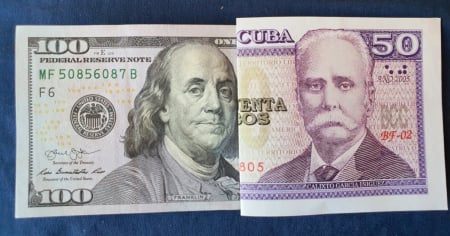
After the decline experienced this Tuesday in the price of the euro in Cuba, this Wednesday the European currency surprises by rising to 500 pesos, breaking a significant sales threshold that reinforces the collapse of the national currency.
This is an absolute record and a historic day in the Cuban informal market, as for the first time since elTOQUE began documenting the fluctuations of currencies on the island, no currency had reached such a selling value.
Sube also this October 1 the dollar, from 438 to 440, an increase of two pesos that adds to a sustained rise experienced by the U.S. currency in recent weeks.
In the case of the Freely Convertible Currency (MLC), whose decline and volatility have been its prominent feature in recent months, it has maintained the 210 CUP sale rate for several days now.
Exchange Rate Evolution
Exchange rate today 01/10/2025 - 7:20 a.m. in Cuba:
Exchange rate of the dollar USD to CUP according to elTOQUE: 440 CUP.
Exchange rate of the euro EUR to CUP according to elTOQUE: 500 CUP.
Exchange rate from MLC to CUP according to elTOQUE: 210 CUP.
A historic record in the informal market
In an analysis article published by elTOQUE in recent hours, the outlet emphasized that the figure reflects "the rapid depreciation of the national currency and the increasing dollarization of the economy," and that it marks an unprecedented milestone.
The value of 500 CUP per euro "lacks precedent in the recent history of the island."
Not even during the so-called Special Period of the 1990s, following the fall of the Soviet Union, were such high levels of depreciation of the Cuban peso against foreign currencies recorded, warned the aforementioned source.
Since elTOQUE started publishing the Representative Exchange Rate of the Informal Market (TRMI) in January 2021, such a high quotation for the euro had never been reached.
For the Observatory of Currency and Finance of Cuba (OMFi), this record reflects "the structural imbalances of the Cuban economy": decline in GDP, energy deficit, contraction of tourism, halt in productive investments, dollarization of domestic trade, and concentration of liquid reserves in military conglomerates.
This is compounded by the phenomenon of mass emigration, which further weakens the productive and fiscal fabric of the country.
In this context, many Cubans prefer the euro over the dollar in the informal market due to its greater stability for those with ties to Europe or who travel to the continent.
The Representative Rate of the Informal Market (TRMI) published by elTOQUE is based on an automated system that analyzes hundreds of currency buy-sell ads on social media and classifieds platforms.
An algorithm filters extreme data and calculates the median of the remaining values, thus providing an objective reference for actual transactions.
Although the Cuban government has attempted to discredit this methodology, elTOQUE notes that the TRMI "has the endorsement of independent economists and international academic publications, such as Applied Economics in the United Kingdom."
And what is the official response?
Since the end of 2024, the Cuban Government has announced its intention to introduce a floating exchange system in an attempt to close the gap between the official and informal value of currencies. However, "more than half a year later, it has not provided details on its implementation."
Independent economists warn that any attempt to regularize the exchange system should start with a reference rate close to the TRMI.
That is to say, the Government would have to officially acknowledge prices four times higher than the current 120 CUP per euro maintained by state banks and official exchange houses (CADECA).
The breach of the 500 CUP threshold per euro marks a critical moment for the Cuban economy. It reflects not only a lack of trust in the State's monetary institutions but also the unstoppable rise of the informal market as a true thermometer of the crisis.
As elTOQUE warns, "the disconnection between official figures and the reality of Cuban pockets has never been so profound."
Equivalence of United States Dollar (USD) bills to Cuban Peso (CUP), according to the exchange rates of this October 1st:
1 USD = 440 CUP.
5 USD = 2,200 CUP.
10 USD = 4,400 CUP.
20 USD = 8,800 CUP.
50 USD = 22,000 CUP.
100 USD = 44,000 CUP.
Equivalence of Euro (EUR) banknotes to Cuban Peso (CUP):
1 EUR = 500 CUP.
5 EUR = 2,500 CUP.
10 EUR = 5,000 CUP.
20 EUR = 10,000 CUP.
50 EUR = 25,000 CUP.
100 EUR = 50,000 CUP.
200 EUR = 100,000 CUP.
500 EUR = 250,000 CUP.
Frequently Asked Questions about the Economy and the Informal Currency Market in Cuba
Why has the euro reached a record value in the Cuban informal market?
The euro has reached a record value of 500 Cuban pesos (CUP) in the informal market due to several factors, including high demand for foreign currency in a context of rampant inflation and a lack of supply compared to the dollar. Moreover, the euro has become a safe haven for those receiving remittances from Europe or needing to conduct transactions related to that continent.
What is the current situation of the dollar in the Cuban informal market?
Currently, the dollar is valued at 440 CUP in the Cuban informal market. This increase reflects the ongoing depreciation of the Cuban peso and the growing dollarization of the economy on the island. The rise in the dollar directly impacts the population, which depends on foreign currency to access basic goods and services.
How does the depreciation of the Cuban peso affect the daily lives of Cubans?
The depreciation of the Cuban peso dramatically reduces the purchasing power of Cubans, as salaries and pensions in pesos are losing value rapidly. This affects the prices of products and services indexed to foreign currencies, such as technology, medicines, or airline tickets, making it harder for those who rely on income in CUP to maintain their standard of living.
What measures has the Cuban government announced to address the currency crisis?
The Cuban government announced its intention to introduce a floating exchange system to close the gap between the official and informal values of currencies. However, more than half a year later, no details have been provided regarding its implementation. Independent economists suggest that any attempt to regularize the exchange system should start from a reference rate close to that offered by the informal market.
Filed under: