
Related videos:
The supposed relief promised by the Cuban regime with the increase in pensions in September has evaporated within weeks.
The Cuban peso (CUP) has plummeted in the informal market since the measure took effect, nearly erasing the nominal increase approved by Resolution 14/2025 of the Ministry of Labor and Social Security.
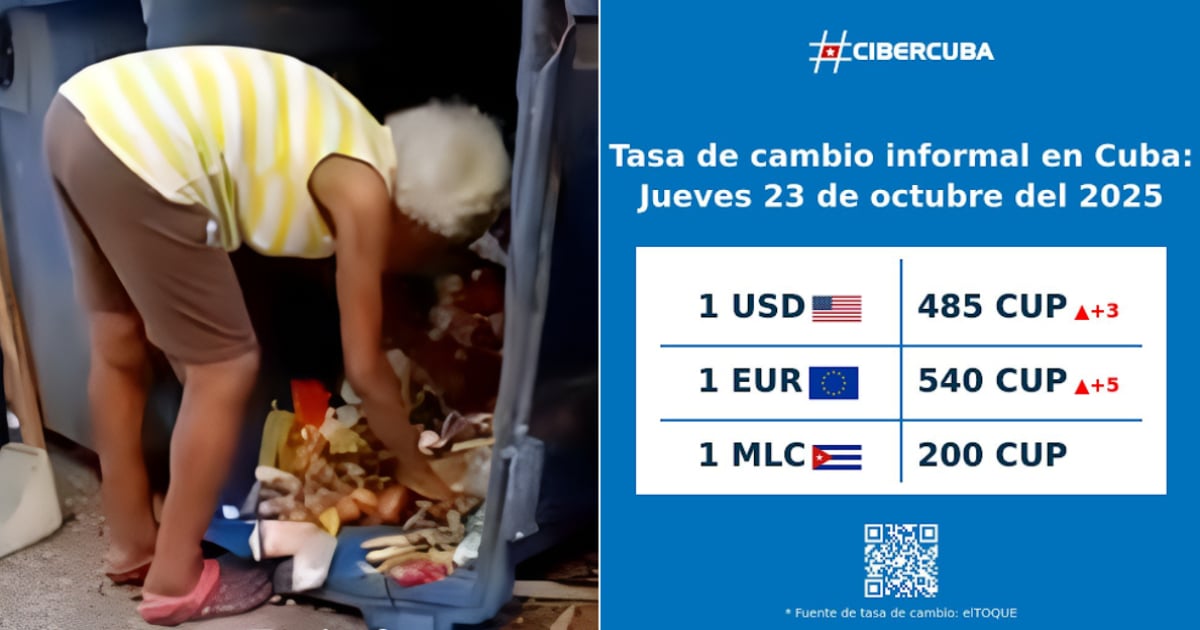
Since September 1, when the adjustment came into effect, the US dollar increased from 415 to 485 pesos, while the euro jumped from 465 to 540. In just seven weeks, the national currency lost nearly 17% of its value against both currencies, reducing the real purchasing power of retirees by over 13%.
And the worst is yet to come.
If the current rate of devaluation—around 0.24% daily—continues until December, the dollar could exceed 570 CUP and the euro could approach 630 CUP by the end of the year, according to calculations made by CiberCuba based on informal rates from the last three months.
This means that in just four months, the Cuban peso will have lost almost 38% against the dollar and 36% against the euro, dragging the real value of pensions down with it.
The minimum pension, set at 4,000 CUP, was equivalent to about $9.60 in September. By December, it will be worth barely $7. In practical terms, retirees will have lost nearly 30% of their purchasing power in just four months.
A rise that vanished in record time
When the regime announced in July the increase in pensions, Prime Minister Manuel Marrero Cruz presented it as an act of "social justice." According to official data, the measure would benefit more than 1.3 million retirees, equivalent to 79% of the total in the country.
The increase was applied to those receiving up to 4,000 pesos
- Pensioners with incomes of up to 2,472 CUP will now receive 4,000 CUP, following an increase of 1,528 pesos.
- Those who were already between 2,473 and 3,999 CUP were adjusted to that same limit.
The adjustment, which came into effect on September 1, 2025, was presented as a "response from the State" to protect vulnerable sectors. However, the reality of the market rendered it almost immediately ineffective.
According to data collected by the Cuban Observatory of Citizen Auditing (OCAC), basic nutrition requires at least 30,000 Cuban pesos per month, seven times more than the current minimum pension.
"That's not enough to live on," acknowledged even Vice President Salvador Valdés Mesa, who publicly admitted that even with a salary of 6,000 CUP, it is not enough “to live given today's prices.”
The everyday drama of retirees
The collapse of purchasing power is evident in the streets: elderly people searching for food in the trash, long lines outside banks, and accounts from retirees confessing that they can't afford to eat three times a day.
Reports published by CiberCuba in recent months reveal an alarming reality: as inflation and scarcity soar, access to essential goods is becoming increasingly restricted.
A carton of eggs exceeds 3,000 CUP, a liter of oil costs more than 3,500, and products such as chicken or powdered milk are only sold in MLC or dollars, currencies that the State does not pay to or sell to citizens.
As a result, millions of Cubans rely on family remittances or the informal market to survive. Without external assistance, old age in Cuba becomes a trap of chronic poverty.
The economic reality behind the failure
The data is compelling.
- In July, before the announcement, the informal dollar was around 385 CUP.
- Three months later, it approaches 490 CUP, and it could reach 600 in December.
- The accumulated loss of purchasing power from September to December is estimated to be between 26% and 28%.
Inflation, the lack of domestic supply, and the increasingly less partial dollarization of retail trade have turned every nominal increase into a temporary illusion.
Meanwhile, military conglomerates like GAESA are concentrating millions of resources—over 18 billion dollars in liquid assets are estimated—and the government continues to allocate funds to empty hotels and mega tourism projects.
Between rhetoric and hunger
The chancellor Bruno Rodríguez Parrilla described the increase in pensions as evidence that "the Revolution leaves no one behind."
But the facts say otherwise: Cuban retirees, after working their whole lives, are further behind than ever. If current trends continue, the minimum pension of 4,000 CUP will be worth less than 6.5 dollars by January 2026.
In the Latin American context, Cuban retirees rank among the poorest on the continent. While in Cuba the minimum pension amounts to only 8 or 9 dollars at the informal market exchange rate, in countries with similarly fragile economies like Haiti or Guatemala, minimum pensions are several times greater than that figure.
In Haiti, the average amount is close to 340 dollars per month, and in Guatemala, the law guarantees that no state pensioner receives less than 3,634 quetzals (about 460 dollars). Even in Brazil, with its saturated and unequal system, the average pension hovers around 190 dollars, and in Colombia, the minimum threshold is set above 355 dollars per month.
These comparisons highlight the true extent of the collapse of purchasing power on the island, where a lifetime of work barely provides enough money to survive for a week.
Across Latin America, low incomes among the elderly are a structural problem; however, in Cuba, where the regime maintains absolute control over the economy and the exchange rate, the pension crisis takes on a more profound character: the national currency is now worthless.
While a Haitian retiree can cover their monthly food expenses with their pension, a Cuban would need to receive at least 30,000 pesos — nearly 70 dollars — to meet basic needs. This contrast not only reveals an economic gap but also the moral collapse of a system that promised to “protect its own” and today condemns them to poverty.
Aging in Cuba, which once appeared as a symbol of socialist dignity, has become the most visible face of the structural failure of the economic model. The increase in pensions, far from being a relief, has been nothing more than an illusion amidst the collapse of the Cuban peso and the growing misery of the country.
Filed under: