
Related videos:
The Cuban Observatory for Conflicts (OCC) described the health crisis in Cuba as a "silent genocide" after analyzing citizen protests and complaints from last October.
According to the non-governmental organization, the combination of state negligence, lack of basic resources, and informational opacity has led to an epidemiological collapse that is already affecting the entire country and that the regime of Miguel Díaz‑Canel refuses to acknowledge in its true magnitude.
Although the Ministry of Public Health of Cuba (MINSAP) has only confirmed three deaths linked to the viral outbreaks, citizen reports and research from the OCC indicate that the actual number of fatalities is much higher.
In a press release sent to this editorial office, the NGO reported that it has compiled a preliminary list of victims—comprising more than a dozen identified cases across several provinces—that the government simply does not acknowledge.
"They are killing us," is a phrase that often echoes on social media. It encapsulates the feeling of abandonment that prevails on the island. According to the OCC, the health crisis is not the result of a natural disaster or the embargo, but rather a state management characterized by corruption and a disregard for human life.
Garbage, mosquitoes, and shortages
The OCC report recalled that since last August, the newspaper Miami Herald revealed that the military-business conglomerate GAESA has about 18 billion dollars in accounts and tax havens.
However, none of those funds appear to have been allocated for the purchase of garbage trucks, fuel, or basic necessities to ensure public hygiene on the island.
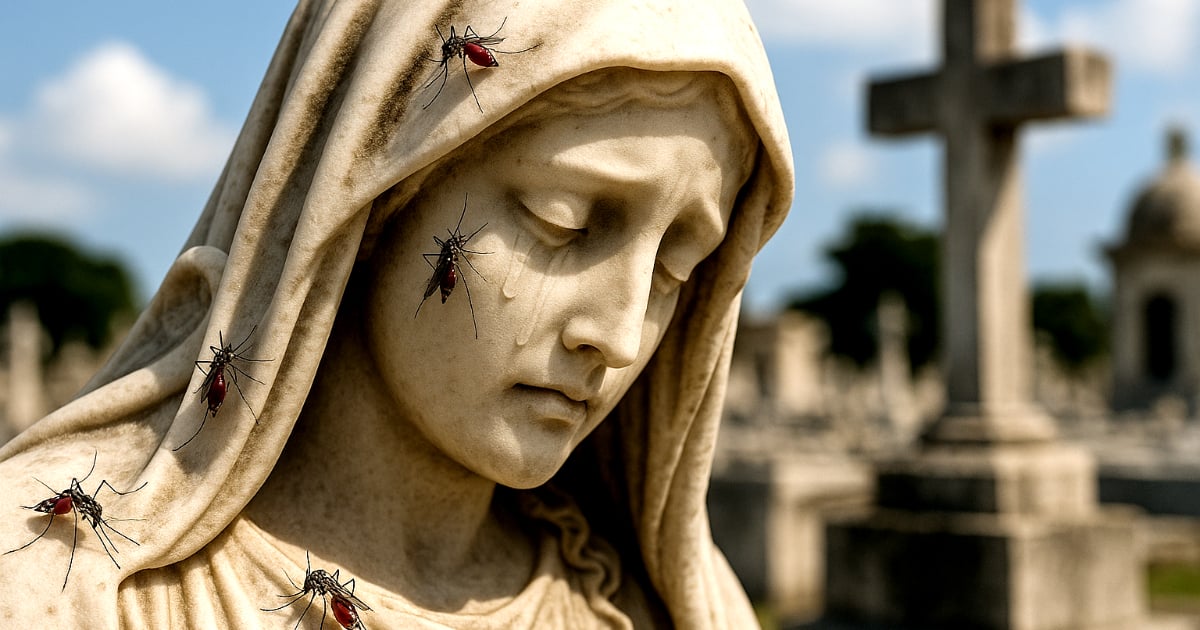
This inaction has turned landfills into common sights in Cuban cities, multiplying infection hotspots. By the time the 2025 rainy season arrived, there was no malathion or abate, nor fuel for the fogging backpacks: mosquitoes proliferated uncontrollably.
Cubans are already familiar with the outcome: the coexistence throughout the country of arboviruses such as dengue (including the hemorrhagic variant), chikungunya, zika, oropouche, and other infectious diseases like Hepatitis A.
Furthermore, the lack of pain relievers, antipyretics, and diagnostic reagents worsens the situation. In areas such as Cárdenas (Matanzas) or Perico (Matanzas), virtually the entire population has had "the virus," as it is referred to given the inability to determine which one exactly.
This has also been documented in local news: for example, in the province of Matanzas, it has been reported that "even my grandparents, who don't even go out on the street, caught dengue."
Collapsed hospitals and official silence
In provinces such as Havana, Matanzas, Cienfuegos, or Holguín, hospitals —including pediatric ones— are overwhelmed. In Matanzas, an outbreak of arboviral disease forced the establishment of an additional hospital next to the provincial pediatric hospital due to the saturation of beds.
The MINSAP, for its part, has preferred to resort to institutional secrecy, denying the existence of deaths due to dengue or chikungunya in certain provinces, despite contrary testimonies.
In this regard, the appearance of the Deputy Minister of Public Health, Carilda Peña García, was telling, as she acknowledged during a televised appearance on the Special Review of TV Yumurí that "dengue kills," yet did not recognize a single death.
Days later, it was confirmed that three patients had died from dengue in 2025.
The names of silence
The OCC has called on Cubans to submit the names, ages, places of residence, and dates of death of those compatriots who have died from any of the viruses triggered by state indifference.
Among the reported cases are children, the elderly, and young people from various provinces: a 13-year-old boy in Guanabacoa, a 63-year-old woman in Cifuentes (Villa Clara), and an 87-year-old elderly woman in Camagüey.
These names are just the tip of the iceberg of the human cost that the Cuban people are already paying: each of these deaths is a silenced cry.
Contradictions and responsibilities
The regime's attitude is a mix of denial and distraction. On one hand, there is talk of active epidemic outbreaks, and on the other, deaths are denied or severe cases are attributed to "comorbidities" instead of acknowledging the structural deficiencies of the system.
For example, although health authorities in Matanzas claimed there had been no reported deaths from dengue or chikungunya, citizens' complaints and independent medical reports contradict those statements.
A journalist linked to the state system, Yirmara Torres Hernández, wrote on her Facebook profile: "There are no dead, because the dead only hurt those who lose them... What hurts is the abandonment. What hurts is being insulted for your intelligence... No. There are no dead, but there are."
These testimonies highlight how the voices that pointed out the crisis have been silenced.
Why "silent genocide"?
The term may seem extreme, but the Cuban Observatory of Conflicts uses it with full awareness of its weight. It does not refer to a sudden tragedy or an inevitable catastrophe, but rather to a sustained policy of planned neglect, a chronic disregard that has slowly taken lives while those in power look the other way.
At the heart of this accusation lies the paradox of a country whose elite, represented by the military-business conglomerate GAESA and the Ministry of Public Health itself, accumulates billions of dollars in reserves and foreign accounts, while hospitals lack painkillers, IV fluids, or even basic latex gloves.
Images of overcrowded wards, patients on makeshift stretchers, and desperate family members are now a daily reality on the island, contrasting sharply with the regime's assertion that it is investing the multimillion-dollar profits from contracting medical services to third countries through GAESA into the public health system.
The mass export of medical personnel, a state-run business that deprives Cuban hospitals of professionals while filling the regime's coffers with foreign currency, has reached obscene proportions and represents the main structural deficit caused by the regime's aberrant thirst for foreign exchange. The remaining doctors, exhausted and poorly paid, must cope with a shortage of supplies and an ever-increasing number of patients.
The deterioration of vector control is another link in this chain of negligence. Fumigation campaigns are delayed or canceled due to a lack of fuel and malathion, and mosquito breeding sites expand unchecked. The seasonal rains provided the perfect catalyst for the viruses to spread with devastating speed.
Meanwhile, the official silence persists as a state policy. The authorities acknowledge only three deaths, while social media, doctors, and family members report dozens. Transparency is notably absent, and information is either rationed or manipulated to uphold the narrative that "everything is under control."
That is why the OCC speaks of a silent genocide: because every omission, every lie, and every denied death is part of a strategy that places human life in the background, subordinated to the preservation of the regime's international image. It is the slow extermination of a people through neglect, disregard, and indifference.
The human cost of silence
While Cubans continue to face fever, pain, long waits in hospitals without diagnoses and without medications, the regime insists that "everything is under control."
That gap between the reality on the ground and the official narrative is a form of indirect violence. The health crisis in Cuba is no longer just a system malfunction: it is a systematic act of abandonment.
The OCC has struck a nerve: "There are no dead, but there are." Acknowledging, documenting, and making them visible will be a key step for the international community and global public opinion to stop treating this tragedy as a fleeting anomaly. Because it is not. It is part of the human cost of the Cuban system.
Until that recognition is achieved, Cubans will continue to pay with their bodies and their lives for the indifference of those who have the power to prevent it.
Complete list of fatalities due to the virus in Cuba, according to the OCC
- Juan, grandfather of the actor Ariel Cabrera, Cárdenas (Matanzas), passed away on October 2, 2025.
- Paqui, 50 years old, San Cayetano neighborhood, Santa Marta, Cárdenas municipality (Matanzas), passed away around October 12, 2025.
- Unidentified young man, 22 years old. San Cayetano neighborhood, Santa Marta, Cárdenas municipality (Matanzas), date unspecified.
- Unidentified boy, 13 years old, Guanabacoa (Havana) October 15.
- Yuniel, a young worker, age unspecified, Cárdenas (Matanzas), October 11.
- Adelaida Yanes, 63 years old, Cifuentes (Villa Clara), October 15.
- Ernestina Aróstegui Varona, 87 years old, grandmother of activist Anamely Ramos, city of Camagüey, October 13.
- Katherine, grandmother of César Roche Torres, 76 years old, city of Matanzas, October 7th.
- Man, 70 years old, husband of the grandmother of a former university professor, city of Matanzas, date not specified.
- Child, age unspecified, Manzanillo (Granma) October 24.
- Olga Rosa López Sardiñas, 75 years old, mother of the exiled artist Eduardo Antonio, Placetas (Villa Clara), October 23.
- Man, 35 years old, son of Doris Rodríguez, Havana, October 18.
- Maritza Herrera Soler, opposition figure, Havana, October 29.
- Unidentified girl, 6 years old, daughter of Fernandito, Rafael Freyre, Holguín, October 21.
- Agustín Luis Patricio, Vásquez Alley between May 20th and San Rafael, Camagüey, October 23rd.
Filed under: