
Related videos:
The Archbishop of Santiago de Cuba, Monsignor Dionisio García Ibáñez, urged Cubans to work towards a more just and independent society, where personal effort and respect for others are the foundation of social life. It is a beautiful dream, but quite difficult to achieve in the current society dominated by a dictatorship and an elite.
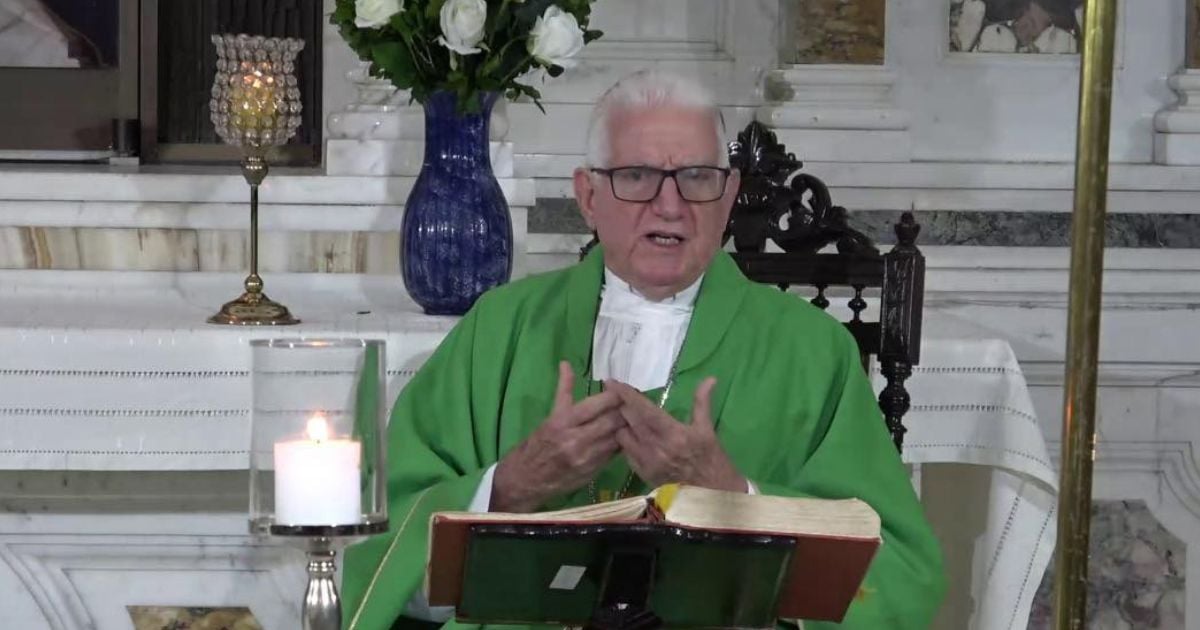
During his homily this Sunday at the Basilica Sanctuary of the Virgin of Charity of El Cobre, the prelate reflected on the current situation in the country and reminded that faith should not be separated from the commitment to everyday reality.
"We must seek a society where a person's work allows them to obtain what they need without relying on handouts," he stated before the faithful gathered in the temple.
García Ibáñez acknowledged the difficulties faced by the population following Hurricane Melissa, but insisted that material shortages cannot be an excuse for the loss of values or dependence. These are very wise words that come at a time of deepening crisis regarding the principles that should be instilled in households.
"The Lord gives us the intelligence to organize ourselves as a society and contribute to the common good; we cannot live waiting for everything to come from outside," he warned.
The archbishop also called for solidarity and collaborative effort as a means of spiritual and material reconstruction of the country, in the context of a prolonged crisis and institutional distrust.
"Any assistance that comes from outside should be appreciated, but the fundamental thing is the effort of our own work to know how to recover," he emphasized.
In one of the most direct moments of his message, Monsignor Dionisio García urged Cubans to respect one another and to build a model of coexistence based on justice and personal responsibility.
"The Lord wants us to live respecting His name, which also means respecting each person," he expressed.
His homily, rich in social and ethical content, joins the recent voices within the Catholic Church calling for a deep reflection on the moral, economic, and human direction of the nation, marked by poverty, migration, and distrust in institutions.
Following the passage of Hurricane Melissa through eastern Cuba, the Catholic Church has prepared to assist those affected.
Cáritas Santiago de Cuba, for example, distributed food and hygiene products to affected families. The aid, which was part of an immediate response to the emergency, was organized through parish structures and coordinated by the Diocesan Office of Cáritas.
On another note, Father José Joaquín Espino, rector of the National Sanctuary of Our Lady of Charity of El Cobre in Miami, announced that he will travel to Holguín on a flight loaded with over 30 tons of humanitarian aid destined for the victims of Hurricane Melissa in eastern Cuba.
Previously, the Catholic Church in Cuba announced the dispatch of four planes with humanitarian aid from Miami for the dioceses most affected by Hurricane Melissa in the eastern part of the country.
Filed under: