
Related videos:
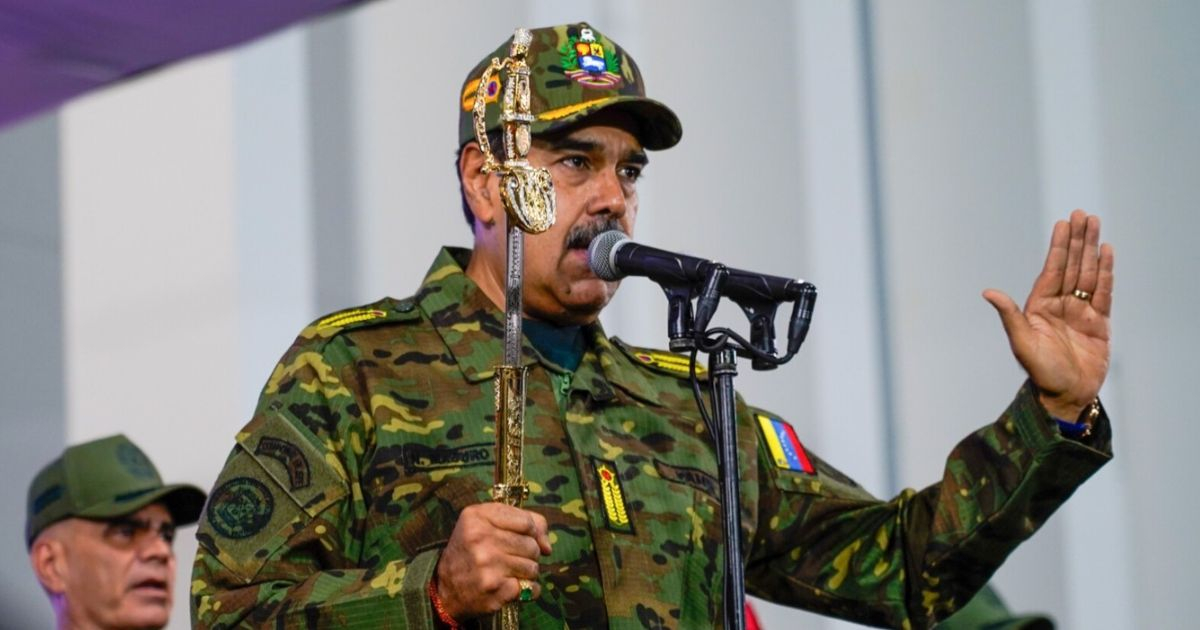
The ruler of Venezuela, Nicolás Maduro, ordered the Bolivarian Military Aviation on Thursday to "be alert and ready" in response to what he sees as an "imperialist threat" from the United States. He asserted that if history were to lead the country to declare itself a "republic in arms," its destiny would be "victory."
In an event celebrating the 105th anniversary of the Bolivarian Military Aviation, broadcast on the state channel Venezolana de Televisión, the dictator addressed the air force officers dressed in an olive green uniform and a red cap, reported the agency EFE.
"I ask you to always remain unperturbed in your serenity, alert, ready and willing to defend our rights as a nation, as a free and sovereign homeland, and I know that you will never fail Venezuela," he said.
Maduro stated that if the country declared itself a republic in arms, it would have "only one destiny: victory."
The message comes amidst a new tension with the United States, following the U.S. military deployment in the Caribbean, which the Chavista leader interprets as a "threat to remove him from power."
The leader of the Venezuelan regime denounced that "for the past 17 weeks, imperialist foreign forces have threatened to disrupt peace in the Caribbean, in Venezuela, and in South America under false and extravagant arguments."
Despite this, he assured that “nothing has ever broken the will” of the country.
“Neither the blockade, nor the sanctions, nor this psychological warfare,” he said.
According to Maduro, Venezuela has developed an "immense capacity for coordination, command, control, communication, and popular-military-police unity" to confront any aggression, and he praised the "fabulous strength of resistance" that—according to him—the people maintain in the face of the "immoral pressures" from the United States.
The event also featured the presence of the Minister of Defense, Vladimir Padrino López, and other military officials.
Maduro's speech coincided with the escalation of tensions between Caracas and Washington, following the U.S. State Department's designation of the Cartel de los Soles —which, according to the Trump administration, is led by Maduro himself and high-ranking Venezuelan officials— as a foreign terrorist organization.
Meanwhile, Vice President Delcy Rodríguez accused Washington of pressuring international airlines not to fly to Venezuela, which is facing a crisis in air connectivity following the cancellation of more than thirty international flights.
Caracas responded by revoking the licenses of companies such as Iberia, TAP, Turkish Airlines, Avianca, Latam Colombia, and Gol.
The regime attributes the increasing restrictions to the "economic and diplomatic siege" by the United States, whose government maintains a military operation against drug trafficking in the Caribbean supported by the aircraft carrier USS Gerald R. Ford.
Amid a context marked by the intensification of the official discourse, Nicolás Maduro asserted that Venezuela is going through a decisive phase, emphasizing the need to unite against what he describes as foreign aggressions. This same tone was echoed by other high-ranking officials of the regime.
Diosdado Cabello openly challenged international airlines that have canceled their flights to Caracas, accusing them of acting under political pressure, and he supported the government's decision to revoke licenses from companies such as Iberia, TAP, Turkish Airlines, Avianca, and Latam Colombia.
Meanwhile, in an unexpected turn of events, Donald Trump suggested the possibility of a dialogue with Maduro, to which the chavista leader responded by saying that "everything is possible" if it is based on mutual respect.
The mention of this potential opening comes at a time when Caracas intensifies its confrontational rhetoric against the United States.
Filed under: