
Related videos:
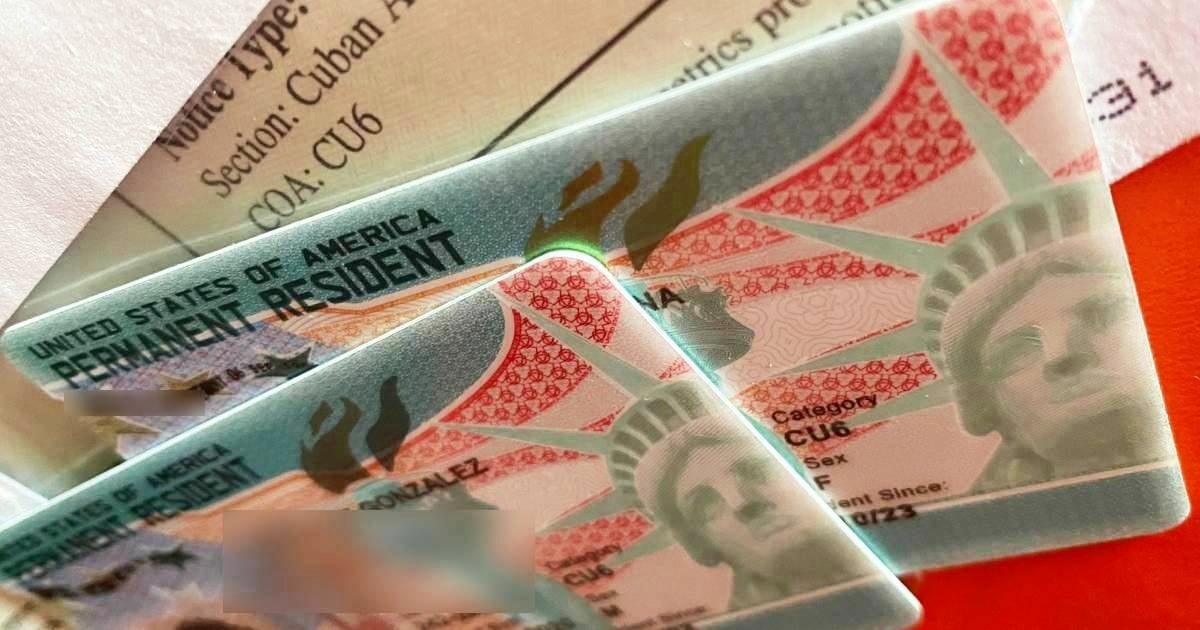
The U.S. government has begun a thorough review of already approved permanent residency applications and has suspended the processing of thousands of immigration requests. Cubans are among those affected.
In what represents one of the broadest immigration review measures in recent years, the U.S. Citizenship and Immigration Services (USCIS) has ordered the immediate suspension of all asylum, residency, and naturalization processes submitted by citizens from 19 countries deemed "high-risk," including Cuba and Venezuela.
The measure, outlined in the PM-602-0192 memorandum, issued on December 2nd, not only halts pending applications but also reopens benefits that have already been approved, including cases of green cards granted since January 2021.
“This memorandum orders a thorough re-evaluation of the already approved benefit applications for foreigners from the countries listed in Presidential Proclamation 10949 who entered the United States on January 20, 2021, or later”, the document clearly states.
Who is under review?
The scope of the measure is unprecedented. USCIS will review the following cases:
Pending asylum requests (Form I-589), permanent residency (I-485), residency renewal (I-90), removal of conditions (I-751), travel permits (I-131), and others.
-Approved applications, including residency cards granted to foreigners who entered since January 20, 2021.
-Applications submitted by nationals of countries mentioned in Presidential Proclamation 10949, a list that includes Cuba, Venezuela, Iran, Sudan, Haiti, Eritrea, Somalia, among others.
“An individualized assessment will be conducted on a case-by-case basis based on all relevant information and facts”, states the memorandum.
How will I know if my case will be reviewed?
The USCIS guide is clear that not all foreigners will be notified at the same time, but the process has already begun.
Within 90 days of the publication of the memorandum, the agency will compile a priority list of cases that could be:
-Called for mandatory interviews or re-interviews.
-Reviewed and possibly referred to ICE or other security agencies.
- Evaluated under security criteria such as: Presence in the TSDS (Terrorist Screening Dataset); connections to organizations, individuals, or activities deemed dangerous under the Immigration and Nationality Act (INA); and involvement in serious criminal activities or lack of identity verification.
“Nothing is off the table until every foreigner has been evaluated and examined to the highest possible degree”, the agency stated.
Impact on Cubans: Canceled Naturalizations and Frozen Visas
The order directly affects Cuban citizens with permanent residency, citizenship applicants, and those with active asylum processes.
Cancellations of interviews and naturalization ceremonies have already been reported without prior explanation, as revealed by immigration lawyers to The New York Times.
Furthermore, since June, the Trump administration had suspended the issuance of several types of visas for Cubans, including those for tourism (B-2), business (B-1), study (F, M), and exchange (J), under a policy that is already known as a new “travel ban.”
“Citizenship is a privilege, not a right,” declared USCIS spokesperson Matthew Tragesser.
What to do if I am a resident or have a pending application?
Experts recommend the following:
-Consult an immigration attorney specialized in this area, especially if your case falls within the date range (entry to the U.S. since January 20, 2021) or if you come from one of the 19 countries under review.
-Do not ignore notifications from USCIS, as many reinterviews will be mandatory.
-Prepare additional documentation to support your eligibility and absence of suspicious connections.
-Be attentive to regulatory changes, as the memorandum allows for new executive orders or internal instructions that could expand the measure.
Is it a pause or a revocation?
For now, it is a suspension of the allocation process and a general review, but it does not imply an automatic revocation of permanent residencies or benefits already granted.
However, USCIS reserves the right to withdraw any benefit if it finds grounds for inadmissibility or a threat to security.
"This address may delay the resolution of some pending requests, but it has been weighed against the urgent need to thoroughly examine the applicants," states the memorandum.
Why now? Recent attacks and political pressure
The decision comes after a series of violent incidents involving asylum seekers.
Among them is the foiled attack by Nasir Ahmad Tawhedi - an Afghan citizen who planned a terrorist attack during the 2024 elections - and the attack in Washington D.C. allegedly carried out by Rahmanullah Lakanwal, which resulted in one death and one serious injury among members of the National Guard.
Both had been admitted to the U.S. under humanitarian protection programs, which sparked criticism of the immigration adjudication system and led the White House to sign Executive Order 14161, with a clear objective: to protect the country from potential threats hidden in previously approved immigration processes.
“USCIS plays a crucial role in preventing terrorists from finding refuge in the United States,” the document emphasizes.
Conclusion
The reopening of approved cases and the suspension of immigration applications represents a paradigm shift in U.S. immigration policy, especially under the Trump administration.
Cubans, Venezuelans, and other Latin Americans included in the list will face a new cycle of uncertainty, mandatory interviews, and the risk of having their benefits canceled.
For those who already have a green card or are awaiting a decision, the warning is clear: "USCIS will reopen your case if you have entered since 2021 and you come from a country deemed high risk."
Surveillance will be extensive, and the impact, according to estimates, could affect more than 1.5 million people.
Filed under: