
Related videos:
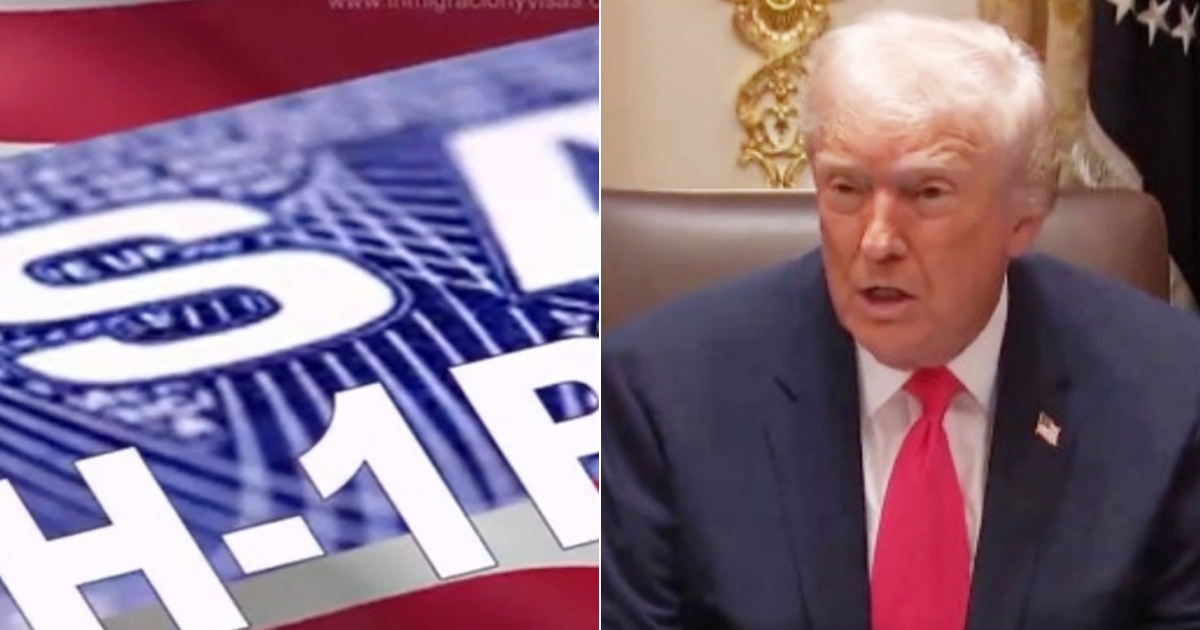
The Donald Trump administration has launched a new offensive against what it perceives as censorship of freedom of speech in the United States. This time, the target is H-1B visa applicants, particularly those who have worked in content moderation, fact-checking, or roles related to digital safety and trust on technology platforms.
An internal memo from the State Department, circulated to U.S. diplomatic missions earlier this month - and revealed exclusively by the agency Reuters - instructs consular officials to thoroughly examine the work histories, resumes, and social media profiles such as LinkedIn of applicants and their family members, in order to identify any potential connections to activities deemed as censorship.
According to the directive, if evidence is found that an applicant "was responsible for or complicit in the censorship or attempt to censor a protected expression in the United States", a visa ineligibility determination must be issued in accordance with a provision of the Immigration and Nationality Act.
Who is being targeted?
Although the cable states that all visa applicants are subject to this scrutiny, it emphasizes the specific case of H-1B visas, given that their holders "often work in the technology sector, including in social media or financial service companies involved in suppressing protected speech."
Specifically, it requests a thorough investigation into whether the applicants have participated in activities such as:
-Fact-checking (fact-checking).
-Content moderation.
-Prevention of misinformation or false narratives.
-Compliance with digital community standards.
-I work in trust and security departments (T&S).
The objective, according to the administration, is to prevent foreign workers from entering the United States to "muzzle Americans."
"We do not support foreigners coming to the United States to work as censors and silence Americans," stated a spokesperson for the State Department, although he declined to confirm the leaked document.
"In the past, the president himself was a victim of this type of abuse when social media companies blocked his accounts. He does not want other Americans to suffer in this way."
The ideological backdrop: The crusade against "censorship"
This policy is part of a discursive offensive by Trump and his allies against what they perceive as a systematic suppression of conservative voices on technological platforms.
After being banned from Twitter and Facebook for his role in the January 6, 2021 Capitol riot, the former president has insisted that large tech companies exercise ideological censorship.
During the presidential campaign and in joint events with Elon Musk, Trump has presented the defense of freedom of speech as one of his key points.
In May, Secretary of State Marco Rubio warned that the United States could restrict visas to “foreign officials and individuals complicit in the censorship of Americans.”
Furthermore, the new approach is not limited to blocking social media profiles.
The State Department has also tightened control over the digital activity of applicants, requiring them to set their social media accounts to public so that they can be reviewed by consular officials.
Critiques from the legal and technological fields
Expert voices in freedom of expression and digital rights have reacted with alarm to the measure.
Carrie DeCell, senior attorney at the Knight First Amendment Institute, stated that "those who study misinformation and work in content moderation teams are not engaging in 'censorship'; they are participating in activities that the First Amendment was designed to protect."
According to DeCell, this policy is "incoherent and unconstitutional."
There is also concern from the tech world.
Alice Goguen Hunsberger, who has led trust and safety teams at companies like OpenAI and Grindr, stated:
“I am alarmed that the work in trust and safety is being confused with 'censorship.'”
Hunsberger recalled that these departments focus on protecting minors from child sexual abuse material (CSAM), preventing fraud, scams, and sextortion, and making the internet a safer space.
To achieve this, he said, it is essential to have professionals from various countries who understand multiple languages and cultural contexts.
A tension between freedoms and borders
The approach of the Trump administration creates a paradox: while claiming to defend freedom of speech, it targets exactly those who work—within the legal framework—to curb abuses and illegal content online.
And it does so by applying a migration filter based on ideological and labor criteria that, according to experts, could have discriminatory and even unconstitutional consequences.
This policy could also significantly impact the U.S. technology sector, which is highly dependent on international talent.
H-1B visas are crucial for companies that hire qualified personnel in fields such as software engineering, cybersecurity, or artificial intelligence.
Many of these workers have held or aspired to hold roles in content moderation and digital trust, precisely the functions that are now stigmatized.
Paradoxically, Trump has shown support for the H-1B program in recent interviews.
In a conversation with Laura Ingraham, when she questioned the massive influx of foreign workers, the former president responded: "It's also important to bring in talent."
Days later, he reaffirmed to business leaders that the United States needs skilled immigrants to train domestic workers in high-tech factories.
A new front in the culture war?
This measure, beyond its immigration implications, can be seen as a new front in the cultural war that Trump is waging against the tech establishment.
By equating fact-checking with censorship and treating moderators as threats, your government presents a vision of digital discourse where content control is framed as an ideological aggression rather than a necessary regulatory tool.
As his presidential campaign progresses, this type of initiative sends a clear signal: those who work to curb misinformation—in the name of security or ethical reporting—could be penalized for it.
And for foreigners hoping to work in the United States in these fields, the message is clear: be careful about what you did before, or you might find yourself left out.
Filed under: