
Related videos:
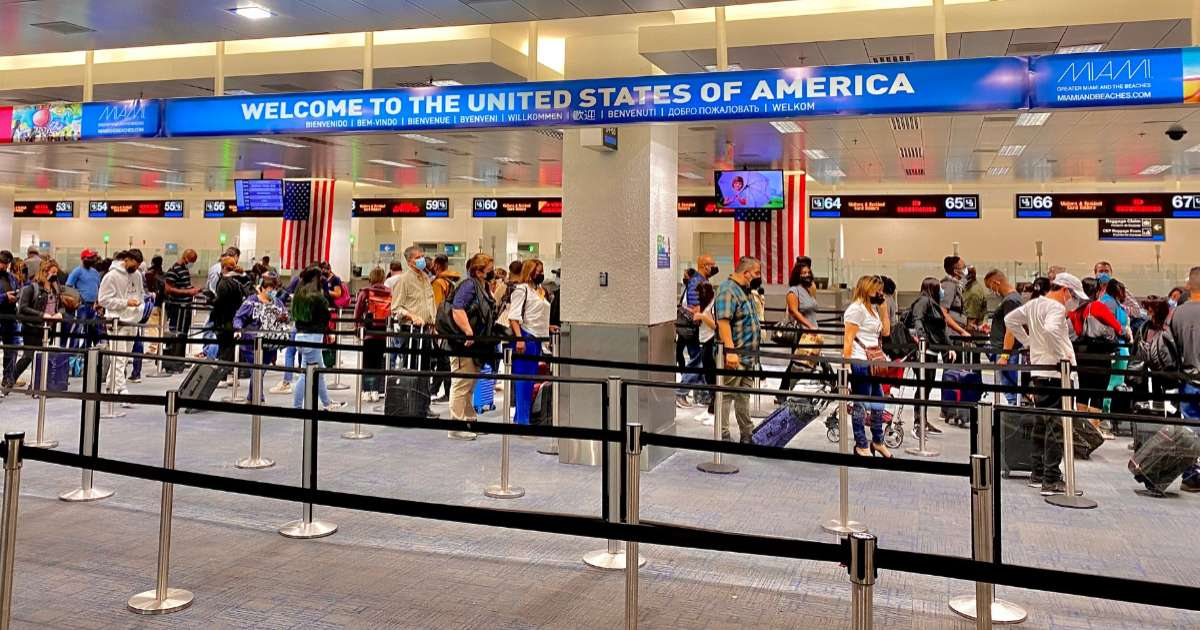
The administration of President Donald Trump expanded the use of passenger data by sharing the names of all air travelers in the United States with the Immigration and Customs Enforcement (ICE), a practice aimed at identifying and detaining individuals subject to deportation directly at airports.
According to revealed by the newspaper The New York Times, since March, the Transportation Security Administration (TSA) has been providing lists of travelers to ICE several times a week, allowing that agency to cross-reference data and deploy agents at airport terminals to make arrests.
The mechanism involves cross-referencing passenger names with databases of individuals who have deportation orders.
Although it was not specified how many arrests have been made through this means, a former ICE official stated that in his region, 75% of the cases identified by the program ended in detentions, the report indicated.
Among the cited cases is that of Any Lucía López Belloza, a 19-year-old university student arrested on November 20 at Logan Airport in Boston while attempting to board a flight to surprise her family in Texas. Two days later, she was deported to Honduras.
The revelation aligns with the official discourse of the Department of Homeland Security (DHS), whose secretary, Kristi Noem, proclaimed "historic advances" in immigration control.
According to their figures, since January 20, 2025, more than 2.5 million irregular migrants have left the country, including 605,000 deported and 1.9 million who left voluntarily.
Noem attributed these results to a radical shift from the previous administration and stated that President Trump has returned the DHS to its "core missions," ensuring what she described as "the safest border in history."
The massive use of passenger data adds to other initiatives that tighten immigration control and expand state surveillance, in a context of growing criticism regarding the impact of these policies on civil rights, privacy, and due process, especially when detentions occur without prior notice in spaces such as airports and during domestic travel.
ICE has invested over $1.4 billion in contracts with technology companies to enhance its surveillance capabilities, including facial recognition systems, social media monitoring, and software to hack mobile phones.
Additionally, it will implement an artificial intelligence system developed by Signal Labs to track and analyze user activity on social media.
This system will identify immigrants through posts, images, locations, and visible personal characteristics in photos or videos. Additionally, the software can detect trends, identify physical traits, and generate automatic alerts for ICE.
The implementation of this AI system could facilitate the identification and capture of immigrants, including those with no criminal records or previous entries in government systems.
Additionally, it can lead to faster arrests and deportations, increasing pressure on immigrant communities that already face a climate of surveillance and fear.
Filed under: