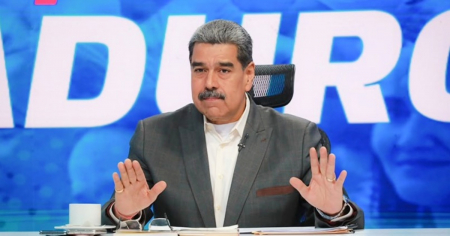
In a new chapter of the rising geopolitical tension in the Caribbean, Nicolás Maduro called this weekend on the member countries of the Bolivarian Alliance for the Peoples of Our America (ALBA) for a "united, popular, prolonged resistance" against the military deployment of the United States in the region.
The proposal was launched during the XXV ALBA Summit, held virtually and broadcast by Venezolana de Televisión, on the occasion of the 21st anniversary of the foundation of the regional bloc.
“Let us combine the united, popular, prolonged resistance of the ALBA peoples with the ongoing offensive to build solid foundations in a joint, common, cooperative economy for mutual benefit,” proclaimed the Venezuelan leader.
Parallely, it was reported that the U.S. military operation - aimed at combating drug trafficking - actually constitutes a direct threat to regional stability and an attempt to force a regime change in Caracas.
Maduro assured that it has already been “25 weeks of aggression, psychological terrorism, and military threat” from Washington.
In his view, this context has required the refinement of a national defense system inspired by historical figures of indigenous resistance and Latin American liberation such as Guaicaipuro and Simón Bolívar.
“They intend a new colonizing project, but they will not succeed; we will be free,” he insisted.
The president also described the recent seizure of a Venezuelan oil tanker by the United States near Venezuelan territorial waters as a "pirate raid and kidnapping."
According to Maduro, this action marks the “total rupture of the legal and diplomatic means of coexistence in the hemisphere,” and is part of a destabilization strategy that transcends the local level to become a “colonial project not only against America but against the whole world.”
The context of the U.S. military deployment
The U.S. government has intensified its military presence in the Caribbean since mid-year, claiming it is aimed at curbing drug trafficking.
However, analysts from the Center for Strategic and International Studies (CSIS) warn that this is the largest U.S. naval and air deployment since the first Gulf War, which has been interpreted by Caracas as a clear "invasion threat."
In parallel, Venezuela has maintained a constant military mobilization across its territory as part of its defensive strategy.
Maduro accuses Washington of using the pretext of drug trafficking to launch a geopolitical offensive against governments that oppose it, particularly his own, which it does not recognize as legitimate and associates with the so-called "Cartel of the Suns."
Cuba: Strong support for Venezuela and rejection of "hegemonism"
Miguel Díaz-Canel, in a video conference intervention, firmly supported the Venezuelan complaint and called for the unity of ALBA “to strongly confront the hegemonic aspirations of the Government of the United States.”
He condemned the "ostentatious, exaggerated, and unjustified" presence of U.S. naval forces in the Caribbean Sea and warned that the deliberate military threat "should alert all peoples and governments on the continent."
Díaz-Canel described the seizure of the Venezuelan oil tanker as "an act of piracy and theft of the resources of the Venezuelan people, constituting a serious violation of international law."
He also accused the United States of not having a genuine interest in combating drug trafficking, but rather using it as a pretext to expand its political control over Latin America and the Caribbean.
"We are not anyone's backyard; we are sovereign countries. The Monroe Doctrine has come out of the closet," he asserted.
Virtual summit, real tensions
Far from the in-person meetings of other times, the XXV ALBA Summit was a digital event with a clear defensive and rhetorical tone.
The logistical restrictions stemming from the U.S. military deployment led the leaders to connect via videoconference.
Among them were Nicaraguan President Daniel Ortega, accompanied by his wife and co-president Rosario Murillo, who also directed criticisms at the West and the European Union for their support of Ukraine in the conflict with Russia.
"We see the EU beating the war drums, intervening on behalf of the Nazis in Ukraine against the Russian Federation," Ortega said in a statement filled with ideological references and aligned with the interests of the Kremlin.
Nicaragua, Cuba, and Venezuela remain the main pillars of ALBA following the recent departure of Bolivia from the bloc, a significant loss marked by a political shift in that country and the preventive detention of former president Luis Arce.
In conclusion, the leaders demanded an "immediate cessation of military threats" in the Caribbean and strongly condemned the security strategies promoted by Washington.
The final document of the summit reflected a common position of rejection against what they consider an unjustified military escalation that threatens regional peace.
The summit thus became a platform to revive the anti-imperialist narrative of the Caracas-Havana-Managua axis, with a discourse that blended the historical legacy of resistance with current denunciations of foreign intervention.
Despite the institutional wear and tear of ALBA and the growing international pressure, its members insist on their right to sovereignty and to resist any attempts at external intervention.
“Until victory, always! Victory, victory, victory!”, concluded Maduro, in a closing statement that aimed to evoke the revolutionary rhetoric of past decades, but takes place in an increasingly adverse international scenario with fewer firm allies in the hemisphere.
Filed under: