
Related videos:
The Spanish airline Plus Ultra, chaired by Julio Miguel Martínez Sola, has become the clearest example of how political interests and the money from authoritarian regimes can sustain a company that is "technically bankrupt."
With millions in losses, aging airplanes, and a minimal market share, the company continues to operate thanks to capital linked to Venezuelan chavismo, the government of Teodoro Obiang in Equatorial Guinea, and contracts with the Cuban regime, reported El País.
His name reappeared in international headlines following the arrest in Madrid of its president, Julio Martínez Sola, and its CEO, Roberto Roselli, accused of money laundering.
The operation, led by the Economic and Fiscal Crime Unit (UDEF) of the Spanish National Police, included a search of the airline's headquarters in the capital.
Both executives were released on provisional terms with precautionary measures while an investigation is ongoing under secrecy.
The case, revealed by El País, seeks to clarify whether part of the 53 million euros of public funds that the government of Pedro Sánchez allocated to the rescue of Plus Ultra during the pandemic ended up being diverted to criminal networks linked to Venezuelan oil and gold.
According to the Anti-Corruption Prosecutor's Office, there are indications that the funds may have been used to pay debts or transfers to PDVSA, the state oil company of Venezuela, which is considered an irregular use of rescue money.
The rescue of Plus Ultra was one of the most controversial in Spain during the pandemic.
In 2021, the company received 53 million euros through the State Industrial Participations Society (SEPI), which manages the Support Fund for the Solvency of Strategic Companies.
Officially, the government argued that the airline was "key" to maintaining connections with Latin America and Africa.
But the reality was different: Plus Ultra had only two operational planes, represented less than 0.1% of the Spanish market, and focused a significant part of its activity in Venezuela and Cuba, not in domestic traffic. No bank wanted to finance it, but the state did.
Over time, its shareholder base shifted towards a core group of Venezuelan entrepreneurs connected to the circle of Nicolás Maduro, known as “boliburgueses”: businessmen who became wealthy through public contracts and opaque schemes involving imports, oil, and gold.
At the same time, the airline expanded its operations to Equatorial Guinea, a country governed by Teodoro Obiang, where it maintains a subsidized route between Madrid and Malabo that, according to sources cited by El País, transports officials and official cargo.
The Plus Ultra case is particularly significant in Cuba, where the airline has maintained a direct relationship with the regime.
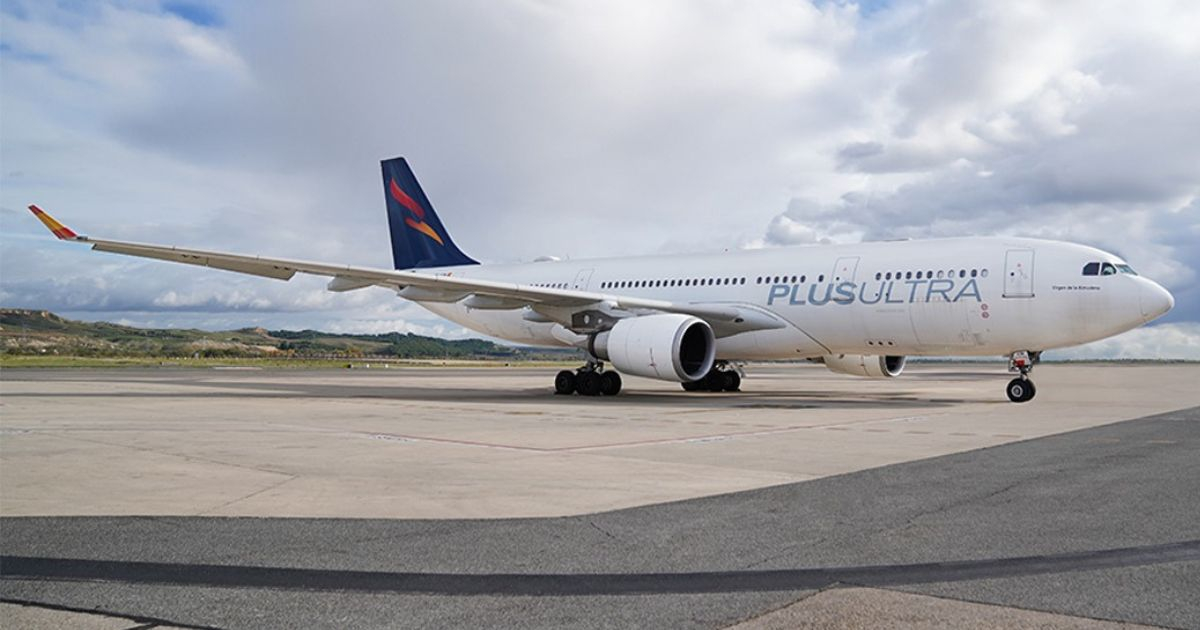
In this regard, Plus Ultra was hired by the government of Miguel Díaz-Canel for the transport of the president and his official delegation during his tour of the Middle East in 2023, utilizing an Airbus A330-202 whose rental can exceed 11,000 dollars per flight hour.
That same plane would have been used for the trip of the Cuban delegation to the UN General Assembly in New York.
Additionally, Cubana de Aviación, the state-owned company of the regime, has relied on Plus Ultra to maintain its international routes.
Due to the sanctions, the obsolescence of its fleet, and the lack of spare parts, Cubana has leased several aircraft, crew, and maintenance from Plus Ultra under wet lease contracts, a model in which the Spanish airline provides all operational resources in exchange for payment in foreign currency.
Thanks to these agreements, Plus Ultra has operated flights between Madrid, Havana, and Santiago de Cuba, and recently also connections between Frankfurt, Holguín, and Havana, which have been described as an "achievement" by the Cuban Ministry of Tourism, although German tourism fell by more than 40% in 2025.
The airline also participated in charter flights from Poland to Varadero, as part of the official plans to boost the high season despite the collapse of the tourism sector on the island.
These links confirm that Plus Ultra has been a key player in the Cuban regime's air logistics, operating official flights, tourist routes, and special missions. Even an Airbus A340 from the company was used on a Madrid–Havana–Gabon flight to transport more than 150 Cuban doctors as part of the controversial "medical missions" that generate millions in revenue for the Cuban State.
The Plus Ultra model cannot be understood without its network of political and financial relationships with Caracas, Malabo, and Havana.
Its dependence on Venezuelan capital, Equatoguinean subsidies, and contracts with Cuba have transformed it into an airline that operates in both commercial and geopolitical spheres.
In fact, several of its aircraft registered in Spain have been seen operating flights under the commercial name of Cubana de Aviación, bearing Spanish livery, which illustrates the direct cooperation between both airlines.
For Spanish researchers, such operations could conceal financial movements between sanctioned companies and governments, under the guise of air transport or technical maintenance contracts.
The Anti-Corruption Prosecutor's Office suspects that part of the Spanish bailout was funneled to accounts in France, Switzerland, and Panama through shell companies linked to Venezuelan businessmen.
UDEF reports suggest that Plus Ultra may have become a vehicle for laundering money originating from Chávez-era corruption, using cross loans and intermediary companies.
At the heart of the case are the very economic circuits that link the Chavista elite and the Cuban regime: political capital, networks of aligned entrepreneurs, and companies used as instruments for money laundering or for obtaining foreign currency through opaque trade routes and contracts.
If the judicial investigation forces Plus Ultra to reduce operations or to enter bankruptcy, Cuba could lose one of its main air routes to Europe.
With only two operational aircraft, Cubana de Aviación relies on companies like Plus Ultra to maintain its international connectivity.
The impact would be direct: a reduction in frequencies, increased ticket prices, and more air isolation at a time of unprecedented energy, tourist, and economic crisis on the island.
Meanwhile, Spanish justice is making progress in a case that has already transcended the business realm.
Plus Ultra has become a symbol of the financial network that links three dictatorships—the Venezuelan, the Cuban, and the Equatorial Guinean— with capital that continues to flow into Europe under the guise of legitimate business. And one question remains: how can an airline that has never made a profit continue to operate, if not fueled by the resources of these dictatorships?
Filed under: