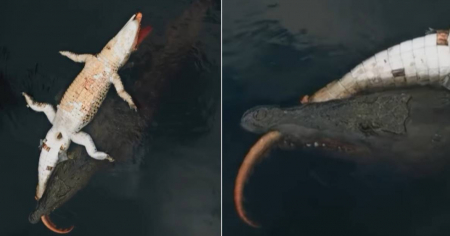
Strange as it may seem, this is the true story of Kuzya, a Cuban crocodile who has spent nearly three decades living as a pet in a plumbing store in Novosibirsk, Siberia. Today, his fate hangs in the balance: a new Russian law prohibits keeping crocodiles as domestic animals, and his owner, Evgueni Fradkin, is considering an unusual and symbolic solution: returning him to his "historic homeland": Cuba.
A crocodile in Siberia
Kuzya entered Fradkin's life in 1996, when he was just a young one.
It was bought "in a regular pet store; it was small back then," the owner explained to the newspaper Moskovski Komsomolets. For years, the reptile lived in a huge aquarium inside the commercial space, equipped with biological filters, infrared lamps, a lighting system that simulated solar cycles, and even a shower.
"I had everything planned: lighting, ultraviolet light, water filtration, feeding..." Fradkin explained. Kuzya's diet includes Siberian crucian carp — his favorite delicacy — along with vitamins and mineral supplements. He can devour three or four large fish at once.
Over time, Kuzya not only adapted to the Siberian climate indoors but also became the star mascot of the neighborhood. He appeared on local television shows, was visited by curious onlookers and customers for years, and authorities conducted inspections two or three times a year without any concerns about his welfare.
Change the law, change the destiny
Everything changed in May 2025, when the Russian government issued a decree prohibiting private citizens from owning wild animals, including all crocodiles, caimans, and alligators, outside of zoos or specialized facilities.
The law came into effect on September 1 of that year. Since then, Fradkin has until February 11, 2026, to deliver Kuzya to a certified center, according to the order issued by the Russian Federal Service for Supervision of Natural Resource Management (Rosprirodnadzor).
The regulation, however, includes an exception: animals purchased before January 1, 2020, can remain with their owners until their natural death. But here lies the problem: Fradkin does not have the purchase receipt from 1996. "Unfortunately, the owner no longer has the receipt to confirm the date of purchase," Russian media report. Without that evidence, everything hinges on how the authorities interpret the situation or what a court decides if the case is taken to litigation.
Possible (and emotional) alternatives
Fradkin does not want to entrust his pet to just anyone. He has explored options at private zoos but hasn't found suitable conditions. "In close-up shots, crocodiles' teeth are yellow. That means they are in an ecologically unfavorable area," he commented. A representative from the Ekaterinburg Crocodile Farm, which would be willing to take Kuzya, said: "Your Kuzya is a beauty... Have you seen how white Kuzya's teeth are? A dentist's dream come true."
Even so, Fradkin is not convinced. He believes that zoos, although legal, are businesses whose primary goal is to generate revenue rather than ensure welfare. And here a third option comes into play: repatriation.
The symbolic "repatriation" of the crocodile
"I thought about going to the consular section of the Embassy of the Republic of Cuba in the Russian Federation. They should return our Cuban crocodile to its historical homeland, to its natural habitat, if it's such a rare and endangered species. It would be a repatriate..." Fradkin stated to the Russian media.
Although the idea has not yet been formally submitted to the diplomatic representation, the owner himself considers it a worthy and significant solution, given the conservation status of the species and the animal's cultural ties to the island.
A scaly ambassador of an endangered species
Kuzya is not just any reptile. It is a Crocodylus rhombifer, an endemic species of Cuba that primarily inhabits the Zapata Swamp and the Isle of Youth. It is classified as “critically endangered” by the International Union for Conservation of Nature (IUCN), and is part of “Appendix I” of the CITES Convention, which imposes strict restrictions on its trade and international transport.
If it is confirmed that Kuzya truly belongs to this species — which should also be verified by experts — his eventual return to Cuba would not only have symbolic value but also potentially conservationist significance.
But the process would not be simple: it would require export and import permits in accordance with CITES, coordination between the environmental authorities of both countries, and, above all, that some Cuban institution is willing to receive and care for the animal, whether in captivity or as part of a protection program.
Open ending for an unusual story
For now, Kuzya remains the star of the plumbing store in Novosibirsk, an unexpected survivor amid the Siberian cold, whose life illustrates a peculiar relationship between legality, affection, and conservation.
While the Russian authorities continue the countdown for his mandatory relocation, his owner resists the idea of parting with the reptile that has been part of his life for nearly three decades. "How can you give away a pet that has lived in a store for thirty years?" he asks, visibly moved.
The story of Kuzya is, without a doubt, a modern fable—albeit with sharp teeth—about the globalization of wildlife, the limits of the law, and the (remote, but not impossible) possibility of a Cuban crocodile returning home after nearly a lifetime in Siberia.
Filed under: