
Related videos:
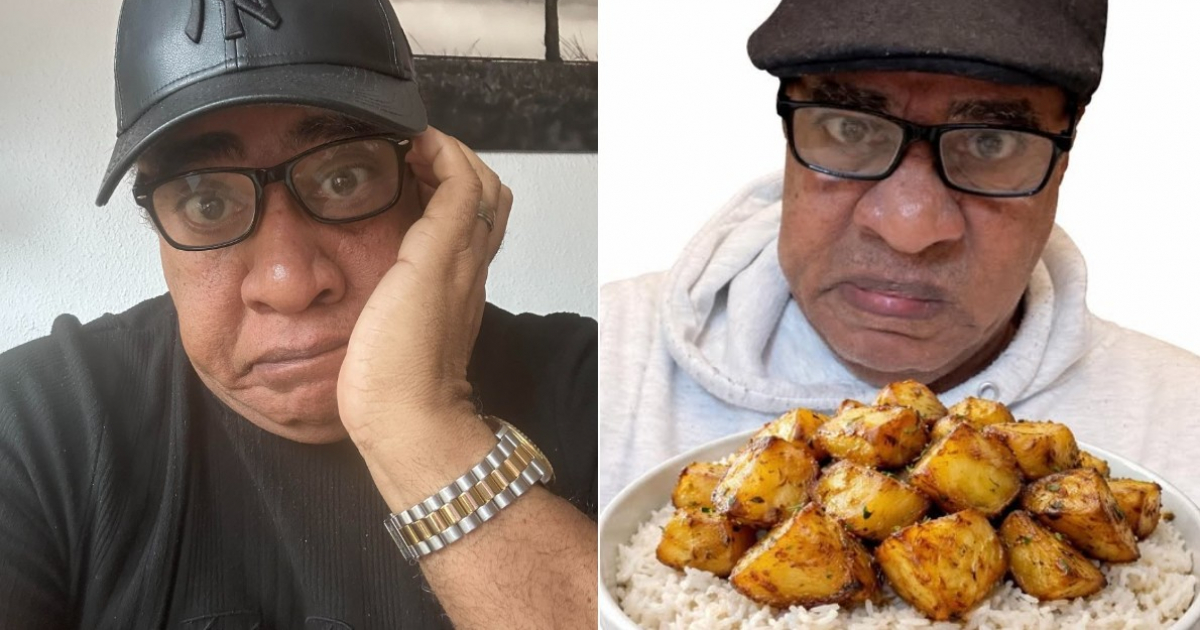
The comedian Jorge Díaz Valera reacted to the regime's latest statement regarding food in Cuba, which has sparked a wave of mockery, outrage, and rejection on social media.
Díaz responded with devastating irony to the statements made by a government official on state television, who implied that rice and potatoes should not be essential components of the national diet.
In a post on , the comedian mocks the government narrative that blames the population for the food crisis.
With his biting style, he wrote that after listening to an "expert in Cuban native foods," he felt "ashamed to realize his mistake in eating in Cuba," and made an unusual announcement.
"I am so Cuban that even if I could, I wouldn't look at a potato ever again in my life, let alone rice. How am I supposed to eat something that isn't from our agricultural culture?" he said sarcastically.
The satire didn't stop there.
Jorge took absurdity to the extreme by claiming that he would even turn off the television if the Pope appeared, and that if he sees someone eating rice in a Chinese movie, he would smash the television.
"Now I understand why so many people are sick in Cuba; it's because for years they have been consuming those products imposed by bad countries. And at the rate things are going, even the pork has its doubts, because it was consumed a lot with the stateless rice," he expressed.
With that hyperbolic language, Díaz highlighted what Cubans perceive as an attempt to justify the ongoing scarcity with rhetoric that borders on the ridiculous.
"From now on, Cubans should pay more attention to what they eat because they get distracted by foreign foods when they should focus more on the foundation of it all," he concluded.
The actor's words are part of the collective catharsis in response to a narrative that aims to explain the food crisis by appealing to tradition or "culinary authenticity," while the shelves remain empty and prices continue to rise.
Instead of providing concrete solutions, the government's response has been to blame the population's "eating habits" for the downfall of the agricultural sector, a narrative that has been met with disbelief by large segments of society.
On social media, many users have supported the comedian's message, pointing out that the issue is not what Cubans eat, but that they have less and less to put in their mouths.
The controversy erupted after Dr. Roberto Caballero, a member of the National Executive Committee of Agricultural and Forestry Technicians, stated on the pro-government program "Cuadrando la Caja" that one of the main obstacles to achieving what is known as "food sovereignty" is the consumption habits of the population.
In their view, products like potatoes - of Andean origin - do not adapt to the country's climate or soils and result in more losses than benefits for the State.
Caballero also questioned the high consumption of rice and went so far as to say, "We are not Asians," implying that this habit needs to change.
His words, spoken in a context of inflation, chronic shortages, and the deterioration of agriculture, were viewed by many as an attempt to shift responsibility onto citizens, while avoiding the structural issues of the state agricultural model, the lack of investment, and the obstacles faced by producers.
The reactions came swiftly.
Activists, journalists, and users recalled that rice is an essential part of Cuban cuisine and that before 1959 the country produced over 160,000 metric tons annually, whereas today it relies almost entirely on imports.
Others joked that Cubans have already stopped eating meat and fish, and now they should also resign themselves to doing without rice and potatoes.
In that context, Jorge Díaz Valera's satire has served as an uncomfortable mirror reflecting the incongruence of the official discourse.
While the fields remain overgrown with marabou, supplies are not arriving, and producers are receiving late or insufficient payments, the debate shifts to what people "should" eat.
The actor's post not only evokes laughter but also channels the frustration of a population weary of speeches that, instead of providing solutions, offer new ways to justify scarcity.
Filed under: