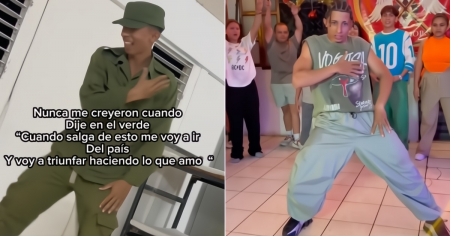
On the morning of December 24th, as many Cuban families prepared for Christmas Eve, Alfredo González returned to the place where his son Annier rests, who passed away in July 2021.
It was not just any visit. González was by the grave of the young man -who committed suicide while serving in the military-, denouncing the military authorities and the Cuban government for the chain of abuses, negligence, and impunity that has claimed the lives of hundreds of teenagers.
"Today I can't be at home with my son like I always used to be with him; I'm stuck here," he said, completely dejected.
From that place, the father expressed that festive dates have ceased to be a reason for celebration for his family and for many others who are experiencing the same pain.
"How many families are today just like me, without a celebration, without anything, as we always were before? We've lost all of that," she lamented.
González directly blamed the high command of the Revolutionary Armed Forces (FAR) for the death of his son and other young people.
He questioned the behavior of the generals and officers, whom he accused of bearing "stars on their shoulders" that, in his view, symbolize the lives of young boys lost under a system that should protect them.
"Each star is a dead child, not due to an invasion, but by those who were supposed to protect them," she stated.
In his words, he harshly criticized the Cuban government and the political project that has turned adolescents into "cannon fodder."
He pointed out that in Cuba there is no war scenario that justifies the continued deaths of young people aged 17 to 20 during Military Service.
"Not everyone has political awareness, nor should they be enslaved. They are children who should not have to carry firearms," he emphasized.
He also recalled a public statement from the ruler Miguel Díaz-Canel regarding the incompatibility between adolescents and weapons, and questioned why this criterion is not applied to the young individuals recruited into mandatory military service.
"You care about those from the outside, but you don't care about those on the inside," he reproached.
In his message, González reiterated that he is not seeking revenge, but justice. He stated that he will continue to demand clear explanations from the highest authorities.
He announced that if the ongoing review process does not conclude satisfactorily, he will meet with the Council of State and demand to be attended to by Díaz-Canel or the Minister of the Armed Forces.
"They may put me in jail, they'll have to release me, and I will go back there again," he warned.
He also directed strong criticism at the Cuban political system, accusing it of fostering mediocrity within its institutions and embittering the lives of thousands of families.
"I don't see a family that feels at ease when their child goes to Military Service," he stated, highlighting the constant fear that parents experience in a system that continues to claim young lives.
González has stated that the death of his son and the treatment he received during his time in military institutions are part of a pattern of abusive practices that have not been eradicated.
In August, he reported that Annier was subjected to physical punishments, humiliations, and medical negligence during his training at the Provincial School of the Ministry of Interior in Matanzas, until he ultimately took his own life after a period of constant harassment.
Since then, the father has reported irregularities in the investigations, mistreatment by officials from the Ministry of the Interior, and limitations on his right to defend himself in judicial proceedings.
He claims that the Prosecutor's Office and the courts have committed omissions and that even his lawyer was coerced, while other parties were allowed to intervene without restrictions.
Although the National Assembly of People's Power responded by directing him to pursue legal action through ordinary channels, González claims that his case has been sent back to the same authorities he is denouncing, without any clarification of the facts.
Since Annier's death in 2021, González has become one of the most prominent voices against Mandatory Military Service in Cuba.
Through social media, letters, and videos, he has articulated complaints that have gained traction among other families, gathered in spaces such as the Facebook group "No more VICTIMS in military service in Cuba," where similar experiences are shared.
His activism has also brought him legal consequences.
In July, he was arrested after publicly pointing out an officer whom he blames for the mistreatment suffered by his son.
Although he was initially charged with contempt, he was released under precautionary measures, with the underlying case that led to his complaints still unresolved.
This December 24th, his message once again placed a direct criticism of the Cuban government on the table for the lack of transparency, the absence of accountability, and the persistence of practices that continue to take the lives of adolescents.
"My son was not a dog, and neither was I," he concluded, reaffirming his determination to continue demanding justice.
Filed under: