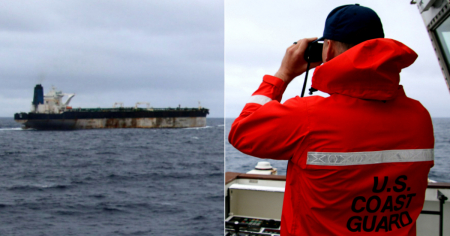
In a new chapter of their offensive against sanctioned crude oil shipping, the armed forces of the United States have intercepted the vessel M/T Sophia in international waters, a ship linked to Venezuelan oil trade.
The operation was carried out in the early hours of Wednesday and is part of a series of recent actions aimed at cutting off the financing routes of Nicolás Maduro's regime.
The detention of the Sophia occurs against the backdrop of an intensified U.S. naval campaign to block oil revenues that sustain sanctioned governments and transportation networks operating outside the international financial system.
"In an operation carried out this morning before dawn, the Department of War, in coordination with the Department of Homeland Security, apprehended without incident a stateless and sanctioned tanker from the dark fleet," reported the U.S. Army on X.
The ship, regarded as part of the so-called "dark fleet," is being escorted by U.S. military units heading toward national territory.
It was a "stateless and sanctioned" vessel, identified as part of a network of ships used to transport Venezuelan oil through evasion schemes: without a recognized flag, with altered documentation, or nonexistent records.
The Sophia, a large-capacity supertanker, is believed to have operated for months as part of a logistical network connecting Venezuelan ports with destinations in Asia and Europe, circumventing naval and commercial tracking mechanisms.
His capture represents a direct blow to this network and confirms Washington's willingness to exert control even in international waters.
"The United States continues to enforce the blockade against all vessels in the dark fleet that illegally transport Venezuelan oil to finance illicit activities, robbing the Venezuelan people. Only legitimate and legal energy trade will be permitted, as determined by the U.S.," warned U.S. Secretary of War Pete Heghseth on X.
The capture of the Marinera: Another blow to the sanctioned transportation network
This operation against the Sophia comes immediately after another similar action: the capture of the ship Marinera, previously known as Bella 1.
The Marinera was intercepted on Tuesday after more than two weeks of pursuit in the Atlantic, having evaded multiple boarding attempts by the U.S. Coast Guard.
The ship had recently changed its flag to the Russian Federation, in an attempt to complicate its tracking or to benefit from Moscow's diplomatic protection.
However, U.S. naval intelligence had identified it as part of the same "shadow fleet" responsible for transporting Venezuelan and Iranian crude oil in violation of international sanctions.
The capture operation was carried out by combined units of the Coast Guard and special forces, who managed to take control of the vessel without any armed confrontations.
During the operation, the presence of Russian ships and a submarine was detected in the vicinity, raising diplomatic tensions between the two countries.
A sustained strategy at sea
The interception of the vessels Sophia and Marinera is part of a broader strategy that the United States has reinforced since last December.
This campaign includes maritime interdiction actions in the Caribbean and the Atlantic and aims to dismantle the supply routes for crude oil that rely on opaque structures, such as the use of shell companies, frequent flag changes, and the deliberate disabling of automatic identification systems (AIS).
These measures are part of a direct pressure policy on the Venezuelan government, which includes not only financial sanctions but also the physical neutralization of the mechanisms that enable the clandestine export of oil.
It is estimated that at least three vessels have been captured since December, indicating a sustained operational escalation.
Consequences and Questions
Although no details have been reported regarding the final destination of the vessels or the legal status of their crews, it is likely that they will face proceedings for violating international sanctions, in addition to possible confiscation of the cargo and the ships themselves. Such actions are typically accompanied by lengthy litigation in federal courts, resulting in the seizure of related assets.
From a diplomatic perspective, the operations also create international tensions.
In particular, the involvement of a Russian-flagged vessel, as in the case of the Marinera, adds geopolitical complexity to the matter.
Although there have been no reported confrontations, the mere presence of U.S. and Russian forces in contested areas raises the levels of tension between the two powers.
The shifting map of sanctioned maritime transport
The evolution of these operations demonstrates a shift in the U.S. approach: from a passive surveillance focus centered on economic sanctions to an active maritime interdiction strategy. This new phase involves sustained military presence, deployment of tactical units, and coordination among various agencies to carry out arrests and seizures on the open sea.
Faced with this pressure, the networks involved in moving sanctioned crude oil have adopted increasingly sophisticated methods: ships that change their names and registrations constantly, shell companies registered in opaque jurisdictions, the use of Asian intermediaries, and complex route triangulations.
The capture of the Sophia and the Marinera could represent a turning point in this maritime struggle. If this pace of operations continues, it is likely that new vessels from the dark fleet will become targets for interceptions, and that regional tensions in the Caribbean and the Atlantic will continue to escalate.
Filed under: