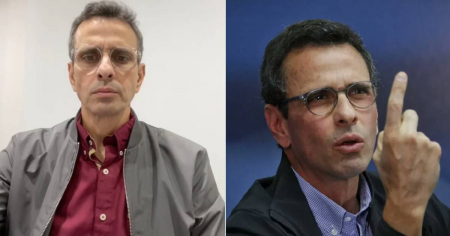
The Venezuelan congressman Henrique Capriles urged this Friday for all political prisoners to be released with “full freedom” and without persecution, amid the process of releases initiated by the interim government of Delcy Rodríguez following the capture of Nicolás Maduro. The opposition leader celebrated the release from prison of his colleagues Enrique Márquez and Biagio Pilieri, but reiterated that the measure should extend to all those detained for political reasons.
The deputy reiterated his demand for full freedom during statements to the press in Caracas, where he called for the closure of judicial cases opened for political reasons and an end to persecution. “This is the moment for all political prisoners to be granted full freedom. All judicial cases against so many people should be closed. Let the revolving door come to an end, with no more persecution or harassment!,” Capriles expressed in a message posted on his X account.
In his statements, the deputy insisted that the country needs to "turn the page on revenge" and called for justice to be guaranteed without discrimination. "I hope that this applies to everyone, not just a group. I hope it leads to full freedom, not that they continue with a sword at their backs," he stated.
Capriles also pointed out that “we need to reduce the propaganda” when asked if there was a consensus with the President of the National Assembly, Jorge Rodríguez, during the first session of Parliament following the capture of Nicolás Maduro by U.S. forces.
Capriles celebrates releases, but calls for more
Hours later, the politician celebrated the release of his colleagues Enrique Márquez and Biagio Pilieri, both opposition members who had been detained for over a year. “My friends Enrique Márquez and Biagio Pilieri are free, having been unjustly deprived of their liberty for more than a year. A big hug to their families. This is another step towards justice and the future,” Capriles wrote, accompanying the message with a video of their reunion.
Capriles added that the release of these leaders should be just the beginning: “Freedom for political prisoners! We want to see them all!” The releases of Márquez and Pilieri are part of the process announced by Jorge Rodríguez, who reported that “a significant number of Venezuelan and foreign individuals” would be released “as a contribution to national pacification.”
The release process occurs a few days after the capture of Nicolás Maduro and the assumption of Delcy Rodríguez as interim president, in a context of transition supervised by the United States. U.S. President Donald Trump described the measure as "a very important and intelligent gesture," emphasizing that Venezuela "is releasing a large number of political prisoners as a sign of its pursuit of peace," according to his message on Truth Social.
Human rights organizations like Foro Penal have emphasized that, while the releases represent progress, there are still hundreds of individuals detained for political reasons. According to their data, more than 800 remain imprisoned or are undergoing judicial processes.
The most anticipated names
Among those released and those still awaiting their release from prison are well-known leaders and activists such as Juan Pablo Guanipa, Rocío San Miguel, Perkins Rocha, Biagio Pilieri, and Enrique Márquez. Many of them had been detained since 2024 or 2025, in some cases under allegations of torture, isolation, or lack of medical attention, according to recent reports.
The climate in Venezuela is one of anticipation regarding the possibility that the process of releases may continue and extend to all political prisoners, as demanded by families, organizations, and opposition leaders.
Days before the releases, following Maduro's detention, Capriles had reiterated his call. "The country is waiting. The moment is now! Freedom now for all political prisoners!" he posted on his X account on January 6.
His recent statements and public gestures solidify his role as one of the most prominent voices advocating for full amnesty and the definitive closure of political persecution processes in the country. Last November, he had already proposed a direct dialogue between Maduro and Donald Trump to address the crisis and the release of political prisoners.
Filed under: