
Related videos:
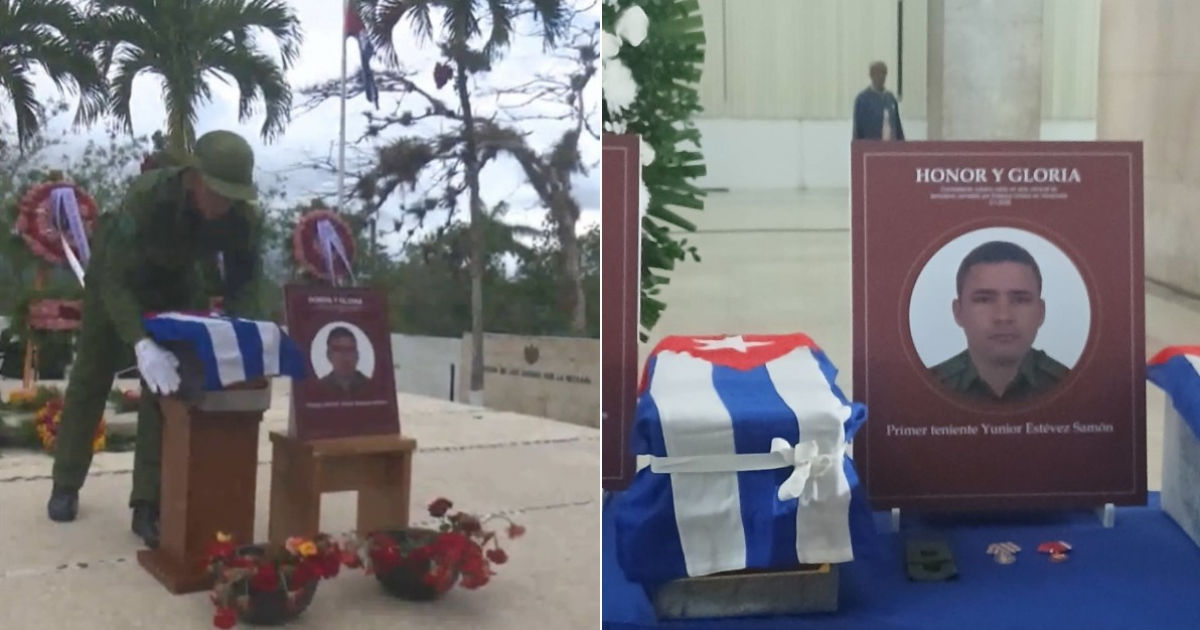
An old schoolmate of Captain Yunior Estévez Samón, one of the 32 Cubans who fell in Venezuela during the operation that ended with the capture of Nicolás Maduro, shared a personal story that starkly reveals how the Cuban regime employs young people from the community as disposable pieces in its political-military machinery.
The digital creator Marcos RL shared on Facebook that Yunior was his classmate at the Pre-University Vocational Institute of Exact Sciences in Guantánamo. He was not a distant name or a photo on an official mural: he was someone with whom he shared classrooms, conversations, and youth.
Years later, that young man accepted an offer that would change his life: to join the Ministry of the Interior, with a guaranteed university education, training without entrance exams, and even a trip to Russia. In exchange, there was just one condition: absolute obedience.
Over time, he became a lieutenant—later a captain—in State Security and eventually joined the Personal Security Directorate of the MININT, the body responsible for protecting leaders.
According to the author of the post, Yunior defended the regime not only out of convenience but also out of conviction. "He fully bought into the fallacy of the propaganda: that the 'revolution' educated the children of peasants, that the system rewarded sacrifice, that it was all worth it."
Even months before his death, he was debating on social media defending the dictatorship. He didn't speak like a cold bureaucrat, but as someone who truly believed in the rhetoric they sold him. "I remember his tone: loyal, convinced, grateful," expressed Marcos RL.
Today, however, that same system which for years denied the presence of Cuban military personnel in Venezuela is organizing solemn tributes across the country to bid them farewell.
"Today Yunior is dead," said his former colleague, who questions how the same regime that for years denied the presence of Cuban military personnel in Venezuela is now organizing solemn tributes across the country to bid them farewell.
While the regime turns funerals into propaganda, it becomes evident that Yunior did not die for Cuba, nor for its people, nor for a just cause, but in defense of a foreign dictator upheld by force. He died protecting Nicolás Maduro, as part of the security apparatus that safeguarded Chavista political power.
Marcos RL's testimony does not celebrate death. On the contrary, it mourns it.
But he rejects the notion that what is actually the result of a machinery that indoctrinates, recruits, and sacrifices is disguised as heroism. A leadership that never sends its own children to the front lines, but sends the children of the people instead.
"This was not bravery. This was cowardice from the Castro leadership, which never sends its own children. It was also induced ignorance and submission from young people in the community turned into cannon fodder to support dictators," he said.
"While Yunior was dying, the children of the officials live outside of Cuba, study at prestigious universities, and enjoy the capitalism they claim to hate. Others, like Sandro Castro, live in Havana surrounded by luxury, alcohol, and excess, while the country is falling apart..." he emphasized.
The author is clear: it was not Donald Trump who recruited Yunior. It was not Trump who indoctrinated him, nor who promised him a career in exchange for obedience, nor who denied for years the presence of armed Cubans in Venezuela. It was the Cuban regime. The same one that now uses his death as a symbol.
Yunior's story is not that of an epic hero, but that of a victim. A victim of a system that transforms young people into tools, convincing them that dying for dictators is glory, and then wrapping them in flags when they can no longer speak.
"I hope this serves to awaken other young people. So they understand that it's not worth dying for those people. That the 'revolution' is not a mother: it’s a recruiter. And that when the system trembles, the first to fall are always the same," emphasized Marcos RL.
"Yunior was not a hero. He was just another victim of Castroism," he affirmed.
At the age of 32, Yunior Estévez Samón, from Guantánamo, a captain in the Personal Security Directorate of the Ministry of the Interior, lost his life far from his country, defending a regime that would never have lifted a finger for him. His death does not glorify the dictatorship; it exposes it.
Filed under: