
Related videos:
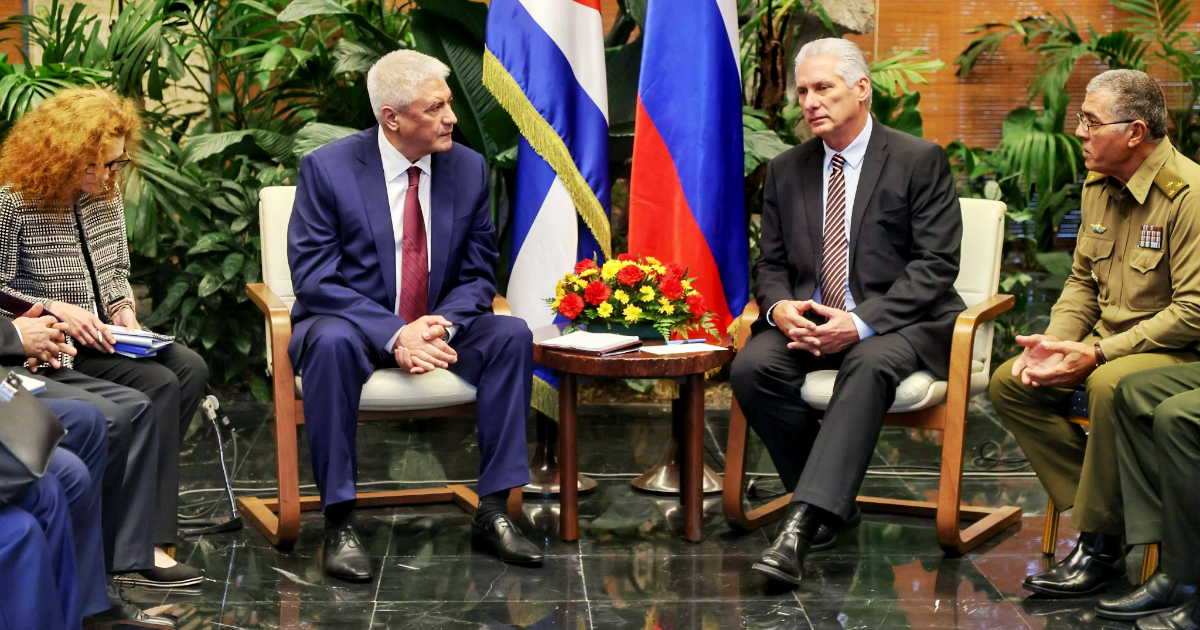
La Habana once again became the backdrop for an event with a distinctly political tone. The Minister of the Interior of Russia, Vladimir Kolokoltsev, began an official visit to Cuba and was welcomed at the Palace by Miguel Díaz-Canel, in a meeting that the leader described as having “great significance.”
It was not a diplomatic courtesy. Amid international isolation, internal deterioration, and the recent collapse of its main regional ally—Venezuela—the presence of the highest-ranking police official from Russia in Havana sends a clear message: Moscow remains the strategic support for a government in crisis.
Kolokoltsev is not a chancellor or an economic official. He is a general with a political rank within the inner circle of the Kremlin, head of the Russian police apparatus, and responsible for internal security, social surveillance, and the repression of dissent.
Since 2012, he has led the Ministry of the Interior and has been sanctioned by the United States and the European Union for his role in repressive policies and in the war against Ukraine. His presence in Cuba does not indicate investments or cultural cooperation, but rather focuses on security, control, and political survival.
Received with honors by his counterpart Lázaro Alberto Álvarez Casas and greeted by the nonagenarian general Raúl Castro, Kolokoltsev lands in Havana to reinforce internal control mechanisms at a time of social fragility and loss of regional support.
From Rhetoric to Dependency
To understand what Kolokoltsev is doing in Cuba in January 2026, we need to go back to 2022.
In the months leading up to the invasion of Ukraine, Moscow hinted that it could deploy military infrastructure on the island (including missiles and nuclear weapons), a symbolic maneuver that renewed its interest in the Caribbean as a zone of geopolitical pressure against the United States.
After the outbreak of the war, Cuba aligned itself with Moscow. In 2023, visits from high-ranking Russian security officials and contacts between MININT and the Russian Ministry of Internal Affairs solidified an increasingly closer cooperation.
It was not just about ideological affinity, but a practical convergence between two states under sanctions, obsessed with internal control. Since then, the bilateral relationship has shifted from a symbolic realm to an operational one, particularly in areas of security and intelligence.
A history of cooperation in security and repression
Since 2023, relations between the Cuban Ministry of the Interior (MININT) and its Russian counterpart have significantly intensified. Technical delegations, training programs, and visits by high-ranking officials have established a cooperation axis in intelligence, surveillance, and cyber control.
Russia has exported digital monitoring technologies, police software, and tactical training to Cuba, under the banner of "security modernization." However, for international observers, all signs point to the strengthening of repression and civil control apparatuses.
Kolokoltsev's visit at the end of 2023 marked that course. His new trip in 2026, following the fall of chavismo in Venezuela, reaffirms Moscow's role as an external guarantor of the survival of the Cuban regime.
2024: Demonstrations of strength and "technical" cooperation
The year 2024 marked a visible turning point. The arrival of Russian warships —including a nuclear submarine— at the port of Havana was an explicit demonstration of strategic alignment.
Although it was presented as a "courtesy" visit, the message was unmistakable: Russia still has allies willing to showcase that relationship even in the midst of war.
In parallel, a less visible but deeper cooperation was established: training of police personnel, technical advice, and public order control training.
It is not coincidental that everything is funneled through the Russian Ministry of Internal Affairs. Moscow does not export prosperity; it exports repressive know-how.
2025: From political support to human resources
In 2025, the Cuba-Russia relationship revealed its harshest face. Allegations regarding the recruitment of thousands of Cubans to fight in Ukraine exposed the extent to which Havana was willing to pay the price of its alignment.
Young people driven by poverty or deceived by promises of work ended up joining the military efforts of the invading Russian army.
That episode confirmed that the alliance was no longer just diplomatic or military, but functional: Cuba provides human resources and political loyalty; Russia offers financial support, diplomatic coverage, and cooperation in security. In that framework, the Russian Ministry of Internal Affairs occupies a central role.
The void left by Venezuela
During the meeting with Kolokoltsev, Díaz-Canel referred to the "events of January 3," a direct reference to the arrest of Nicolás Maduro and the collapse of his regime.
The loss of Caracas —the main source of energy support for two decades— leaves Havana in a position of extreme vulnerability.
Venezuela was the political and economic support of Castroism during the toughest years of the "special period." Its collapse forces Cuba to increase its dependence on Moscow.
Without Venezuelan oil and with a collapsed economy, the regime focuses its strategy on internal security and on maintaining Russian support in the UN Security Council.
The alliance of control
The official discourse presents Kolokoltsev’s visit as an act of “fraternal” cooperation, but in practice, it is a convenient alliance between two authoritarian regimes.
For the Kremlin, Cuba is a symbolic piece in its strategy of influence; for the Castro regime, Russia is a logistical lifeline and a source of legitimacy among its most steadfast supporters.
The Russian minister's actual agenda includes meetings with the MININT, the National Revolutionary Police, and high-ranking officials of State Security. According to diplomatic sources, the discussions focus on "mechanisms for technical and operational cooperation," a euphemism for an exchange on how to maintain control in times of crisis and protests.
Meanwhile, the country is sinking
The visit comes at an especially difficult time for the Cuban population. Prolonged blackouts, rampant inflation, shortages of food and medicine, and mass migration define daily life.
In this scenario, it is evident that the regime prioritizes the survival of its power over the well-being of its citizens.
Each approach to Moscow reinforces this logic: the regime seeks to shield itself, not to reform. While Russia promises assistance "in terms of security," the population still lacks solutions to the problems that drive them to exodus or despair.
A message inward and outward
The arrival of Vladimir Kolokoltsev in Havana is not a formal visit but a political statement.
Internally, it seeks to reassure the ruling elite and the leaders of MININT, demonstrating that they are not alone.
Outwardly, it aims to send a signal of resistance: Cuba remains within the Moscow-Havana axis despite international isolation and the evidence that Moscow does not guarantee immunity or fulfill its commitments to its partners.
But that alliance, based on repression, dependency, and political calculation, is unlikely to bring relief to the Cubans. Rather, it confirms that, while the country sinks into poverty and despair, the regime focuses its efforts on perfecting the tools of control.
Filed under: