
Related videos:
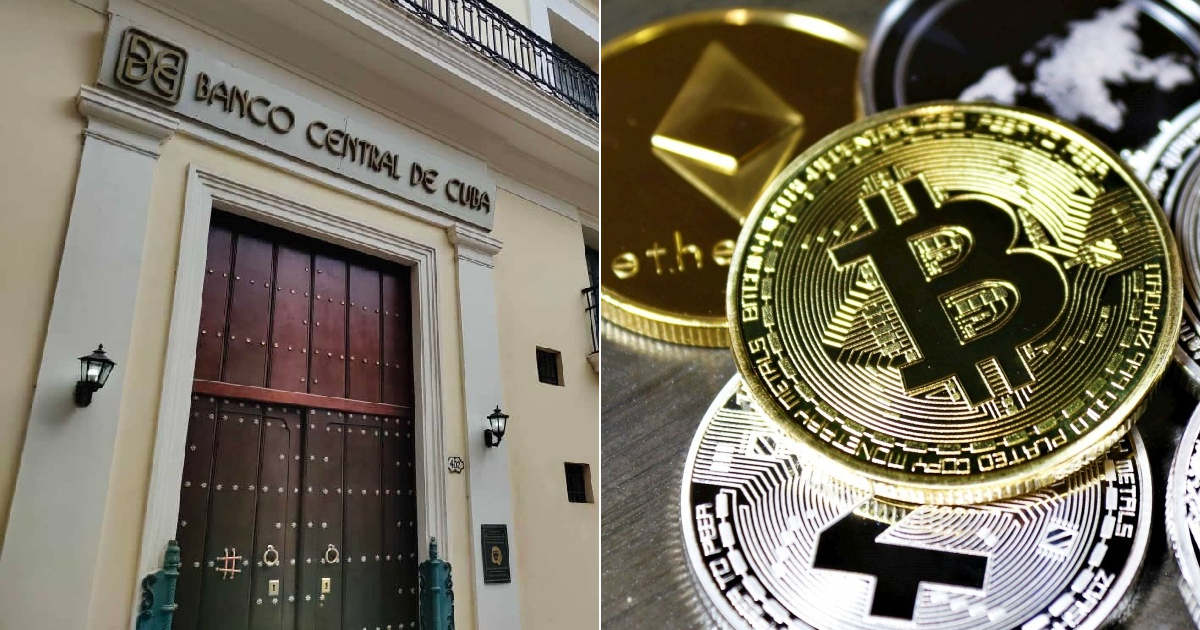
It's laughable. They seem to be running out of ideas to keep themselves entertained during the idle times, which apparently are quite frequent. With the economy in a state of humanitarian crisis and all internal and external balances lost, the Central Bank of Cuba is engaging in a dangerous game and grants authorization to 10 Cuban companies (nine small and medium enterprises and one mixed company with a one-year license, which can be extended upon request) to use cryptocurrencies for payments abroad.
The group of authorized companies consists of: Dofleini (dedicated to Information Technology); La Calesa Real and El Asadito (both in Gastronomy); La Meknica (Transport); Ingenius Tecnologías (IT Solutions); DQ Dasqom SURL (Software Development); Pasarela Digital SURL (Digital Solutions); Cema Soltec (Information Technology); Ara (IT Services); and the Mixed Company of Sanitary Products S.A. Prosa, from the Light Industry.
A brief note in the state press on March 23 reports this news, as for the first time in the financial history of BCC, the entity has authorized a group of Cuban companies to begin using cryptocurrencies for their payments abroad. Apparently, they believe that by doing so, international transactions can be facilitated in a context of financial restrictions, as well as creating opportunities for technological innovation in small and medium-sized enterprises. Of course, they are not on the right track.
On the other hand, the authorization by the BCC to operate with cryptocurrencies entails accepting certain conditions that significantly limit the scope of management. On one hand, only cross-border payments related to the corporate purpose of each entity will be permitted. On the other hand, transactions will be registered exclusively through licensed virtual asset service providers (VASPs) authorized by the bank.
Entities authorized to operate with cryptocurrencies fall within the field of Information Technology and digital solutions, and they must submit quarterly reports to the BCC, detailing the amounts transacted, the cryptocurrencies used, and the intermediary PSAV, according to the publication.
The news comes as a bit of a surprise. Not so much due to the chosen moment, amidst a grave humanitarian crisis, but because there is a sense that, in the Castro regime, and specifically in the case of the BCC, they have no idea what these cryptocurrencies are and what implications they entail.
It is worth noting that cryptocurrencies are a type of digital money that exists solely on the internet and utilizes cryptographic technology to ensure security, transparency, and decentralized control. They have nothing to do with the central planning of the economy and the outdated economic interventionism that governs the communist economy of Cuba. In other words, cryptocurrencies are the antithesis of the economic control established by the regime.
Cryptocurrencies operate thanks to a technology called blockchain and ensure that each transaction is recorded on a public "chain" that is distributed across thousands of computers, making it very difficult to forge or manipulate. Additionally, transparency and rigor must be included as fundamental elements of the transactions.
On the other hand, it is important to note that, unlike traditional currencies (such as the Cuban peso, the euro, or the dollar), cryptocurrencies do not rely on central banks. If these entities responsible for monetary policy have no jurisdiction over cryptocurrencies, what is the BCC doing meddling in the authorizations and operations?
There are so many differences between cryptocurrencies and official currency that any comparative review of both reveals they are very different things.
Thus, official money, for example, is connected to state control through monetary policy; its use is regulated, which provides it with a degree of stability and recognition, and as a result, it enjoys institutional trust.
Cryptocurrencies, for their part, are not centrally controlled by an official institution, display very high levels of volatility, lack regulation, and trust is provided by the technology, operating through decentralized networks, the blockchain, which facilitate transactions between users.
Precisely, for all these reasons, although central banks lack authority concerning cryptocurrencies, they do not ignore them; instead, they are currently developing initiatives to achieve a certain rapprochement, understanding that they operate in different spaces. For example, CBDCs (central bank digital currencies) are being developed, such as the potential digital euro from the ECB, and they are striving to regulate the use of cryptocurrencies, which is viewed simultaneously as both a risk and an opportunity.
Considering these characteristics of cryptocurrencies, the BCC has authorized 10 companies to conduct international payments using cryptocurrencies, and this decision carries risks. While it is true that they can be a viable alternative for international payments—especially when dealing with countries that have limited banking systems—it is equally important to exercise caution and possess knowledge. Several factors justify this consideration.
Firstly, there is the high volatility of cryptocurrencies, which means that their value can change significantly in a very short period. This necessitates the use of stablecoins, such as USDT linked to the dollar, a type of cryptocurrency designed to maintain a stable value, usually tied to a traditional currency like the dollar (1 stablecoin ≈ 1 USD). Unlike cryptocurrencies like Bitcoin, which can fluctuate greatly in price, stablecoins aim to avoid that volatility, but access to them is limited.
Secondly, the regulation arises from the fact that some countries restrict or prohibit the use of cryptocurrencies. It is quite interesting that China, one of the main partners of the Cuban communist regime, has prohibited cryptocurrencies since 2021.
Thirdly, the possible irreversible errors arise from the fact that any money transfer made to the wrong address cannot be recovered.
In short, the effects of limited adoption arise from the fact that not everyone accepts payments in crypto. Once again, China is included, but Turkey, Morocco, and Egypt are also added to this list of countries that do not accept payments. Additionally, there are very strong restrictions in Nigeria, India, and Indonesia.
The BCC should be cautious with this game of cryptocurrencies as a means of international payment. The Castro regime has never developed a responsible policy regarding its international transactions and, as a consequence, has closed off access to financing. Allowing certain companies to operate with cryptocurrencies for their international payments now is to open one door while failing to close another, which cannot afford any further delay. The responsibility lies with the BCC, but later it will deny it.
Filed under:
Opinion article: Las declaraciones y opiniones expresadas en este artículo son de exclusiva responsabilidad de su autor y no representan necesariamente el punto de vista de CiberCuba.