
Related videos:
The numbers leave no room for debate: a fully autonomous vehicle driving through an American city is 85% less likely to cause an accident with injuries than a human driver on the same stretch. This is not a future projection. It is the result of 56.7 million miles driven without a driver, documented in a peer-reviewed study published in Traffic Injury Prevention in May 2025. The relevant question is no longer whether autonomous cars are safer than humans. The question is who will be the first to scale that advantage — and how.
The piece of information that changes everything
The Waymo study —a subsidiary of Alphabet— on its fleet of robotaxis in Phoenix, San Francisco, and Los Angeles is the most rigorous safety analysis published to date on Level 4 autonomous vehicles (without a driver on board). Its findings, compared to equivalent human drivers in the same urban areas, are hard to ignore: –85% in injury accidents (0.41 incidents per million miles vs. 2.78 for humans), –57% in reported accidents to the police (2.1 vs. 4.85 per million miles), and –96% in intersection collisions with injuries — the most lethal type of accident in urban environments.
Intersections account for 27% of fatal road accidents according to data from the NHTSA. It is precisely in these situations where human error—distraction, speeding, ignored traffic signals—claims the most lives. And it is exactly there that the autonomous system demonstrates its greatest advantage: reaction times in milliseconds, 360 degrees of simultaneous perception, and zero fatigue.
A detail that headlines often overlook: of the 38 serious accidents reported by Waymo between July 2024 and February 2025, only one was clearly attributable to the autonomous system. In 34 of the cases, the Waymo vehicle was stopped at a traffic light when it was struck by another human driver.
USA: the open-air laboratory
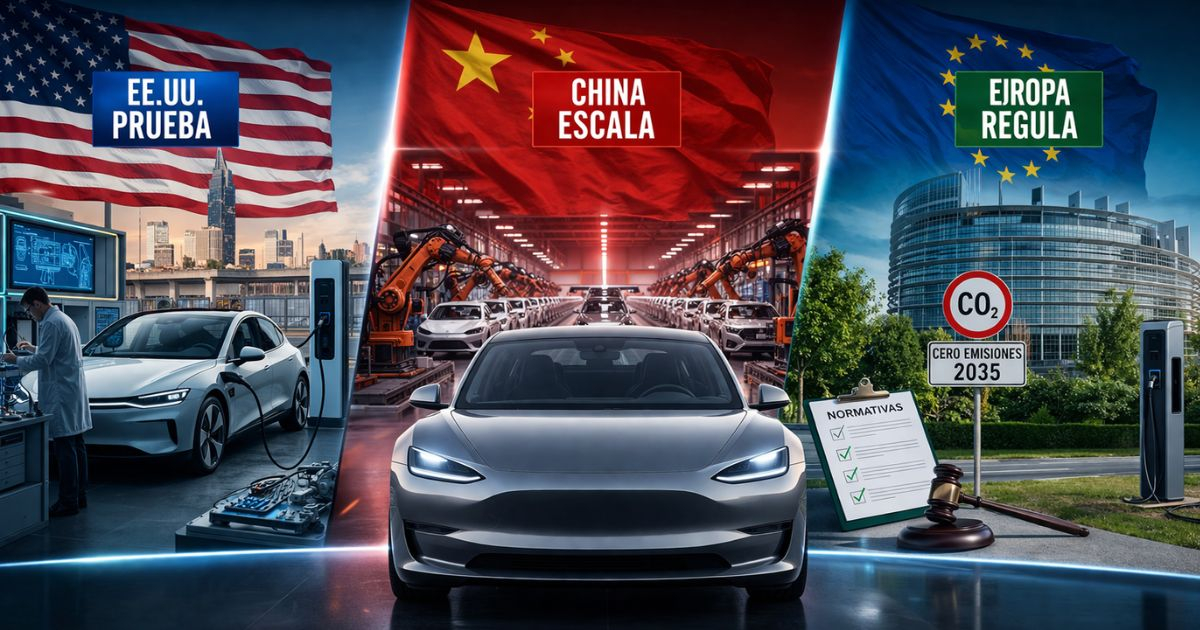
The U.S. regulatory model is, in essence, a real-time experiment. Companies deploy, collect data, correct, and redeploy. The federal government establishes reporting obligations—since June 2021, any incident involving an autonomous vehicle must be reported to the NHTSA—but does not require prior approval for commercial deployment.
Waymo currently operates over 1,500 vehicles with an average of 250,000 trips per week across five cities. Its expansion includes an agreement with Uber to reach Atlanta and Austin, and plans to launch in London in 2026. The cost of its vehicles—based on the Jaguar I-Pace with high-range sensors—remains high, which limits the pace of scaling.
Tesla occupies a different space: its Autopilot and Full Self-Driving systems are Level 2, which means they provide driver assistance that requires constant human supervision. However, it accounts for 78.7% of all reported incidents involving ADAS systems in the U.S., largely because its volume of vehicles on the road is massively greater than any fleet of robotaxis.
China: the one who climbs the fastest
While Waymo leads in scientific rigor and data transparency, China excels in deployment speed and cost efficiency. Baidu Apollo Go has completed over 17 million trips globally and operates in 22 cities, including Beijing, Shanghai, Wuhan, Shenzhen, Hong Kong, Dubai, and Abu Dhabi. Its 250,000 weekly driverless trips place it on operational par with Waymo, but with a crucial structural difference: the cost per vehicle.
The sixth generation of Baidu's robotaxi, the RT6, costs less than $30,000 per unit. The seventh generation is expected to be below $20,000. The Waymo vehicle costs several times more. This gap makes profitability—the true measure of maturity for any technology—achievable for China much sooner.
In fact, Baidu announced in 2025 that it has achieved profitability per vehicle in Wuhan, a city where it operates its largest fleet with over 1,000 units. It is the world's first profitable robotaxi operation, with fares that are 30% cheaper than those in Beijing or Shanghai.
In terms of safety, Apollo Go reports one airbag deployment for every 10.14 million kilometers traveled without a driver, with no fatalities or serious injuries recorded. The other Chinese players —Pony.ai, WeRide, AutoX— each have fleets consisting of hundreds of vehicles. Pony.ai was the first company to obtain a license to operate throughout the entire municipality of Shenzhen. The Chinese government has identified autonomous driving as a national strategic technology, with commercial regulations in effect since December 2023 and dozens of cities with licensed pilot zones.
Europe: Caution as Policy
Europe does not deny the data. It is aware of it. The issue is that it applies a different regulatory philosophy: the precautionary principle. Here, it is not deployed to learn; it is approved before deployment.
The result is a notable regulatory fragmentation. Each member state has jurisdiction over traffic rules and pilot programs, forcing companies to navigate 27 distinct legal frameworks. The Draghi report of 2024 explicitly identified this fragmentation as a structural brake on European competitiveness in autonomous mobility. In concrete terms, the EU limits the approval of autonomous vehicles to a maximum of 1,500 units per model and year. The European Commission was scheduled to lift that limit in July 2024. It did not comply.
There are legitimate technical reasons for caution. European cities present different conditions: higher density of cyclists and pedestrians, complex roundabouts, older infrastructure, and inconsistent signage between countries. An autonomous shuttle pilot in Barcelona in 2025 identified interactions with pedestrians as the greatest technical challenge. Models trained in Phoenix or Wuhan are not directly exportable.
Germany is the most advanced exception: it legalized Level 4 driving in 2021 and in December 2025 published the first legal framework for remote teleoperated driving. Spain is still in the public consultation phase. The European Commission's Automotive Action Plan from March 2025 anticipates cross-border testing corridors and a European Autonomous Vehicle Alliance — steps in the right direction, but perceived as delayed.
Conclusion
The outcome of this race will not solely be determined by who has the best technology. It will depend on who first achieves the combination of demonstrated safety, viable cost per vehicle, and a regulatory framework that allows for scaling. In 2026, China has an advantage in the latter two. The U.S. leads in the former.
Filed under: